


Blog
11KV Outdoor VCB Supplier in North Delhi: Why the Relay Settings Matter as Much as the Breaker Itself

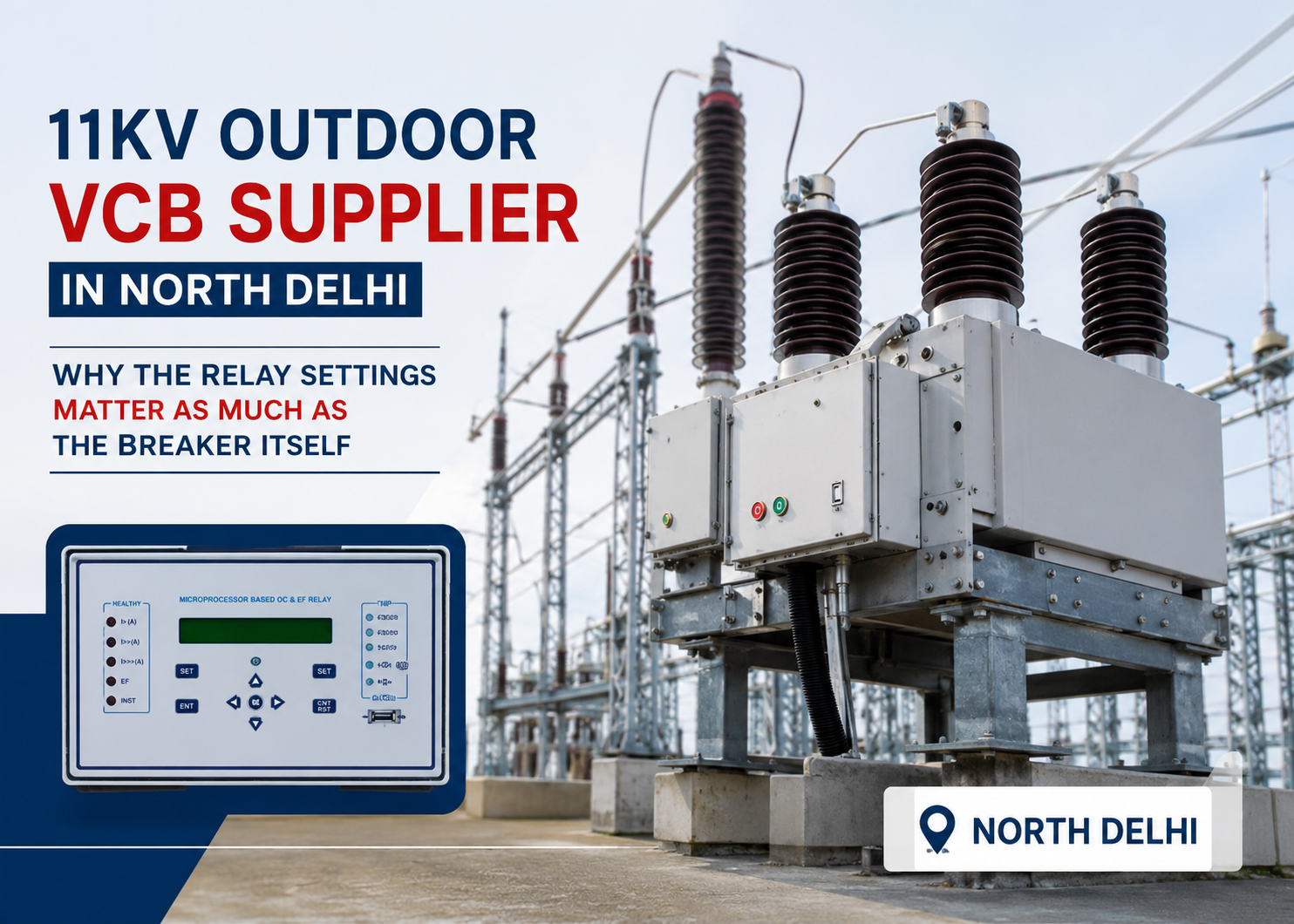
Picture a small factory in a North Delhi industrial belt. The new 11KV outdoor VCB is installed, painted and looking sharp on its plinth. Three weeks later a fault on one outgoing feeder trips the incomer instead, and the whole plant goes dark for two hours.
The breaker did nothing wrong. It opened exactly when it was told to. The problem was that nobody had checked what it was being told.
That gap is what this guide is about. If you are shortlisting an 11KV outdoor VCB supplier in North Delhi, the datasheet only gets you halfway. The other half is the protection around the breaker, and most buyers never ask about it.
The breaker is the muscle, the relay is the brain
An outdoor vacuum circuit breaker does one physical job. It opens and closes the circuit, and it interrupts fault current by extinguishing the arc inside a sealed vacuum interrupter.
It decides nothing on its own. The protection relay reads current from the CTs, compares it with its settings and sends the trip command. If those settings are wrong, you can own the best breaker in the market and still get nuisance trips, or worse, no trip when you need one.
So when you talk to a supplier, ask about the whole HT switchgear package and not just the breaker rating.
What to ask about the relay
Before you approve an order, get clear answers to these:
- Relay type. Is it a numerical relay with overcurrent and earth fault protection? Which make and model?
- Characteristic curves. Does it support the IDMT and definite-time settings your upstream protection needs?
- Communication and display. Can your electrician read the fault records and trip history on site, without special software?
- Auxiliary supply. What does the relay run on, and what happens if that supply fails?
- Test terminals. Can the relay be tested without disturbing the wiring?
None of this is exotic. A good supplier answers these in a few minutes. If you get vague replies, treat that as information.
CT ratio: small detail, big consequences
The current transformer is the relay’s eyes, so a wrong ratio means the relay sees the wrong picture. This is the most common mistake I see in specifications that look fine on paper.
Two quick rules help:
- Match the CT to the load and the fault level. A CT that is too large gives poor sensitivity at normal loads. One that is too small can saturate during a fault, and then the relay is working with bad data.
- Keep metering and protection separate. Metering CTs and protection CTs have different accuracy classes for a reason. Check that your VCB panel drawing shows both and that they are not shared.
If your DISCOM requires a particular metering arrangement, confirm it before the drawing is frozen, not after.
The unglamorous part: trip supply
Ask this one question and you will learn a lot about a supplier: “What powers the trip coil?”
Most outdoor installations use a DC supply with a battery and charger, though some compact setups rely on other arrangements. Whichever one applies, ask:
- Is there trip circuit supervision, so you are alerted when the trip path is broken?
- Who checks the battery, and how often?
- What happens on a cold winter morning, when batteries are at their weakest?
A breaker that cannot trip because the battery is dead is just an expensive switch. It is a boring problem, and it is also one of the easiest to prevent.
Settings and testing: who does what
Here is where responsibility often goes missing. The supplier assumes the contractor will set the relay. The contractor assumes the supplier already did. The client assumes somebody did.
Settle this in writing before dispatch:
| Question | Why it matters |
|---|---|
| Who calculates the relay settings? | They depend on your load and the upstream grid, not on a generic default. |
| Who tests the relay? | Secondary injection testing confirms it trips at the settings you expect. |
| Is a test report included? | You need a record for your files and for inspection. |
| Are breaker timing tests documented? | These confirm the mechanism opens and closes within its design limits. |
Please treat any numbers I mention in conversation as general guidance. Your actual fault level and upstream settings must be confirmed with your DISCOM and your electrical consultant for your own site.
What North Delhi adds to the picture
North Delhi is not one type of site. Industrial clusters like Narela, Bawana and Wazirpur have heavy motor loads and frequent switching. Residential and commercial pockets in the Rohini and Model Town belt care more about tidy compact installations and quiet neighbours.
A few local realities are worth planning for:
- Dust and humidity. Open yards collect both. Ask about enclosure protection, sealing and anti-condensation heaters, especially for the relay and control compartment.
- Shutdown windows. Your DISCOM decides when you can be disconnected for commissioning. If testing is not planned before that day, it gets rushed on that day.
- Access. A fenced plot reached through a narrow lane changes how a panel is delivered and lifted. Settle this early.
None of these are dramatic, but together they separate a smooth energisation from a stressful one.
How to judge a supplier in one conversation
You do not need a big checklist. Three questions usually tell you everything:
- “Can you show me a type test report for this breaker rating?”
- “Who will set and test the relay, and will I get the report?”
- “What support do I get after the panel is energised?”
A supplier who answers all three clearly, and puts the answers in the quotation, is usually one you can work with.
Where Arpan Power Projects fits in
Arpan Power Projects supplies 11KV and 33KV HT switchgear, including outdoor and indoor VCBs, RMUs, VCB panels and compact substations for industrial, commercial and infrastructure projects. Our registered office is at Netaji Subhash Place, Pitampura, and our unit is in Khera Kalan Industrial Area, so North Delhi sites are close to us.
When a North Delhi customer enquires about an 11KV outdoor VCB, we start with the load, the fault level and the site conditions, not just the breaker rating. That conversation covers the relay, CTs and testing as well, because that is where projects tend to go wrong.
If you are comparing options, you can also look at our 11KV Outdoor VCB Supplier in India page for the product details. To get the specification and relay package checked against your site, speak to the Arpan Power Projects team.
Frequently asked questions
Does an 11KV outdoor VCB come with a relay?
It depends on the configuration. Some panels include a numerical relay, CTs and metering, and some are supplied as the breaker alone. Always confirm what is included in the quotation.
Who should set the relay on an outdoor VCB?
Settings should come from a protection calculation based on your load and the upstream network, and then be tested at site. Agree who does this before the order is confirmed.
Is an outdoor VCB suitable for dusty North Delhi locations?
Yes, when the enclosure, sealing and heaters are chosen properly for the site. Ask your supplier about the ingress protection of the control compartment in particular.
What documents should I ask for from a VCB supplier?
Ask for the datasheet, general arrangement drawing, type test reports, routine test reports and the relay test report. Keep these in your project file.
Planning an 11KV outdoor VCB project in North Delhi?
Share your load, location and fault level, and we will help you work out the breaker, CT and relay package that suits your site.