

Blog
11KV RMU Supplier in India: How to Size Your Ring Main Unit and Vet the Company Behind It

Most ring main units get chosen in about ten minutes. Someone copies the feeder count from an old drawing, asks three suppliers for a price, and picks the lowest. Then the unit sits in a substation for twenty years.
That’s backwards. The unit matters, but the 11KV RMU supplier in India you pick decides whether the right unit shows up, whether the test reports match it, and whether anyone answers when a feeder trips.
This guide shows how to size a 11KV ring main unit properly and how to judge a supplier before you send a purchase order. It’s written for project engineers, consultants and procurement teams.
What an 11KV RMU does (quick refresher)
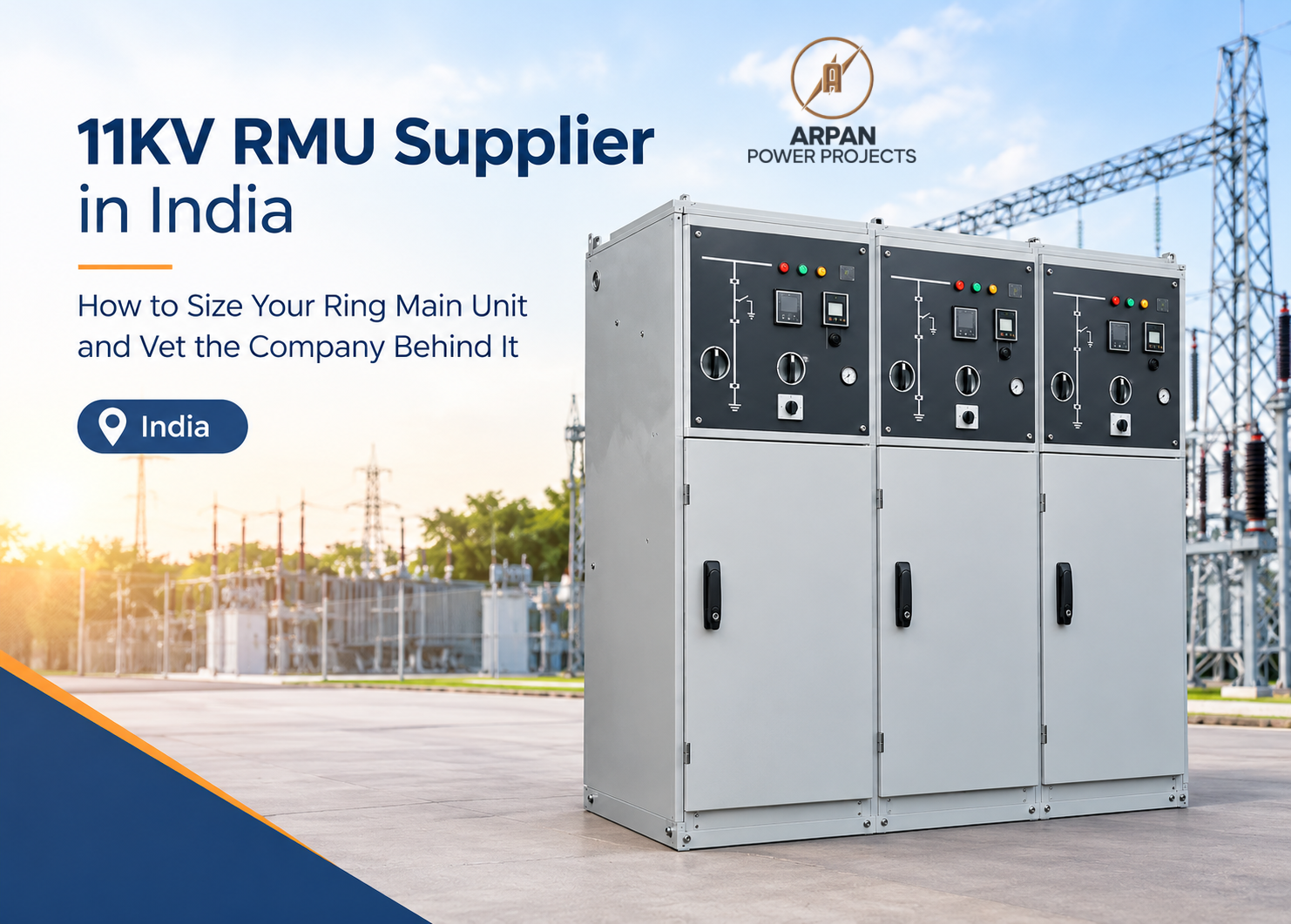
A ring main unit (RMU) is a compact, factory-assembled switchgear block that sits on a cable ring network. It lets you isolate a section, feed a transformer and protect it, all in one footprint. Most 11KV RMUs are built as 12 kV class equipment, so don’t be surprised when datasheets say “12 kV”.
You’ll find them in residential townships, commercial towers, campuses, hospitals, metro and solar projects, and industrial plants. Wherever a transformer needs a safe, protected connection to an 11 kV ring, an RMU is usually the answer.
Start with the transformer, not the catalogue
This is where most sizing mistakes begin. The transformer decides what the RMU has to carry and how it should protect it. The full-load current on the 11 kV side is easy to calculate: kVA ÷ (√3 × 11).
| Transformer rating | Approx. full-load current at 11 kV |
|---|---|
| 315 kVA | 16.5 A |
| 500 kVA | 26 A |
| 630 kVA | 33 A |
| 1000 kVA | 52.5 A |
| 1600 kVA | 84 A |
| 2000 kVA | 105 A |
Two things follow from this table.
The ring switches are rarely the problem. A 630 A ring switch has plenty of headroom over these numbers. The limit is the protection on the transformer feeder.
The protection choice depends on transformer size and your protection needs. Fuse-switch units are common for small and medium distribution transformers. Once the transformer gets large, or you need relay-based overcurrent and earth-fault protection, a vacuum circuit breaker (VCB) feeder is the usual route. Fuse ratings and limits vary by manufacturer, so always check the maker’s fuse selection chart rather than a generic rule of thumb.
Don’t guess the fault level
The short-circuit rating is the number people copy from the last project. Please don’t.
A system with a 250 MVA fault level works out to roughly 13 kA at 11 kV. Stronger networks go higher. Units are commonly offered at ratings such as 16 kA or 20 kA for 3 seconds, but the right value comes from your system study or the utility supplying the ring. If you’re in Delhi NCR, your DISCOM or consultant can confirm the figure for your point of connection.
Under-rating here is a safety issue. Over-rating is just money. Know the real number before you ask for a quote.
RMU or VCB panel: which one do you need?
Buyers ask this a lot, and it’s a fair question, because both live at 11 kV.
- Choose an RMU when you’re feeding distribution transformers on a ring, space is tight, and you want a sealed, compact unit that needs little maintenance.
- Choose a VCB panel when you need a full switchboard with relays, metering, many outgoing feeders, or higher-current incomers, typically in an industrial plant or a main receiving substation.
- Use both in bigger projects: a VCB panel at the incomer, RMUs down the line feeding individual transformers.
If you’re leaning towards an outdoor ring main unit, our guide on choosing an outdoor RMU for Indian weather covers enclosure, plinth and corrosion questions in detail. For indoor switch rooms, the indoor ring main unit and the compact Safelink RMU are the usual starting points.
Six questions that separate a real supplier from a middleman
Datasheets all look alike. These questions don’t.
1. Who actually manufactures the unit?
Suppliers in India fall into three groups: the manufacturer, an authorised channel partner, and a trader. All three can be legitimate. But you should know which one you’re dealing with, because it decides who handles warranty, spares and site faults.
2. Does the type test report match this exact model?
Reports should cover the same voltage class, rating and design as the unit you’re buying. A report for a “similar” model isn’t proof. Ask for the full report, not a summary page.
3. Will each unit get routine tests before dispatch?
Type tests prove the design. Routine tests prove your unit. Ask whether a test report ships with every RMU, and whether you can witness testing if the project needs it.
4. Does it comply with your client’s or utility’s specification?
Many utilities and large clients publish their own technical specifications and approved-vendor requirements. Check this early. It’s painful to discover a mismatch after the order is placed.
5. What’s included in the scope?
Cable termination kits, spare fuses, protection relays, motorised operation, SCADA readiness, commissioning support. These are the items that quietly turn one quote into two different offers.
6. Can you speak to someone who’s used them?
A good supplier will happily give you a reference. A hesitant one tells you something too.
What really moves the 11KV RMU price
Everyone wants a number, and we get it. But 11KV RMU price isn’t a fixed figure, and anyone quoting one without asking questions is guessing.
Here’s what actually drives it:
- Configuration (for example, how many cable switches and whether the transformer feeder uses a fuse-switch or a VCB)
- Fault rating and internal arc classification
- Motorisation, remote control and fault indicators
- Indoor or outdoor enclosure
- Make and quality of the internal components
- Accessories, testing requirements and freight to site
A quote that’s far below the others usually leaves something out. Compare scope line by line before you compare totals. If you want a template for doing that cleanly, our RFQ guide for outdoor VCBs works just as well for RMU enquiries.
Mistakes that cost projects time
These come up again and again on site:
- No spare way. The ring grows, and there’s nowhere to connect the next feeder. Specify extensibility now.
- Wrong cable details. Cable size, type and termination style should be confirmed before the unit is built, not at the trench.
- Ignoring dimensions. Check the unit’s depth, door swing and operating clearance against the room or plinth drawing.
- Treating earthing as someone else’s problem. Earth pit readings should be known before commissioning day.
- Forgetting the phone number. If nobody can tell you who to call after commissioning, that’s a red flag at the order stage.
Delivery across India, support in Delhi NCR
Distance matters more than people admit. A unit built hundreds of kilometres away means longer lead times and slower support when something needs attention.
Arpan Power Projects supplies HT switchgear from New Delhi, with a manufacturing unit at Khera Kalan Industrial Area. We support projects in Noida, Gurugram, Ghaziabad and Faridabad, and ship to sites across India. If you already know your configuration, you can go straight to our 11KV RMU supplier page. For technical details of the unit itself, see the 11KV RMU product page, and for higher-voltage networks, our 33KV RMU range.
What to send when you need a quote
You’ll get a faster and more accurate reply if you share:
- Transformer rating(s) and number of transformer feeders
- Number of ring (cable) feeders and any spare ways
- Fault level from your system study
- Indoor or outdoor installation
- Remote operation or SCADA requirement
- Site location and delivery address
Send these to the team at Arpan Power Projects through the contact page, and we’ll recommend a configuration instead of just returning a price.
Frequently asked questions
Can one RMU feed more than one transformer?
Yes, if it has more than one transformer feeder way. Each transformer feeder gets its own protection (fuse-switch or breaker), so a fault on one doesn’t take down the others.
Is a 12 kV RMU the same as an 11KV RMU?
In practice, yes. 11 kV is the system voltage, and 12 kV is the equipment’s rated voltage class. Most units sold for 11 kV networks carry the 12 kV rating.
Should I choose a fuse-switch or a VCB for the transformer feeder?
It depends on transformer size, the protection you need, and your utility’s rules. Fuses suit many distribution transformers. A VCB with a relay makes sense when you need adjustable protection or higher ratings.
How do I check that a supplier’s documents are genuine?
Ask for the full type test report, match the model and ratings to your order, and check that the testing lab is recognised. If something doesn’t line up, ask the supplier to explain before you proceed.
How long does delivery take?
It depends on configuration, current stock and testing requirements. Share your specification early and ask for a delivery commitment in writing.
The takeaway
Choosing an 11KV RMU supplier in India isn’t about finding the lowest number on a quote. It’s about sizing the unit from your transformer and fault level, checking the paperwork against your exact model, and picking a company that will still be reachable after commissioning. Spend an extra afternoon on this, and you’ll avoid most of the problems that show up two years later.