Blog
33KV RMU Supplier in India: What Every Project Engineer Should Know Before Buying

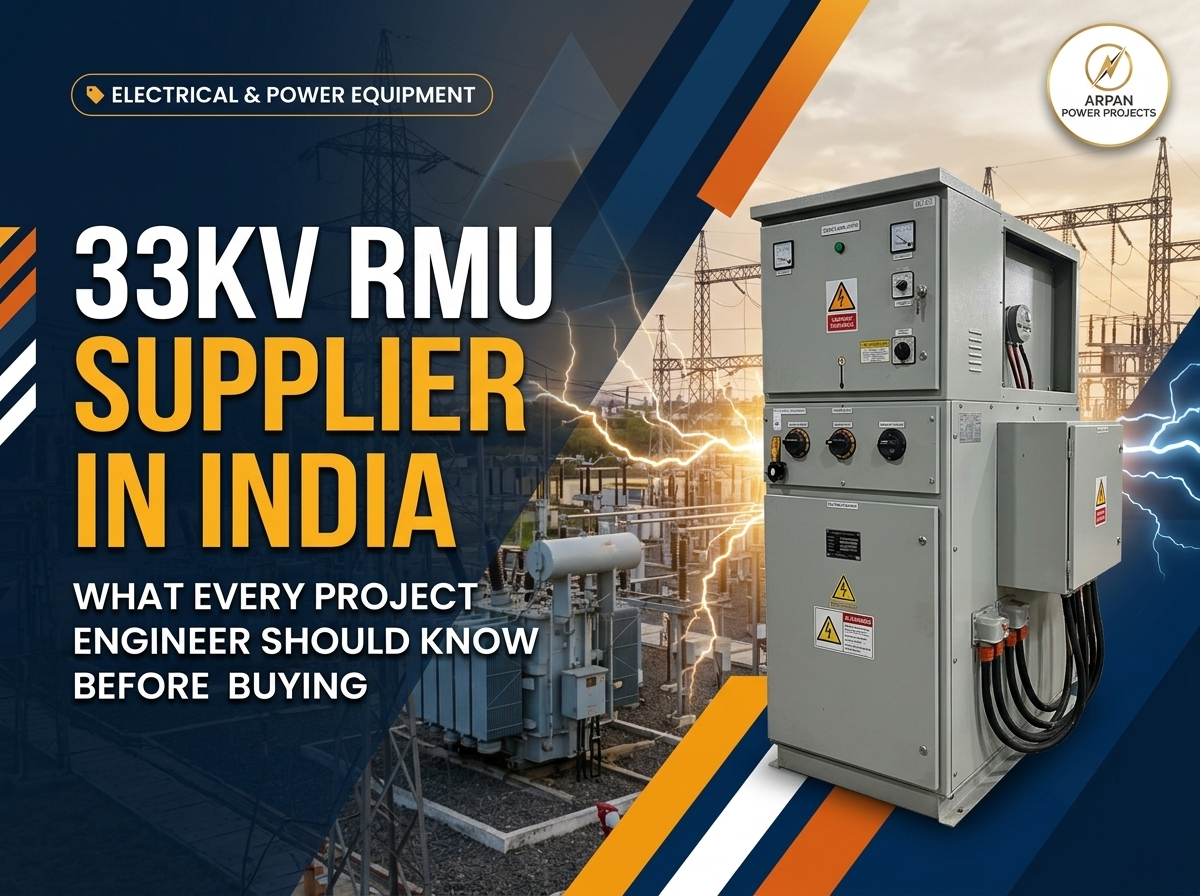
Ever stood in front of a 33KV switchyard drawing and wondered why the ring main units are eating up half the panel budget? You’re not alone. Most engineers get comfortable with 11KV distribution gear pretty early in their career. Then a project scales up to 33KV — a big industrial feeder, a large township, a utility substation — and suddenly the equipment choices get a lot more serious. And a lot more expensive if you get them wrong.
That’s really where a dependable 33KV RMU earns its keep, and why picking the right 33KV RMU Supplier in India ends up mattering more than most tender documents ever give it credit for.
So let’s get into it: what a 33KV Ring Main Unit actually does, where it fits into a network, what separates a good one from a mediocre one, and a practical checklist worth running through before you sign off on a vendor.
What Exactly Is a 33KV RMU?
A Ring Main Unit, put simply, is a compact switchgear package that lets you connect, isolate, and protect sections of a cable ring network from one sealed enclosure. Instead of separate incoming, outgoing, and protection panels scattered across a room, everything sits together — switching, earthing, often protection too — in a single factory-tested unit.
A 33KV RMU does much the same job as its more familiar 11KV cousin, just at a higher voltage class. And that one jump in voltage changes things: thicker insulation clearances, tougher arc-fault containment, generally a heavier build overall. You’ll usually find it wherever a network needs to move more power — bulk industrial supply, large townships, or the backbone ring feeding several smaller 11KV substations further down the line.
Think of it this way: if 11KV RMUs handle local distribution, a 33KV RMU sits one level up, shifting bigger blocks of power between substations before it eventually gets stepped down for actual use.
Where 33KV RMUs Are Actually Used
It’s tempting to assume RMUs are mainly a city-distribution thing. But 33KV units turn up in a surprisingly wide range of places:
- Large industrial plants drawing heavy load, where a resilient ring feed beats a single radial connection
- Utility sub-transmission networks, where a 33KV ring feeds several 33/11KV substations at once
- Large township and real estate projects, where one 33KV ring quietly supports multiple compact substations across the site
- Renewable energy evacuation — solar and wind parks especially, where generation gets pooled before stepping up or down
- Ports, mining operations, and process industries, where a shutdown simply isn’t an option and ring configuration allows fault isolation without stopping everything
If any of that sounds like your project, there’s a good chance a 33KV RMU — or a few of them — is already sitting somewhere on your single-line diagram, even if nobody’s called it out by name yet.
Why the 33KV Version Is a Different Engineering Problem
It’s easy to think of a 33KV RMU as “just a bigger 11KV RMU.” It isn’t, really — the design considerations shift quite a bit once you cross into this voltage class.
1. Insulation and Clearances
Higher voltage needs larger electrical clearances and tighter insulation coordination, whether the unit runs on SF6 gas, air, or solid dielectric insulation. Tolerances that pass fine at 11KV just won’t hold up at 33KV.
2. Fault Level and Arc Containment
A 33KV network usually carries a higher fault current potential than its 11KV counterpart. So the RMU’s internal arc-fault classification (per IEC 62271-200 or equivalent) isn’t a box to tick — it’s a real safety question, and probably the first thing a serious buyer should be asking about.
3. Outdoor Durability
A lot of 33KV rings sit outdoors — on poles, in kiosks, at unmanned substation yards. An Outdoor RMU Supplier in India worth its salt should be able to show you proper IP-rated enclosures, corrosion-resistant coatings, and weatherproofing built for your actual site. Coastal air, industrial dust, and high-humidity zones each demand something a little different.
4. Feeder Configuration and Future Load Growth
Since 33KV rings tend to carry more load and feed several downstream points, feeder-way planning ends up mattering a lot more than people expect. Buying just enough ways for today’s load — with no room to grow — is one of the more common mistakes project teams make, and one of the costlier ones too.
A Practical Checklist Before You Choose a Supplier
Before you sign off on a purchase order, it’s worth running through a short, honest checklist:
- Type testing and standards compliance — ask for actual IS/IEC 62271-200 type test reports, not just a line on a datasheet
- Insulation medium — SF6, air-insulated, or solid dielectric, matched to your site and how much long-term maintenance you’re willing to take on
- IP rating — non-negotiable if you’re talking to an Outdoor RMU Supplier in India, since the unit will be facing open weather
- Fault level rating — checked against your actual system fault study, not some generic “standard” number
- Feeder ways and future scalability — enough spare capacity for at least one expansion down the road
- Post-installation support — spares availability, commissioning help, and how fast they actually respond when something breaks down
- Track record — has this supplier actually delivered 33KV equipment on projects your size before, or would this be a first for them too?
A genuine 33KV RMU Supplier in India should be able to walk you through every one of these without dodging into a generic brochure.
33KV RMU vs. 11KV RMU: A Quick Comparison
| Parameter | 11KV RMU | 33KV RMU |
| Typical role | Local / last-mile distribution | Sub-transmission / bulk feeder ring |
| Insulation clearance | Lower | Significantly higher |
| Fault level demand | Moderate | Generally higher |
| Common setting | Commercial buildings, townships | Industrial plants, utility rings, renewable evacuation |
| Enclosure toughness | Standard | Heavier-duty, often outdoor-rated |
Handy to keep next to your single-line diagram when you’re deciding which one actually fits. The two are related, sure, but they’re not interchangeable — and pricing them as if they were is a mistake that shows up more often than it should at tender stage.
Why the Right Supplier Matters More Than the Spec Sheet
Here’s something you won’t find in most product brochures: two RMUs with nearly identical datasheets can behave very differently once they’re actually in the field. It comes down to build quality, how tight the quality control was during manufacturing, and whether the supplier actually shows up for commissioning and after-sales support — or disappears after the invoice is paid.
At Arpan Power Projects, we work as a supplier, channel partner, and stockist for 11KV RMU, 33KV RMU, Indoor and Outdoor VCBs, Compact Sub Stations, and Transformers — representing established engineering manufacturers and standing behind every unit with design consultation, testing support, and after-sales help. We’re based out of New Delhi, with a manufacturing presence in Khera Kalan, and we work with clients across Delhi NCR and pan-India projects, from utility rings to heavy industrial feeders. A 33KV order isn’t just a purchase order line item to us — it’s equipment that needs to hold up for 20-plus years out in the field.
If your project needs a dependable 33KV RMU Supplier in India, it’s worth having that conversation before you finalize the single-line diagram, not after.
Final Thoughts
A 33KV Ring Main Unit isn’t just a scaled-up 11KV unit with a bigger price tag. It’s a different engineering call altogether, and the stakes go up fast if the specification, insulation, or supplier selection is off. Verifying type tests, insulation suitability, fault ratings, and after-sales backing before you commit takes a bit more time upfront — but it saves a lot more in downtime and rework later.
Whether you’re planning a new industrial feeder, expanding a utility ring, or evacuating power from a renewable site, working with an experienced RMU Supplier in India who actually understands ground realities — not just catalog specs — is usually what separates a substation that runs quietly for two decades from one that keeps showing up in your maintenance logs.
Frequently Asked Questions (FAQs)
1. What is the main difference between a 33KV RMU and an 11KV RMU?
They do the same core job — connecting, isolating, and protecting sections of a ring network — but a 33KV RMU is built for higher voltage. That means bigger insulation clearances, higher fault-level handling, and usually a heavier-duty enclosure. You’ll mostly find it in sub-transmission or bulk feeder roles rather than last-mile distribution.
2. Can a 33KV RMU be installed outdoors?
Yes, as long as it has the right IP rating and a weatherproof enclosure suited to your site. Worth confirming this directly with your Outdoor RMU Supplier in India before you finalize the order — especially if you’re anywhere near the coast or in a dusty industrial belt.
3. What insulation type is best for a 33KV RMU — SF6, air, or solid dielectric?
Honestly, it depends on your site, how much maintenance you can realistically commit to, and local environmental regulations. SF6 units are compact and widely used, air-insulated designs sidestep the greenhouse-gas debate, and solid dielectric is picking up traction on safety-focused projects. A good supplier will talk through these trade-offs with you rather than just pushing whatever they have in stock.
4. How many feeder ways should I specify for a 33KV RMU?
Enough for your current load, plus some room for at least one future expansion. Under-specifying feeder ways is a mistake that shows up again and again in ring network planning — and it’s an expensive one to fix later.
5. Does Arpan Power Projects supply 33KV RMUs across India?
Yes. We supply 33KV RMUs alongside 11KV RMUs, Indoor and Outdoor VCBs, Compact Sub Stations, and Transformers, to clients across Delhi NCR and pan-India — with design consultation and after-sales support built in, not sold separately.
6. How long does a 33KV RMU typically last?
With the right specification, decent manufacturing quality, and regular inspection, a well-built 33KV RMU can comfortably run for 20 to 25 years. Real-world lifespan still comes down to load conditions, environment, and how well it’s maintained along the way.