
Blog
Indoor VCB Supplier in India: A Complete Guide to 11KV & 33KV Vacuum Circuit Breakers

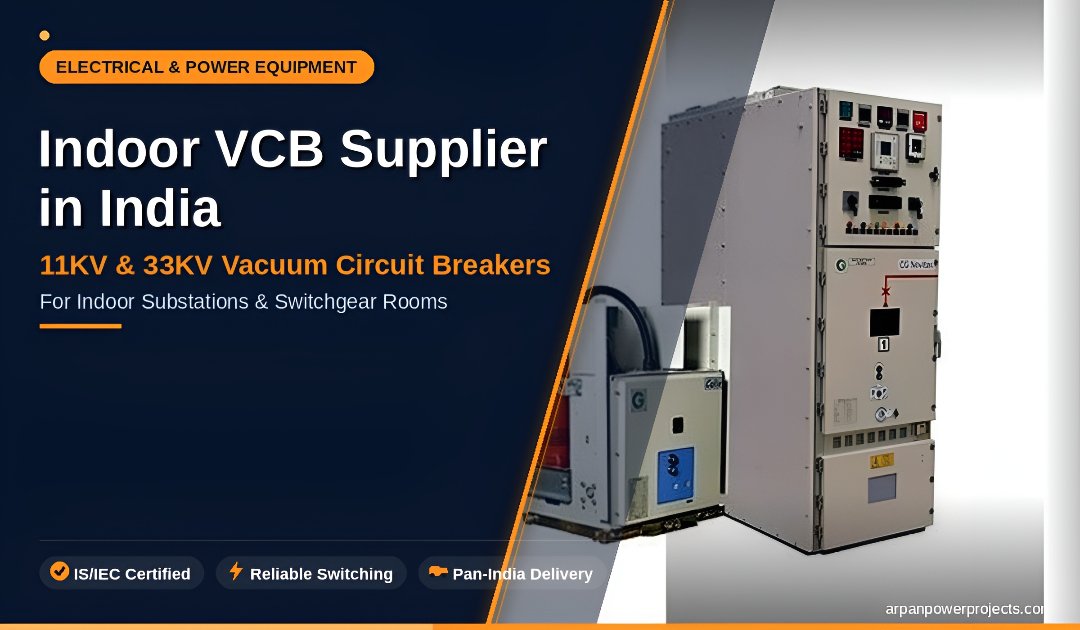
Step into any indoor substation room and you’ll notice something — the switchgear panels are quiet, compact, almost easy to overlook next to the sprawling outdoor yards. That’s exactly the point. An indoor VCB is built to handle serious switching duty inside a small, enclosed space, which is why choosing the right Indoor VCB Supplier in India matters more than most buyers realize. Get the selection wrong, and you won’t find out until the panel is already installed and the load is live — by then, it’s a shutdown and a redesign, not a quick fix.
That’s usually when the phone calls start. A contractor picked a panel based on price alone, the busbar rating didn’t match the site’s fault level, and now there’s a shutdown, a redesign, and a very unhappy client. It’s a more common story than it should be, especially with how many indoor substations are coming up right now in industrial parks, IT campuses, hospitals, and commercial high-rises across India.
This guide walks through what an indoor VCB actually is, where 11KV and 33KV versions differ, what to check before you sign a purchase order, and how to think about choosing a VCB supplier in India you won’t have to second-guess six months later.
What Is an Indoor VCB, Really?
A Vacuum Circuit Breaker (VCB) is a switching device that interrupts fault current using a vacuum interrupter instead of oil or gas. It’s the safety mechanism that protects your electrical network when something goes wrong — a short circuit, an overload, an insulation failure — by breaking the circuit before the fault can cause bigger damage.
An indoor VCB is simply the version of this breaker designed to live inside a building: a substation room, a switchgear hall, an industrial control room. Unlike its outdoor counterpart, it isn’t built to fight off monsoon rain, dust storms, or direct sun exposure. Instead, it’s optimized for:
- A compact, floor-mounted or panel-mounted metal-clad enclosure
- Lower IP (Ingress Protection) rating since it’s shielded from weather
- Easier integration with indoor busbar systems and protection relays
- Simpler maintenance access within a controlled environment
This is why indoor VCBs are the standard choice wherever space is tight and the equipment sits inside a dedicated electrical room rather than in the open.
11KV Indoor VCB vs 33KV Indoor VCB — What Actually Changes
On paper, both do the same job. In practice, the voltage class changes quite a bit about how the panel is built and where it fits into your network.
11KV Indoor VCB
Used for distribution-level switching — factory feeders, building sub-distribution, commercial complexes, and utility ring circuits. These panels are generally more compact, easier to retrofit into existing switchgear rooms, and form the majority of indoor installations in India simply because most commercial and light-industrial loads sit at this voltage.
33KV Indoor VCB
Steps up to sub-transmission level switching — think large industrial plants, bulk power receiving stations, and grid interconnection points. The insulation clearances are wider, the busbar and enclosure need to handle higher fault levels, and the panel footprint grows accordingly. If your site is drawing power directly from a 33KV feeder rather than stepping down first, this is the class you’re specifying.
Getting this distinction wrong at the tender stage is one of the most common (and expensive) mistakes engineers run into — a panel rated for one voltage class simply won’t be compatible with switchgear built for the other.
Where You’ll Actually Find Indoor VCBs at Work
- Industrial plants — protecting motor control centers, process loads, and captive power connections
- Commercial buildings and IT parks — indoor substations tucked into basements or dedicated electrical rooms
- Hospitals and data centers — where reliability and a controlled, dust-free environment matter as much as switching performance
- Utility distribution networks — indoor ring circuits feeding urban and semi-urban load centers
- Metro and railway infrastructure — compact traction substations with strict space constraints
What to Check Before You Buy an Indoor VCB
A lot of buying decisions come down to price comparisons on a spreadsheet, but a few technical checks matter far more once the panel is installed and running.
- Rated voltage and fault level — confirm the panel matches your site’s actual short-circuit level, not just the nominal voltage.
- Breaking capacity (kA rating) — under-specifying this is a safety risk, not just a performance shortfall.
- Type-tested vacuum interrupters — ask for routine and type test certificates rather than taking a supplier’s word for it.
- Compliance with IS/IEC standards — IS 13118 and IEC 62271 are the benchmarks worth checking against.
- Panel form (metal-clad vs metal-enclosed) — affects both safety segregation and future maintenance access.
- Protection and interlocking scheme — compatibility with your existing relay and SCADA setup matters for a smooth commissioning.
- After-sales support — spares availability and service response time, especially for critical facilities that can’t afford long downtime.
Choosing the Right Indoor VCB Supplier in India
There’s no shortage of vendors quoting on tenders, but a supplier relationship that actually holds up over the equipment’s lifetime comes down to a few things:
- Documented testing and traceability — every breaker should come with test certificates, not just a datasheet.
- Manufacturing and quality oversight — whether products are built in-house or sourced through vetted OEM partnerships, there should be a clear quality process behind every panel.
- Pan-India delivery and site support — a supplier who can serve project sites across states without long lead-time surprises.
- Transparent technical guidance — a good supplier tells you when a spec doesn’t fit your load profile, instead of just pushing the highest-margin panel.
At Arpan Power Projects, this is exactly how we work with project engineers and EPC contractors across India. As a trusted RMU supplier in India and VCB supplier in India, we supply 11KV and 33KV Indoor VCBs, Outdoor VCBs, RMUs, Compact Sub Stations, and Transformers, backed by direct coordination on technical specification, testing documentation, and delivery timelines — from our Delhi-NCR base to project sites nationwide, including industrial hubs like Gurugram, Noida, Faridabad, Pune, and Ahmedabad.
Frequently Asked Questions
1. What’s the main difference between an indoor and outdoor VCB?
An indoor VCB is built for a sheltered, controlled environment like a switchgear room, with a lower IP rating and a more compact enclosure. An outdoor VCB is weatherproofed for open-air installation, with a higher IP rating and added protection against rain, dust, and temperature swings.
2. Can a 33KV Indoor VCB be used for an 11KV application?
No. Voltage class, insulation clearance, and busbar design are specific to the rated voltage. Using a 33KV panel for an 11KV site (or vice versa) isn’t just inefficient — it’s a compatibility and safety issue.
3. How long does an indoor VCB typically last with proper maintenance?
With routine maintenance and correct operating conditions, a well-manufactured vacuum circuit breaker typically gives 20–25 years of reliable service, since the vacuum interrupter itself has a very high mechanical and electrical endurance rating.
4. Is a type-test certificate mandatory when buying an indoor VCB?
It should be. Type-test certification confirms the breaker has been independently verified against short-circuit, temperature-rise, and dielectric tests under IS/IEC standards — it’s one of the simplest ways to separate a reliable product from an untested one.
5. Do you supply indoor VCBs outside Delhi NCR?
Yes. While our registered office and manufacturing unit are based in New Delhi, we supply and coordinate indoor and outdoor VCBs, RMUs, and compact substations to project sites across India.
Final Word
An indoor VCB isn’t a place to cut corners — it’s the component standing between a fault and a full-scale shutdown. Whether you’re speccing an 11KV panel for a commercial building or a 33KV unit for an industrial receiving station, the right supplier should be someone who understands your load profile, not just your budget.
If you’re evaluating indoor VCB suppliers in India for an upcoming project, get in touch with Arpan Power Projects for technical specifications, pricing, and delivery timelines — or browse our full range of VCB, RMU, and substation products. Related reading: How to Choose the Right 11KV Outdoor VCB Supplier in India | 11KV RMU Supplier in India