
Blog
CSS Compact Substation Supplier in India: How to Pick the Right One for Your Project

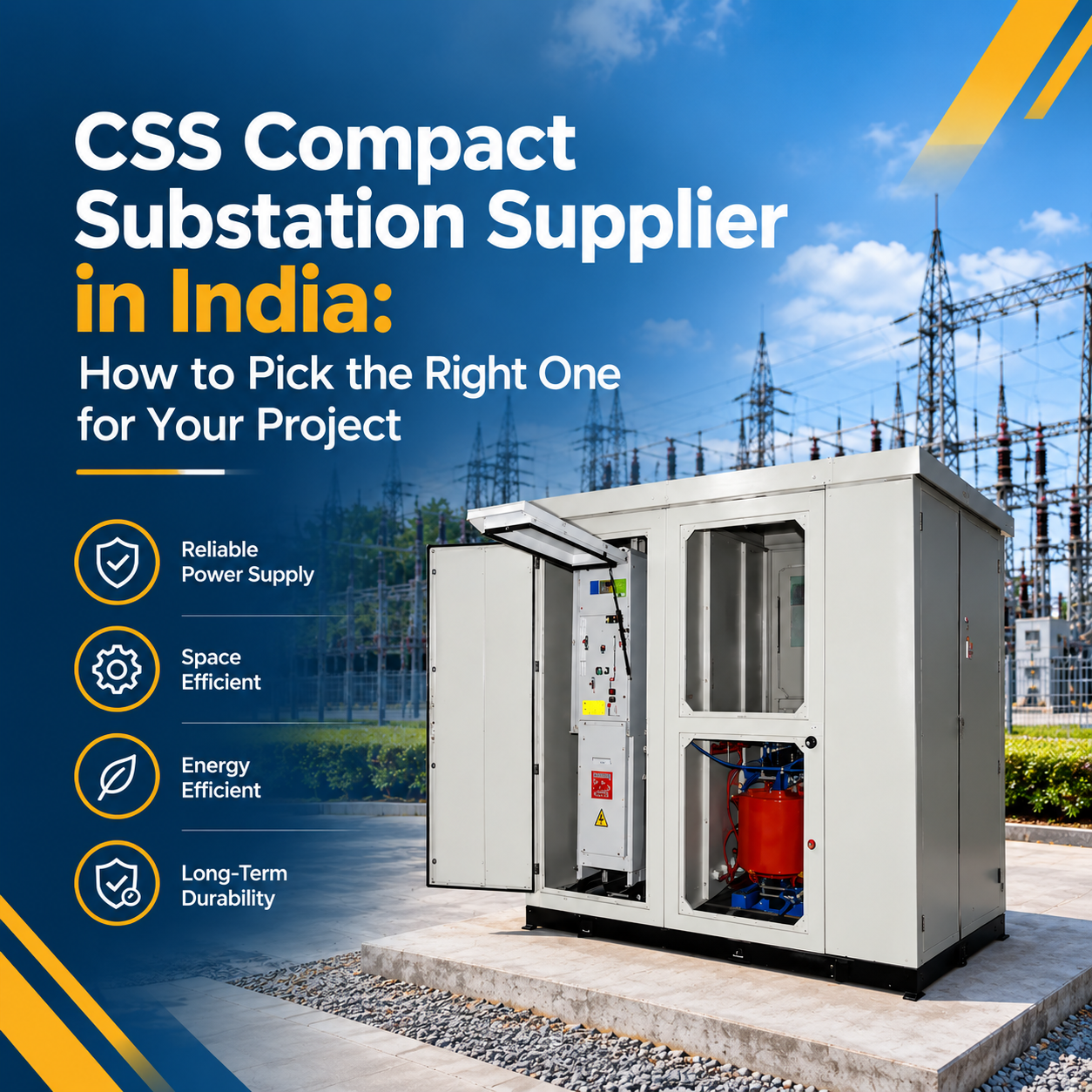
Space is the one thing every project site runs short of eventually. Whether it’s a commercial tower in Pitampura squeezing in one more transformer room, or an industrial unit trying to fit a full substation into a corner that was never really meant for it — this is exactly the problem a Compact Substation (CSS) was built to solve.
But here’s the catch most buyers don’t realise until it’s too late: not every CSS unit sitting in a catalogue is actually built the same way inside. Two suppliers can quote you the same footprint, the same kVA rating, and still hand you products that behave completely differently once installed. So the real decision isn’t “which CSS to buy” — it’s “which CSS Compact Substation Supplier in India can you actually trust with the internals.”
This guide breaks down exactly what to check, for project engineers and facility teams working on sites across Pitampura, North Delhi, and the wider NCR belt.
What a CSS Actually Does (And Why It’s Not Just “A Smaller Substation”)
A Compact Substation combines the transformer, HT switchgear, and LT panel into a single, factory-assembled enclosure — instead of building three separate rooms and wiring them together on site. That sounds simple, but it changes a few things that matter a lot in practice:
-
-
Faster commissioning
— since it arrives largely pre-tested, not assembled on-site piece by piece
-
-
-
Smaller civil footprint
-
— useful when land or built-up space is limited
-
-
-
Fewer site-level errors
— factory assembly removes a lot of the human error that creeps in during on-site wiring
-
The trade-off is that once it’s sealed and delivered, you’re relying entirely on the manufacturer’s internal quality — you can’t easily “fix” a badly designed compact substation the way you might troubleshoot a conventional layout.
The Real Checklist Before You Choose a Supplier
1. Ask What’s Actually Inside
A CSS is only as good as the components packed into it. Find out which transformer, VCB or switchgear brand, and protection relays the supplier uses internally — and whether these are manufactured in-house or bought out and assembled. A supplier who also builds their own transformers and switchgear typically has tighter control over how the whole unit performs together, rather than depending on three different vendors’ compatibility.
2. Check IP Rating Against Your Actual Site Conditions
Not every CSS needs the same enclosure rating. A unit installed in a covered basement has very different requirements from one sitting in an open yard exposed to Delhi’s summer dust storms and monsoon runoff. Ask for the IP rating in writing, and match it honestly against where the unit will actually sit — not just where it looks good on paper.
3. Confirm Type Test Reports, Not Just Drawings
Request CPRI or ERDA type test certification for the specific rating you’re buying. A general product brochure with impressive renders isn’t the same as documented proof the design has been tested under fault conditions.
4. Look at Cable Entry and Maintenance Access
This sounds minor until installation day. Poorly planned cable entry points or maintenance access can turn a “compact” advantage into a long-term headache every time your team needs to inspect or service the unit. Ask to see the actual layout drawing, not just outer dimensions.
5. Understand After-Sales Support for a Sealed Unit
Because a CSS is a single integrated package, a fault inside it isn’t something your in-house electrician can casually open up and fix. Ask the supplier directly: how fast can their technician reach your site, and do they stock spares locally, or does every issue mean waiting on a distant regional office?
6. Match Capacity to Actual Load Growth, Not Just Current Load
It’s tempting to size a CSS exactly to today’s requirement to save on cost. But compact substations aren’t easy to “expand” later the way a conventional layout sometimes can be. A supplier who asks about your 5-year load projection — not just today’s number — is usually thinking about your project, not just closing the sale.
Common Mistakes Buyers Make With CSS Procurement
Comparing only footprint and price. Two units with identical dimensions can have very different internal build quality. Always ask what’s inside before comparing price.
Assuming “compact” means “low maintenance forever.” It reduces certain risks, but routine testing and maintenance are still necessary — skipping this because the unit looks self-contained is a common and costly mistake.
Not verifying local service history. For projects in Pitampura and Delhi NCR specifically, ask how many CSS installations the supplier is currently servicing within the region. A supplier with strong pan-India sales but no real NCR service footprint can leave you waiting during a fault.
Why This Matters More in Delhi NCR Right Now
Pitampura and the surrounding North West Delhi industrial-commercial belt have seen a steady rise in mid-sized commercial and warehousing projects, many of which simply don’t have room for a conventional substation layout. That’s pushed CSS demand up quickly — and, as with any fast-growing category, it’s attracted suppliers who are better at marketing a compact box than actually engineering what’s inside it. Asking the right technical questions upfront is the only real way to tell the two apart before the purchase order is signed, not after.
About Arpan Power Projects
Arpan Power Projects manufactures CSS Compact Substations, Indoor and Outdoor VCBs (11kV–36kV), Ring Main Units (RMU), HT Control & Relay Panels, and Transformers — all built and tested in-house. Because the transformer, switchgear, and protection components inside our compact substations come from our own manufacturing line, project teams get one accountable partner for the entire unit, along with local service support for Delhi NCR projects during and after commissioning.
Frequently Asked Questions
What’s the difference between a CSS and a conventional substation?
A conventional substation is built and wired on-site using separately installed transformer, switchgear, and LT panel sections. A CSS (Compact Substation) combines all of this into a single factory-assembled, pre-tested enclosure, reducing on-site work and space requirements.
Can a CSS be expanded later if my load increases?
It depends on the design. Some manufacturers build in spare capacity or modular sections for future expansion, but many compact units are sized to a fixed rating. Always ask about future load flexibility before finalising the size.
Is a CSS suitable for outdoor installation?
Yes, provided it has the correct IP rating for outdoor exposure. Always confirm the enclosure rating matches your actual site conditions — indoor-rated units should not be installed in open, weather-exposed areas.