

Blog
33kV Outdoor VCB Supplier in New Delhi: Complete Buyer’s Guide for Substations & Industrial Projects

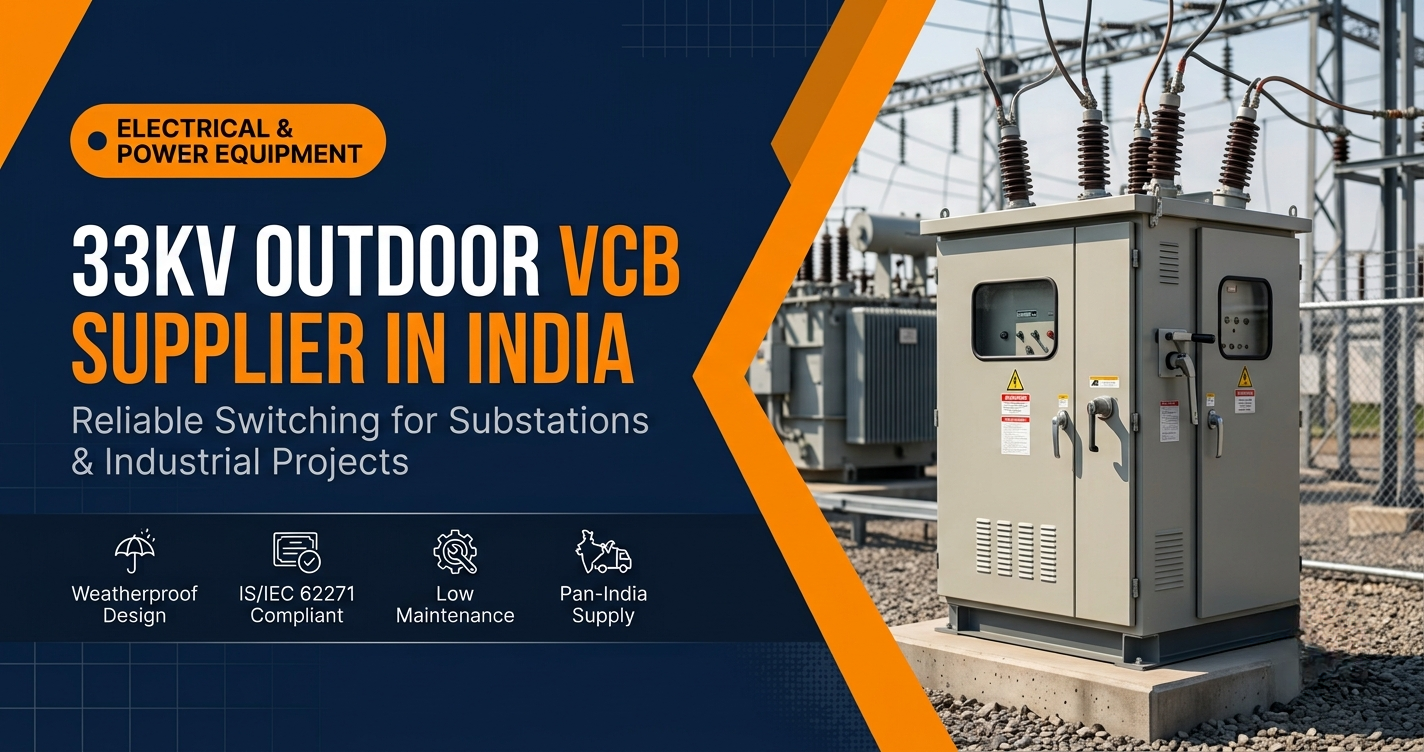
If you’ve ever stood at a 33kV outdoor yard in New Delhi during monsoon inspection, you already know why this equipment gets taken seriously. Between the capital’s dust load, temperature swings, and dense industrial and infrastructure activity across Delhi NCR, no control room walls, no filtered air — just open weather and load that has to keep flowing regardless. A 33kV Outdoor VCB isn’t a scaled-up version of its indoor cousin; it’s built for an entirely different set of stresses, and choosing the wrong one — or the wrong 33kV Outdoor VCB Supplier in New Delhi — shows up as a maintenance headache within the first monsoon season, not years down the line.
This guide walks through what actually matters when you’re evaluating a 33kV Outdoor VCB Supplier in New Delhi, Delhi, without the marketing fluff that usually fills these pages.
What Makes a 33kV Outdoor VCB Different From an Indoor Unit
The core switching technology — a vacuum interrupter breaking fault current in milliseconds — is similar across indoor and outdoor VCBs. What changes is everything around it.
An outdoor unit at 33kV needs to handle:
- UV exposure that degrades cheap polymer housings over 3–4 years
- Moisture ingress through gasket points during heavy rain
- Temperature swings from 45°C afternoon heat to cold nights, which stresses seals
- Dust and pollution settling on bushings, which can eventually cause flashover if creepage distance isn’t specced correctly for your site’s pollution level
This is why a 33kV Outdoor VCB is typically housed in a weatherproof, often kiosk-type or canopy enclosure, with anti-condensation heaters built in — something an indoor panel simply doesn’t need.
Where 33kV Outdoor VCBs Are Actually Deployed in New Delhi & NCR
You’ll mostly see these deployed across New Delhi and the wider Delhi NCR region at:
- Grid substations run by DISCOMs stepping down from higher transmission voltages across Delhi
- Industrial areas like Okhla, Bawana, Narela, and Mayapuri running their own 33kV incoming feeders
- Commercial and infrastructure developments in Gurugram, Noida, Faridabad, and Ghaziabad requiring dedicated 33kV switching
- Metro and railway traction substations across the NCR network
- Data centers and large real estate projects increasingly common in the Delhi-NCR corridor
If your project sits anywhere in this belt, the outdoor VCB isn’t optional equipment — it’s the switching backbone of the whole feeder.
Technical Specifications Worth Actually Checking
Don’t just ask “is it 33kV rated” and move on. Push for these numbers on the datasheet:
| Parameter | What to check |
| Rated voltage | 33kV (confirm it’s rated, not just “suitable up to”) |
| Rated short-circuit breaking current | Typically 20kA/25kA — match to your fault level study, not a generic default |
| Rated normal current | 630A/800A/1250A depending on feeder load |
| IP rating | IP54 minimum for outdoor; IP55/56 in high-dust or coastal zones |
| Standard compliance | IS/IEC 62271-100 (circuit breakers) and IS/IEC 62271-200 (metal-enclosed switchgear) |
| Mechanical/electrical endurance | Look for Class E2/M2 rating for reduced maintenance cycles |
| Anti-condensation heater | Should be standard, not an add-on |
A supplier who hesitates to share test certificates (type test reports from CPRI, ERDA, or an equivalent NABL-accredited lab) for these parameters is a supplier you should be cautious about — this isn’t paperwork you should have to chase after the order is placed.
SF6 vs Vacuum Interruption: Which One for Outdoor 33kV?
Vacuum interrupters have largely become the standard for 33kV outdoor breakers in India — they need less maintenance, don’t carry the environmental handling concerns of SF6 gas, and perform reliably across the temperature range most Indian sites see. SF6 outdoor breakers still show up in some legacy grid installations, but for new projects, vacuum technology is almost always the more practical, lower-lifecycle-cost choice unless your utility’s technical spec explicitly calls for SF6.
How to Vet a 33kV Outdoor VCB Supplier in New Delhi
This is where most delays and post-installation issues actually originate — not in the switchgear design, but in supplier selection. A few practical filters:
Ask for site references, not just brochures. A genuine VCB Supplier in India serving substations and industrial clients should be able to point to installed sites you can verify, not just a product catalog.
Check local service backup. Outdoor equipment eventually needs field servicing — heater replacement, gasket checks, contact resistance testing. A supplier with no service presence in your region means longer downtime when something needs attention.
Confirm factory testing, not just design compliance. Routine tests (power frequency withstand, mechanical operation tests) should be done per unit before dispatch — ask for the test certificate tied to your specific unit’s serial number, not a generic type-test document.
Compare lead times honestly. Outdoor VCB panels are often customized (cable entry type, busbar configuration, enclosure material) — a supplier quoting the same lead time for every configuration is usually not being precise.
For projects based in New Delhi or NCR specifically, prioritize a VCB Supplier in India with an actual local office or service depot in the region — this cuts response time significantly during fault situations compared to a supplier operating only out of another state.
Common Mistakes Project Engineers Make While Sourcing
- Specifying breaking capacity based on nameplate load instead of an actual fault level study
- Ignoring pollution level classification (light/medium/heavy) when deciding creepage distance on outdoor bushings
- Assuming IP54 is sufficient in coastal or high-dust industrial zones, where IP55/56 is the safer call
- Comparing quotes on price alone without normalizing for included accessories (heaters, earth switches, interlocks)
Wrapping Up
A 33kV outdoor VCB is one of those components that quietly does its job for fifteen-plus years — right up until it doesn’t, and by then it’s usually because a corner was cut at the sourcing stage. Getting the technical spec right, insisting on proper test documentation, and choosing a supplier who can actually service what they sell will save far more in avoided downtime than any discount on the initial quote.
FAQs
Q: What’s the typical lifespan of a 33kV outdoor VCB?
With proper maintenance, 20–25 years is a realistic expectation for vacuum interrupter-based outdoor breakers, though mechanical endurance rating (M2 class) affects how many operations it can handle over that period.
Q: Is IP54 enough for outdoor installation in India?
It’s the practical minimum for most inland sites, but coastal, industrial-dust, or heavy-monsoon regions typically warrant IP55 or IP56 for better long-term sealing.
Q: How is a 33kV Outdoor VCB different from a compact substation?
A VCB is one switching component; a compact substation integrates the VCB (or RMU), transformer, and LT panel into a single pre-fabricated unit. If you’re evaluating a full package rather than standalone switchgear, that’s a separate decision worth comparing.
Q: Can a 33kV Outdoor VCB be upgraded or retrofitted into an existing switchyard?
Yes, in most cases — if the existing structure and busbar configuration allow for it, a VCB panel can be retrofitted to replace older oil circuit breakers (OCBs) or aging SF6 units. It’s worth getting a site survey done first, since cable entry type and foundation sizing can differ between manufacturers.
Q: How often does a 33kV outdoor VCB need maintenance?
Vacuum interrupter units are low-maintenance by design, but annual checks are still recommended — contact resistance testing, heater function checks, gasket and seal inspection before monsoon, and mechanism lubrication as per the manufacturer’s schedule. Skipping the pre-monsoon check is where most field issues start.
Q: What documents should I ask for before finalizing a supplier?
At minimum: type test certificates (from CPRI/ERDA or an equivalent NABL lab), routine test certificate for your specific unit, IS/IEC 62271 compliance declaration, and warranty terms in writing. If the supplier can’t produce these upfront, treat it as a red flag rather than something to chase post-delivery.
Q: Does Arpan Power Projects supply and service 33kV Outdoor VCBs in New Delhi?
Yes — Arpan Power Projects supplies 33kV Outdoor VCB panels to substations, industrial units, and infrastructure projects across New Delhi and the Delhi NCR region, with local service support for installation, testing, and after-sales maintenance.