

Blog
11KV Outdoor VCB Panel in Daryaganj: Planning for Crowded Lanes, Curious Hands and Old Delhi’s Tight Clearances

Most articles on outdoor switchgear quietly assume an empty yard. A fenced plot, a gravel base, a gate with a guard, and nobody within shouting distance.
Daryaganj is the opposite. Walk down any lane here on a Sunday, when the book market spreads across the pavements, and you’ll see how little spare ground there is, and how many people pass within arm’s reach of whatever stands outside a building.
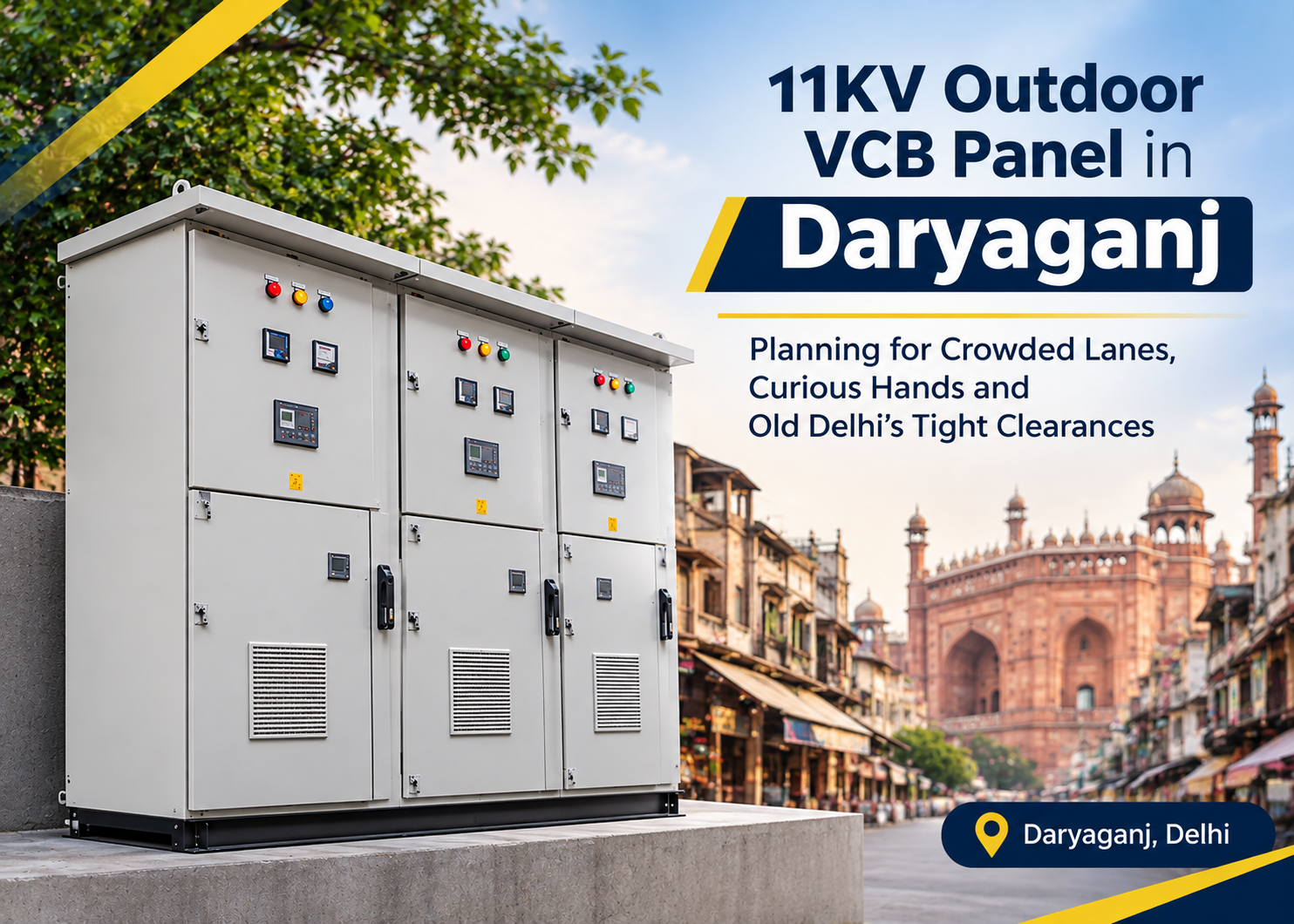
That is the real question behind an 11KV Outdoor VCB Panel in Daryaganj. It isn’t only about ratings or the make of the breaker. It’s whether the panel can reach the site, fit the space and sit safely beside a crowd. This guide walks through those three questions the way we at Arpan Power Projects would walk a customer through them before a drawing is even drawn.
Why “outdoor” means something different in Old Delhi
An outdoor VCB panel is a weatherproof enclosure that holds a vacuum circuit breaker, its protection relay, meters and controls for an 11 kV feeder. In a large substation yard, the boundary fence does most of the safety work. In Central Delhi, the “yard” is often a corner of a compound, a strip beside a building or a shared courtyard, and the boundary wall belongs to a neighbour.
So the panel and its immediate surroundings have to carry the safety load themselves. Outdoor 11 kV outdoor switchgear makes sense when there is no room to build a ventilated switch room. But it only works if the site answers three questions honestly.
Question 1: Can the panel physically reach your site?
This is where most Old Delhi projects wobble, and it has nothing to do with electrical design.
- Lane width and turning. A truck that sails through a highway can get stuck at the first bend of a narrow market lane. Measure the route, not just the plot.
- Vehicle timings. Goods vehicles in the older parts of the city are usually allowed only in certain hours. Check what applies to your lane, because the rules are strict and they change.
- Lifting. Outdoor panels are normally handled by crane using lifting eyes and a base frame. Ask for the overall dimensions and weight early, then check where the crane can stand and whether overhead cables, shop signage or awnings are in the way.
A small habit saves a lot of grief: send your supplier a few photos of the lane entrance and the spot where the panel will stand. Ten minutes of looking at pictures is cheaper than a delivery day that goes wrong.
Question 2: What will be standing next to it?
A level concrete plinth that matches the base frame is the starting point. In Daryaganj, the neighbourhood around the plinth deserves just as much thought.
Door swing and working space. The doors must open fully, and an operator needs room to stand safely while the breaker is racked or checked. If a shop shutter or a parked scooter blocks that, the clearance doesn’t really exist.
Fire load next door. Daryaganj is full of publishers, printing presses and paper godowns. Paper is fuel. Keep stock well away from the enclosure, and keep an extinguisher suitable for electrical fires within easy reach. This is general good practice, but it matters more here than in a bare industrial yard.
Water. Low lanes collect water in the monsoon. Raise the plinth above the surrounding level, plan drainage, and seal the cable entry properly.
Cable route. Decide early whether cables come in from below or from the side. Old city lanes hold decades of buried services, and a trench that looks simple on paper can turn into a surprise.
Question 3: Who can touch it?
In a quiet yard, a locked door is enough. In a busy market area, plan as if curious hands, playing children and the odd hopeful vendor will all pass by.
- A real boundary. A lockable fence or a brick enclosure with a gate, so the panel doors are never the only barrier.
- Locks with a named key-holder. One person responsible, not a bunch of keys floating around.
- Clear danger boards and a shock-treatment chart, visible even at night, with proper lighting.
- Earthing done and tested before energising. Keep the test record with the site file.
- Nothing leaning on it. You’d be surprised what gets tied to a cabinet when nobody is watching. Make “no hanging, no parking, no stalls” part of the site rules.
- Regular checks of the louvres for dust, nests and blockages.
A quick site-readiness check
| Check | Why it matters in Daryaganj | Who usually knows |
|---|---|---|
| Lane access and vehicle timings | Narrow lanes and restricted goods-vehicle hours | Site manager, local traffic rules |
| Crane position and lifting path | Overhead cables, signage, tight turns | Crane operator, your supplier |
| Plinth level and size | Waterlogging, base frame fit | Civil contractor |
| Door swing and operator space | Safe operation and maintenance | Electrical contractor |
| Paper or stock nearby | Fire risk around the enclosure | Site owner |
| Fence, locks and signage | Public contact in a crowded area | Site owner, contractor |
| Earthing | Safety before the first switch-on | Electrical contractor |
| Utility and inspector approvals | Energisation cannot go ahead without them | Consultant, utility office |
What to put in your enquiry
A vague enquiry gets a vague quotation. For a 11 kV outdoor switchgear panel, share these points:
- How many feeders, and the duty of each: incomer, outgoing or transformer feeder.
- Rated current and fault level.
- Protection and metering requirements.
- Whether you need SCADA or remote operation.
- The enclosure’s degree of protection (IP rating). Outdoor service usually calls for a higher rating than an indoor panel, and the datasheet should state it clearly.
- Site location, access photos and any known constraints.
Approvals and timing: don’t leave them for last
An 11 kV connection needs the right paperwork. Your distribution utility has its own process for HT connections, and the statutory electrical inspector’s clearance is normally needed before energisation. If your plot sits close to a protected monument or in a specially regulated area, extra permissions may apply as well.
We can’t give one answer for every plot, and your electrical consultant or contractor will know which rules apply to yours. What we can say is that connecting a feeder needs a planned outage, so talk to the utility early rather than after the panel arrives.
How Arpan Power Projects approaches a site like this
We would rather ask a few awkward questions before dispatch than solve a problem at a lane entrance. Our panels are built at our manufacturing unit in Khera Kalan Industrial Area, Delhi, and our team can help you choose the bay arrangement, relay and metering that suit your feeder.
If you’re still weighing a complete enclosure against a bare breaker, our page on the 11KV Outdoor VCB Panel explains what sits inside and what the enclosure adds. For a switch room option, you can also look at our wider HT panel and VCB range.
Frequently asked questions
Can I install an 11KV Outdoor VCB Panel in Daryaganj on any plot?
Not automatically. It depends on the plot, ownership, utility rules and inspector approval. Check these before you place the order.
Should I choose an outdoor panel or an indoor VCB for a crowded building?
If you have a ventilated room with proper cable access, an indoor panel is a good fit. If not, an outdoor panel saves the building space. The vacuum circuit breaker technology is the same. The housing is what differs.
How do I protect the panel from tampering?
Use lockable doors, a fence or enclosure, clear signage, lighting and regular rounds. Don’t depend on the panel doors alone.
What should I send to get an accurate quotation?
The feeder details, rated current, fault level, protection and metering needs, and a few photos of the access lane and plinth location.
Final thought
A good 11KV Outdoor VCB Panel in Daryaganj is decided on the lane and the neighbourhood as much as on the datasheet. Get the access, the clearances and the safety planning right, and the electrical side becomes the easy part.
If you’re planning one, share your requirement with Arpan Power Projects through our contact page or call +91 98688 64101, and we’ll help you work through it.