

Blog
11KV Outdoor VCB Panel in South Delhi: A Bay-by-Bay Walk Through What You’re Actually Buying

There’s a moment in almost every site meeting that makes me smile. Someone slides a quotation across the table. It says “1 set, 11kV outdoor VCB panel, 3 bays,” and everyone nods.
Now ask the three people in the room what sits inside the second bay. You’ll get three different answers, and at least one of them will be a guess.
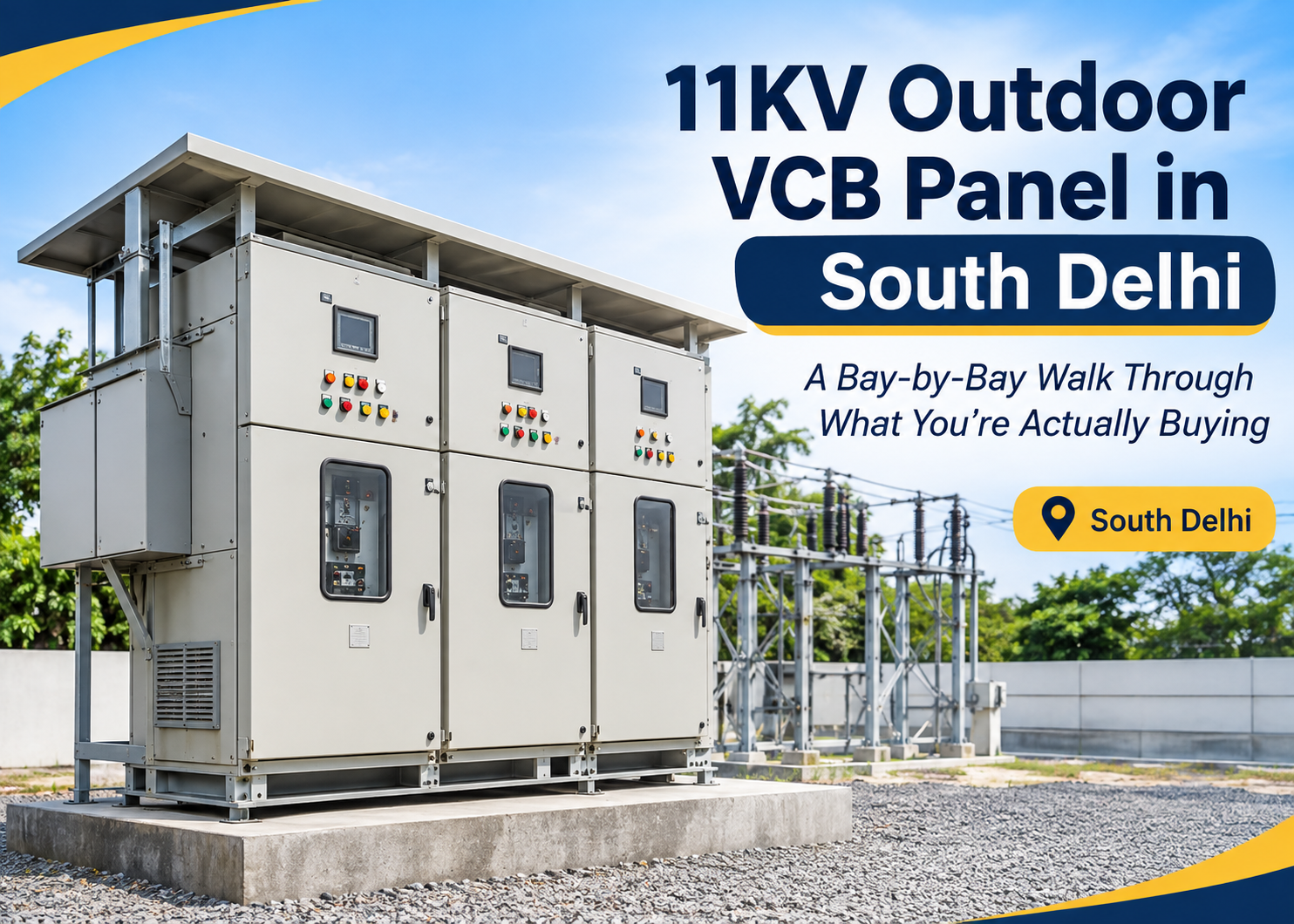
If you’re planning an 11KV Outdoor VCB Panel in South Delhi, it pays to understand the object before you negotiate the price. So let’s open the doors and walk through it, one bay at a time.
Quick read
- The breaker is one part. The outdoor VCB panel is the whole system around it: enclosure, busbars, CTs, PTs, relay, wiring, earthing and DC supply.
- Each bay has a job. Knowing which bays you need is the biggest cost lever you have.
- In Delhi, the small things (heaters, gaskets, plinth height, canopy) decide how the panel ages.
- A good drawing review before fabrication saves weeks later.
A breaker is not a panel
People use the two words as if they mean the same thing. They don’t.
The 11kV vacuum circuit breaker is the switching device. Inside it, the contacts open and close in a vacuum interrupter, which is what quenches the arc when a fault current has to be broken. It’s a clever bit of engineering, but on its own it can’t protect anything.
The panel turns that breaker into something usable. It adds the metal-enclosed housing, the busbars that carry current between bays, current and voltage transformers for measurement and protection, a relay that decides when to trip, control wiring, an earthing system, and a battery-backed DC supply so the breaker can still trip when the mains has failed.
When you read the spec for our 11KV Outdoor VCB Panel, you’re really reading the list of all these parts working together. The standards that matter are IEC 62271-200 or IS 3427 for the metal-enclosed switchgear, and IEC 62271-100 or IS 13118 for the breaker itself.
Bay by bay: what each section does
Most outdoor HT panel lineups are built from a few familiar bays. Your project may use some of them, or all.
The incomer bay. This is where power enters the lineup from the utility or the upstream feeder. It carries the main breaker and the main protection. If this bay is under-specified, everything downstream inherits the weakness.
The outgoing or transformer feeder bay. This feeds a transformer, a motor or another load. Each outgoing feeder normally has its own breaker and its own protection settings. A site with three transformers usually needs three of these, and that’s where the panel count starts to climb.
The metering bay. This holds the CTs and PTs used for energy metering, and often the metering bay is the one that raises the most questions. Metering arrangements are usually tied to the supply authority’s requirements, so confirm the accuracy class, the CT/PT details and the sealing arrangement with your DISCOM before the drawing is frozen. Fixing it afterwards means rework.
The bus coupler bay. This is only needed when you have two sections of busbar that must be tied together or separated. Many South Delhi sites, such as a single-transformer showroom or a small institutional block, simply don’t need one. Don’t pay for what the single-line diagram doesn’t ask for.
What’s inside a single bay
Open one bay and you’ll usually find four zones:
- Breaker compartment. The VCB sits here, often on a withdrawable truck so it can be isolated and serviced without shutting the whole lineup.
- Busbar compartment. The main current-carrying path between bays, separated from the rest.
- Cable compartment. Where incoming or outgoing cables terminate, with space for the cable box and, where needed, surge arresters.
- Low-voltage compartment. Relay, meters, indicators, selector switches and control wiring. This is the face the operator actually sees.
Pay attention to the interlocks too. A well-built panel won’t let you close the earth switch while the breaker is live, or rack the breaker in or out in the wrong state. Those mechanical interlocks are boring, and they exist for the day someone is tired and in a hurry.
The small parts that decide how the panel ages in Delhi
A new panel always looks good. What matters is how it looks after three summers and three monsoons.
- Space heaters and thermostat. Delhi’s monsoon humidity is hard on enclosed electrical equipment. When the temperature drops overnight, moisture condenses inside the cabinet. A heater with a thermostat or hygrostat keeps the interior just warm enough to stay dry. Ask whether it’s included and how it’s powered.
- Canopy or roof design. Outdoor panels sit in direct sun, and peak summer temperatures in the city are punishing. A proper canopy cuts solar heating and keeps rain off the doors and vents.
- Gaskets, door seals and IP rating. Outdoor enclosures are commonly specified at IP54 or higher, but the right figure depends on your site and your consultant’s call. Look at the actual door seals, not just the number on the datasheet.
- Battery and charger. The DC supply is what lets the relay trip the breaker. Check the battery’s age at commissioning, and ask when its first replacement is due.
- Plinth height. Several pockets of South Delhi see waterlogging during heavy rain. Build the plinth with the worst day in mind, not the average one.
- Cable entry. Sealed gland plates stop water and small animals from finding their way in. This costs almost nothing and avoids a lot of grief.
Fitting an 11KV Outdoor VCB Panel in South Delhi: site notes
South Delhi isn’t one kind of site. A showroom plot in Saket, a campus near Vasant Kunj, a society in Greater Kailash and an industrial unit in Okhla all behave differently.
A few things we’d settle early:
- Front clearance. A withdrawable breaker needs room to be rolled out. Check the general arrangement drawing for the working space in front of the panel and for door-swing, not just the footprint.
- Distance from boundary walls, trees and overhead lines. Your consultant and the inspector will both look at this.
- Cable route. Know where the trench runs, and how deep, before the panel arrives, not after.
- Who will operate it. If the person switching the panel at 2 a.m. has never seen it, plan a short walkthrough. A 20-minute briefing on the single-line diagram prevents many wrong operations.
If you’re still deciding between a panel lineup and a compact enclosed kiosk for a tight plot, our post on kiosk-type enclosures in South Delhi walks through that trade-off. And once you know what you need, the guide to ratings and protection shows how to match the numbers to your fault level.
A short checklist to review before you approve the drawing
| What to check | What to ask | Why it matters |
|---|---|---|
| Bay count and arrangement | Does it match my single-line diagram exactly? | Extra bays add cost, and missing bays add delay |
| Busbar rating and short-circuit withstand | Is it matched to my fault level and load? | Rated for the site, not for the catalogue |
| Numerical relay | Which functions are enabled, and who sets them? | A relay with nobody owning the settings is a risk |
| CT/PT details | Ratios, accuracy class, burden | Wrong CT data causes metering and protection errors |
| Anti-condensation heaters | Included? Thermostat controlled? | Humid Delhi monsoons |
| Enclosure finish and IP rating | What is it, and how is it tested? | Long-term weather resistance |
| Test documents | Type test report and routine test certificate | Proof the design and your unit were tested |
| Spares | Trip coil, closing coil, auxiliary contacts | Avoids long waits after a fault |
Where Arpan Power Projects fits in
Arpan Power Projects supplies 11KV and 33KV VCBs, RMUs, transformers and compact substations from its base in Delhi, with a manufacturing unit at Khera Kalan Industrial Area and a registered office at Netaji Subhash Place, Pitampura.
For South Delhi enquiries, the useful first step is simple: send your single-line diagram or a few site photos. The team can tell you which bays you actually need and which you can leave out, so you’re not quoted for a lineup bigger than the job. If you want to compare cost drivers before approaching anyone, our piece on pricing and RFQs covers that, and the process after ordering is in our post on the road from purchase order to energisation.
Frequently asked questions
How many bays do I need in an outdoor VCB panel?
It depends on your single-line diagram: one incomer, one outgoing feeder per transformer or load, a metering bay if your supply arrangement needs it, and a bus coupler only for split-bus systems. Start from the diagram, not from a standard count.
Can I use an indoor VCB panel outdoors?
No. Indoor panels aren’t built to handle rain, humidity and direct sun. Outdoor panels have weatherproof enclosures, sealed doors and a canopy, and that’s what you’re paying for.
Do outdoor VCB panels need regular maintenance?
Vacuum breakers are low-maintenance, but not maintenance-free. Plan periodic checks of the mechanism, coils, contacts, heaters, battery and charger, and keep records of every test.
Do I need clearance before energising the panel in South Delhi?
Generally yes. Installations usually need inspection and approval from the electrical inspectorate, and the supply arrangement goes through your DISCOM. Procedures can change, so confirm the current requirements for your exact address.
Can the panel be customised for my site?
Often, yes. Bay arrangement, relay make, metering details, cable entry and canopy design can usually be adjusted to the project. Share your drawing early so changes happen on paper, not on the shop floor.
Before you finalise the order
Buying an 11KV Outdoor VCB Panel in South Delhi isn’t really about choosing a number of boxes. It’s about knowing what each bay does, whether your site needs it, and which small details will keep it dry, cool and operable for years. Review the drawing, ask for the test papers, and have the operator briefed before the day of energisation.
If you’d like a second pair of eyes on a specification, reach out through our contact page. The Arpan Power Projects team will give you a straight answer on what fits and what doesn’t.