
Blog
11KV Outdoor VCB Kiosk Type in South Delhi: Is a Compact Enclosure Right for Your Plot?

Walk through Saket, Vasant Kunj or Greater Kailash with an electrical contractor and you’ll hear the same sentence sooner or later: “There’s just no space.” The transformer upgrade is approved, the load has grown, and then somebody asks where the breaker is supposed to go.
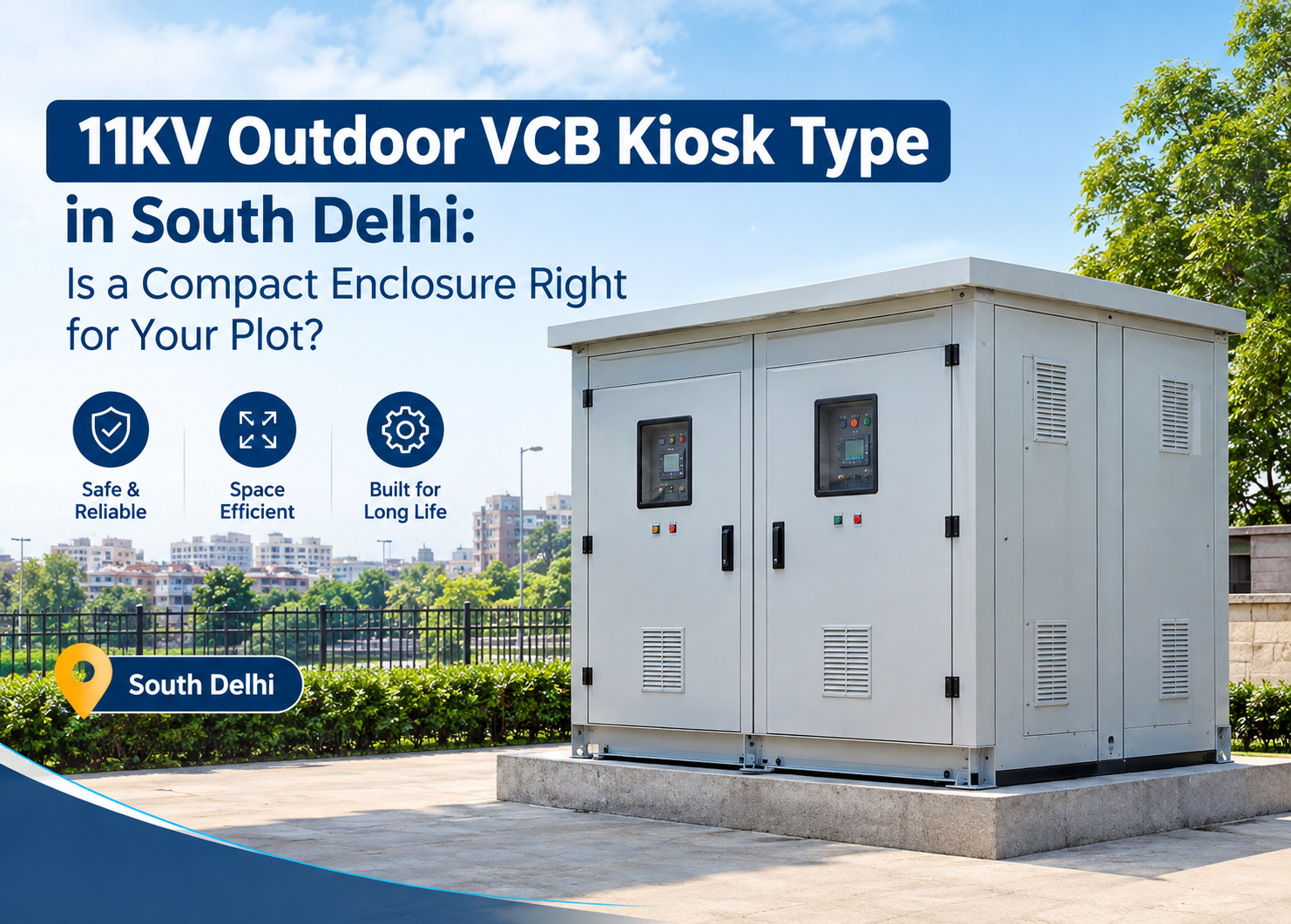
That’s usually the moment people start looking at an 11KV Outdoor VCB Kiosk Type in South Delhi. A kiosk packs the vacuum circuit breaker, relay and controls into one weather-proof enclosure. You get a smaller footprint and a tidier look, and it’s easier to keep the neighbours and the RWA happy.
But a kiosk isn’t automatically the right answer. This guide is about making that call properly, for sites in South Delhi specifically. If you want the basic definition, we’ve covered it in our kiosk type and panel buying guide.
Quick read
- A kiosk-type VCB makes sense when the plot is tight, visible or shared.
- An open-yard breaker is still cheaper and simpler when you have room and nobody is watching.
- Fault level, control supply and heat management matter more than the kiosk’s paint finish.
- Confirm DISCOM and statutory inspection requirements before you freeze the specification.
Why South Delhi sites keep landing on kiosks
Every part of Delhi has its own personality when it comes to HT work. South Delhi’s is about constraints.
Space is the first one. Older colonies were planned long before anyone imagined a 1000 kVA transformer in the corner of the compound. Institutional campuses, hospital annexes and showroom plots around Nehru Place and Okhla often have a few metres to spare, not a few acres.
Neighbours are the second. An open breaker yard with exposed insulators and danger boards is not something a residents’ welfare association enjoys looking at. A closed, painted outdoor VCB kiosk is easier to accept, and easier to screen with a boundary wall or planting.
Security is the third. In a busy area, unattended exposed equipment gets curious visitors. A lockable enclosure with a proper door interlock keeps hands away from live parts.
Weather is the fourth, and it applies everywhere in Delhi. Summer afternoons push past 45°C, monsoon waterlogging is real in low-lying pockets, and dust finds every gap. A kiosk has to be specified for all three, which we’ll come to below.
Kiosk, open-yard or indoor: a quick comparison
| Kiosk type | Open-yard outdoor VCB | Indoor VCB panel | |
|---|---|---|---|
| Footprint | Compact, self-contained | Needs more clear area | Needs a switch room |
| Looks and neighbour acceptance | Good | Often questioned | Hidden inside |
| Weather exposure | Protected by enclosure | Depends on breaker design | Protected by building |
| Heat inside the enclosure | Needs attention | Open air | Depends on room ventilation |
| Best for | Tight or visible plots | Large, secure yards | Buildings with a proper substation room |
If you already have a switch room, an 11KV indoor VCB is usually neater. If you have a big plot and a simple scheme, an open-yard breaker does the job at lower cost. The kiosk sits in the middle. It’s the practical choice when space is limited and the equipment will be seen every day.
Five checks before you say yes to a kiosk
These apply to any 11KV outdoor VCB kiosk, but they matter more in a dense city.
1. Fault level at your incoming point. Get the figure in writing from your consultant or the utility. Ratings like 16 kA, 20 kA or 25 kA are common, but your site decides which one you need. An under-rated breaker can’t be rescued later with a setting. Our guide on matching the breaker to the job explains the ratings in detail.
2. The relay and who owns the settings. The breaker only opens when the relay tells it to. Ask which relay is included, what CT ratio is planned and who supplies the setting sheet. Get it on paper before commissioning day.
3. Control supply. Most kiosks rely on a battery and charger to close and trip the breaker. A dead battery means a breaker that can’t protect you. Ask how it’s sized, how long it carries the load during an AC failure, and who tests it.
4. Heat inside the enclosure. This is the check people forget, and Delhi summers punish it. A closed enclosure holds heat from the breaker, relay and wiring. Ask about ventilation, louvres with dust filters, and the design ambient temperature. Don’t accept “outdoor type” as an answer on its own.
5. Plinth, cable entry and drainage. The kiosk stands on a plinth, so check its height against local waterlogging, how cables will enter from below, and whether the area drains. In a few South Delhi pockets, an extra 150 to 300 mm of plinth height can save a lot of trouble. Your civil engineer should confirm the right figure for the actual site.
For what happens after the kiosk lands on site, our kiosk site preparation and commissioning guide walks through the full sequence.
Approvals: don’t leave them for the end
Most of South Delhi is served by BSES Rajdhani, but boundaries and requirements can differ by area, so confirm with the concerned DISCOM office before finalising metering and the incoming arrangement. The installation will also need clearance from the statutory electrical inspector before energisation, and the equipment should align with the applicable standards, such as IS 13118 or IEC 62271-100 for the breaker and the relevant safety regulations from CEA.
Institutional and commercial sites may have extra conditions, such as campus rules, fire department requirements or building society permissions. Raise these during the site visit, not after the kiosk is booked. Approvals rarely delay a project by themselves. Late approvals do.
Locality notes from the field
A few patterns we see when discussing HT kiosk requirements around South Delhi:
- Saket, Vasant Kunj and Nehru Place: commercial towers, malls and hospitals. Space is tight, visibility is high, and uptime expectations are strict. Kiosk type is a frequent fit.
- Okhla and nearby industrial pockets: small and mid-size units adding load. Crane access and truck turning space usually decide the layout.
- Mehrauli, Chhatarpur and farmhouse belts: large plots but fragmented approvals, with long cable runs. Here an open-yard unit is sometimes the more economical choice, so don’t assume a kiosk.
- Hauz Khas and Greater Kailash: dense residential and institutional campuses, where noise, appearance and neighbour concerns weigh heavily.
These are general patterns, not rules. Every plot has its own surprises, which is why a site visit settles more questions than a week of emails.
Keeping a kiosk healthy after energisation
A vacuum breaker is low-maintenance, not zero-maintenance. A yearly check should include the operating mechanism, spring-charging motor, trip and close coils, contact resistance, door seals, earthing, battery and charger, and the condition of ventilation filters. After a heavy monsoon, look at the cable box and plinth too. Keep a simple logbook. Whoever inherits the installation will thank you.
Why a nearby supplier makes the whole process easier
Every point above gets easier when your supplier can reach the site fast. Arpan Power Projects supplies 11KV and 33KV VCBs, RMUs, transformers and compact substations, with a manufacturing unit at Khera Kalan Industrial Area, Delhi, and a registered office at Netaji Subhash Place, Pitampura. Our team can review your drawing or site photos before quoting, join the discussion with the utility, and be there on commissioning day. You can look at the available configurations on our 11KV outdoor VCB kiosk type product page.
If price is your first concern, read our piece on what sets the price and how to write a clean RFQ before you ask for quotes.
Frequently asked questions
Is a kiosk-type VCB suitable for a basement-adjacent or low-lying plot in South Delhi?
It can be, if the plinth height, drainage and cable entry are designed for waterlogging. Share site photos with your supplier and let your civil engineer confirm the plinth level.
Kiosk type or open-yard outdoor VCB, which one is cheaper?
An open-yard unit is usually cheaper on equipment alone. A kiosk can save money on land use, screening and security. Compare the total installed picture, not just the equipment line.
Can a kiosk be installed inside a society or campus?
Usually yes, with a suitable clear area, safe clearances and the required permissions. Confirm with the DISCOM and the campus management before fixing the location.
Who decides the relay settings?
It depends on the project. The consultant, the DISCOM or the supplier may provide them. Ask early and get the setting sheet in writing.
Does Arpan Power Projects support South Delhi enquiries?
Yes. We handle enquiries from South Delhi, the wider Delhi NCR and projects across India.
Before you decide
A good 11KV Outdoor VCB Kiosk Type in South Delhi starts with the plot, not the catalogue. Fault level, relay, control supply, heat and plinth decide whether it will still be doing its job quietly after five monsoons. If you’d like a second opinion on a specification or a site, send your details through our contact page and the team at Arpan Power Projects will come back with a clear recommendation.