
Blog
11KV Outdoor VCB Panel in North Delhi: Built to Survive 45°C Summers, Monsoon Damp and Winter Fog

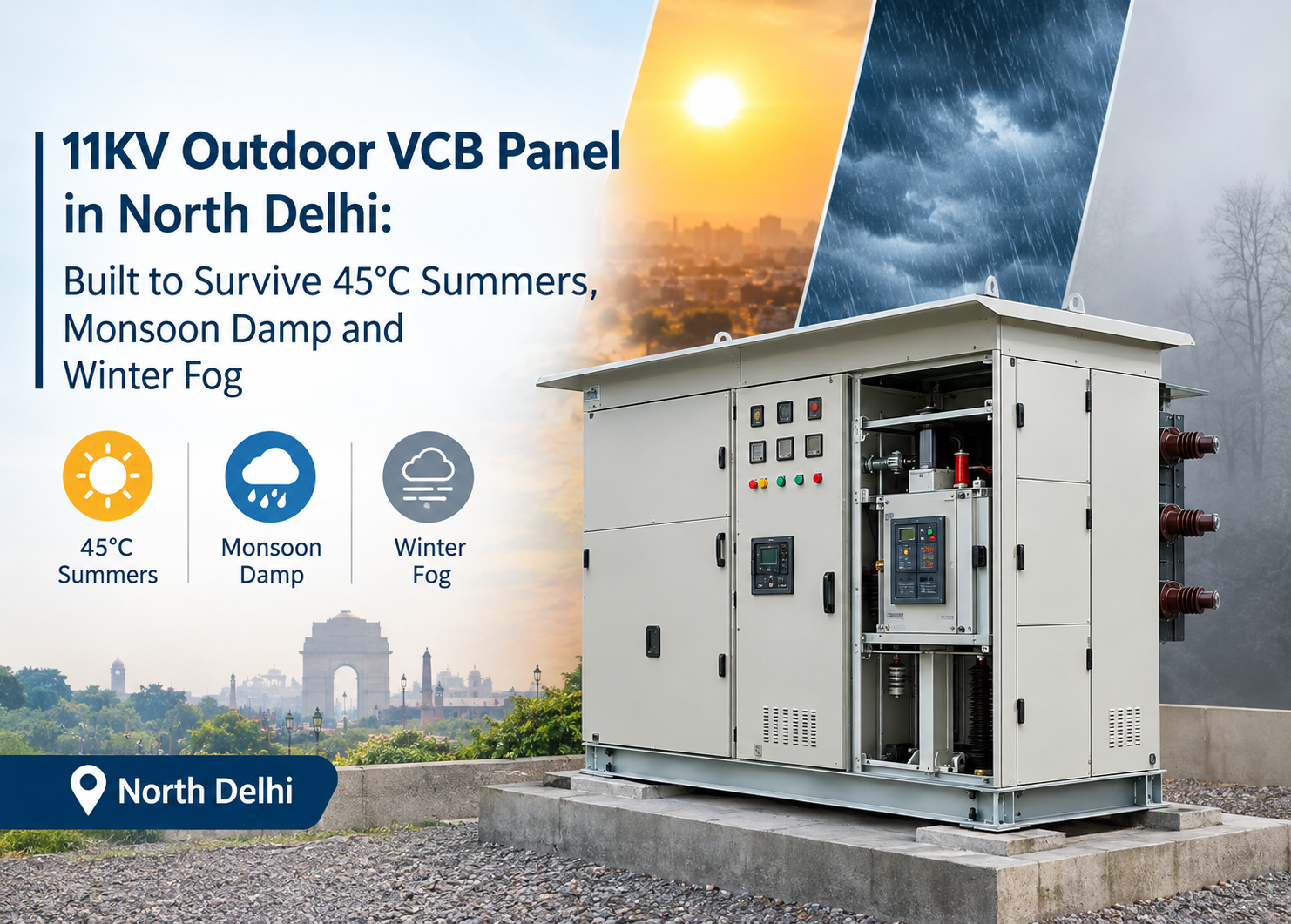
A breaker that sails through its factory tests in a cool workshop can behave very differently on a June afternoon, with the yard at 46°C, a dust haze overhead and the panel door baking in direct sun. Anyone who has looked after HT equipment in this city knows it. The weather, not the datasheet, is usually what tests an installation first.
That’s the angle I want to take here. Most guides on an 11KV Outdoor VCB Panel in North Delhi talk about ratings and relays. Those matter, and we’ve covered them elsewhere on this blog. But the panels that give people trouble five years later are rarely the ones with the wrong kA figure. They’re the ones where nobody asked how the enclosure would cope with Delhi’s heat, dust, humidity and fog.
This guide is for facility managers, electrical contractors and consultants planning an outdoor VCB panel around Rohini, Narela, Bawana, Model Town, Civil Lines, Burari and Wazirpur.
Quick read
- Delhi’s weather is hard on outdoor switchgear in four different ways: heat, dust, damp and fog.
- Ask for temperature-rise and ingress-protection details, not just the voltage and fault rating.
- Condensation is the quiet killer. An anti-condensation heater is cheap insurance.
- Raise the plinth, seal the cable entries and plan a pre-summer and pre-monsoon check.
What we mean by an outdoor VCB panel
A vacuum circuit breaker (VCB) interrupts fault current inside a sealed vacuum bottle. On its own it’s just the breaker. An 11KV outdoor VCB panel wraps that breaker, along with the current transformers, relay, metering and control wiring, inside a weatherproof enclosure that can stand in a yard or on a plot without a building around it.
It sits between two neighbours. A bare 11KV outdoor VCB on a steel stand is the lighter option for open substations. A kiosk-type unit is a walk-up cabinet, popular where controls need extra housing. The panel format is the sensible middle ground for many commercial campuses, schools, hospitals and industrial plots in the north of the city.
Why North Delhi is a demanding place for outdoor switchgear
Heat
Switchgear ratings are normally stated for a maximum ambient temperature of 40°C. Delhi crosses that line most summers, and a dark enclosure in full sun runs hotter than the air around it. Current-carrying parts then start from a higher baseline before the load even arrives.
So ask the supplier two things. First, is the continuous current rating comfortable for your real load at the temperatures you’ll see, or is the panel working at its limit? Second, can they share the temperature-rise test report? A panel running at 80% of its rating ages far more gently than one running at 100%.
Design details help too. A double-skin or sloped canopy over the roof, sensible ventilation and light-coloured finishes all keep the interior cooler.
Dust and the things that live in it
Narela, Bawana and the Wazirpur belt carry a lot of fine dust, and anywhere near open ground you’ll also meet insects, birds and the occasional rat. Dust on insulators and in mechanisms is a slow problem. A rodent in the cable box is a fast one.
Look for an enclosure with a suitable ingress-protection rating (IP54 is a common starting point for outdoor panels, but confirm what your project needs), mesh on ventilation openings, and properly sealed cable entries. After installation, a sealed gland plate is worth more than most people give it credit for.
Monsoon damp and winter fog
Here’s what surprises many first-time buyers. Water doesn’t have to get in to cause damage. In a Delhi monsoon, humidity stays high for weeks. In winter, fog and cold nights push the temperature below the dew point, and moisture condenses on cold metal and insulation inside a closed panel.
That condensation can leave tracking marks on insulators, corrode terminals and make secondary wiring unreliable. It’s often the reason a panel that worked fine all summer fails to close or trip when someone needs it.
The fix is simple and inexpensive. An anti-condensation heater with a thermostat or hygrostat keeps the interior just warm enough to stay dry. Ask for it in the specification, and make sure someone checks it’s actually switched on after commissioning.
Low-lying plots
Pockets along the Yamuna side of North Delhi, including parts of Burari, Wazirabad and the Civil Lines stretch, know what waterlogging looks like. After the Yamuna flooding of 2023, many electrical teams started asking about plinth height as a first question, not an afterthought. Raise the plinth above the highest water level your site has seen, and make sure drainage runs away from the panel, not towards it.
A short checklist to put in your specification
| Question to ask | Why it matters |
|---|---|
| What is the temperature-rise test result at rated current? | Shows how the panel copes with Delhi summers |
| What IP rating does the enclosure carry? | Dust, rain and insect protection |
| Is an anti-condensation heater included? | Keeps moisture away in monsoon and fog |
| What surface treatment and sheet thickness is used? | Corrosion resistance, especially near industrial areas |
| How are cable entries sealed? | Stops rodents and water at the weakest point |
| What breaker standard does it follow? | Look for compliance with IEC 62271-100 or IS 13118 |
| Which test reports come with the panel? | Type test and routine test records for your file |
If you want to go deeper on the electrical side, our piece on matching the breaker to the job explains fault level, relays and control supply in plain language.
Approvals and local requirements
Most projects in this part of the city fall under Tata Power-DDL’s network, so metering and connection requirements usually follow their rules. Statutory electrical inspection comes before energisation as well. Requirements do get revised, so confirm the current process with the concerned offices before you freeze drawings. Getting this wrong costs weeks, not hours. For a view of how the site-level questions play out in the Pitampura area, see our four site questions guide.
A maintenance rhythm that suits Delhi’s calendar
Forget the generic annual checklist. Tie your checks to the seasons instead.
- Before summer (March to April): clean dust from ventilation mesh, check cable terminations for heat marks, measure contact resistance and test the control supply.
- Before monsoon (June): inspect door gaskets, roof seams, gland plates and the plinth drainage. Confirm the heater works.
- After monsoon (October): look for corrosion, moisture marks and insect nests, and re-check earthing.
- Before winter fog (November): test the heater and thermostat again, and operate the breaker a few times to keep the mechanism free.
Keep a plain logbook beside the panel. When a different engineer takes over, it’s the first thing they’ll want to see.
Choosing who to buy from
The weather questions above are easiest to settle when the supplier can visit your site, look at where the sun hits, where water collects and what’s growing nearby. That’s hard to do from a catalogue.
Arpan Power Projects has its registered office at Netaji Subhash Place, Pitampura, and a manufacturing unit at Khera Kalan Industrial Area, so most North Delhi sites are a short drive away. We supply 11KV and 33KV VCBs, RMUs, transformers and compact substations. If you’d like to see the available configurations, our 11KV Outdoor VCB Panel page lists the options. And if you’re comparing an outdoor installation with a room-based one, our guide to the 11KV Indoor VCB in North Delhi will help you weigh the trade-offs.
Frequently asked questions
Is an 11KV outdoor VCB panel suitable for Delhi’s summer heat?
Yes, provided it’s specified for it. Check the rated current against your real load, ask about temperature-rise testing and look for a canopy and ventilation design that handles direct sun.
Why does condensation matter if the panel is already weatherproof?
Because weatherproof stops rain, not humidity. Moist air gets inside through normal breathing of the enclosure, then condenses when temperatures drop. A heater with a thermostat is the standard answer.
Can the panel be installed inside a school, hospital or industrial campus?
Usually, if there’s an open area with safe working clearances, crane access and the required approvals. Share a layout or site photos with your supplier first.
Do you support projects across North Delhi?
Yes. We support enquiries from Rohini, Narela, Bawana, Model Town, Civil Lines, Wazirpur and the wider Delhi NCR.
Before you decide
A good 11KV Outdoor VCB Panel in North Delhi is chosen for the climate it will live in, not just the voltage it will carry. Ask about heat, dust, damp and drainage early, and the electrical details will usually fall into place. If you’d like a second opinion on a specification or a site, send your details through our contact page and the team at Arpan Power Projects will get back to you with a clear recommendation.