

Blog
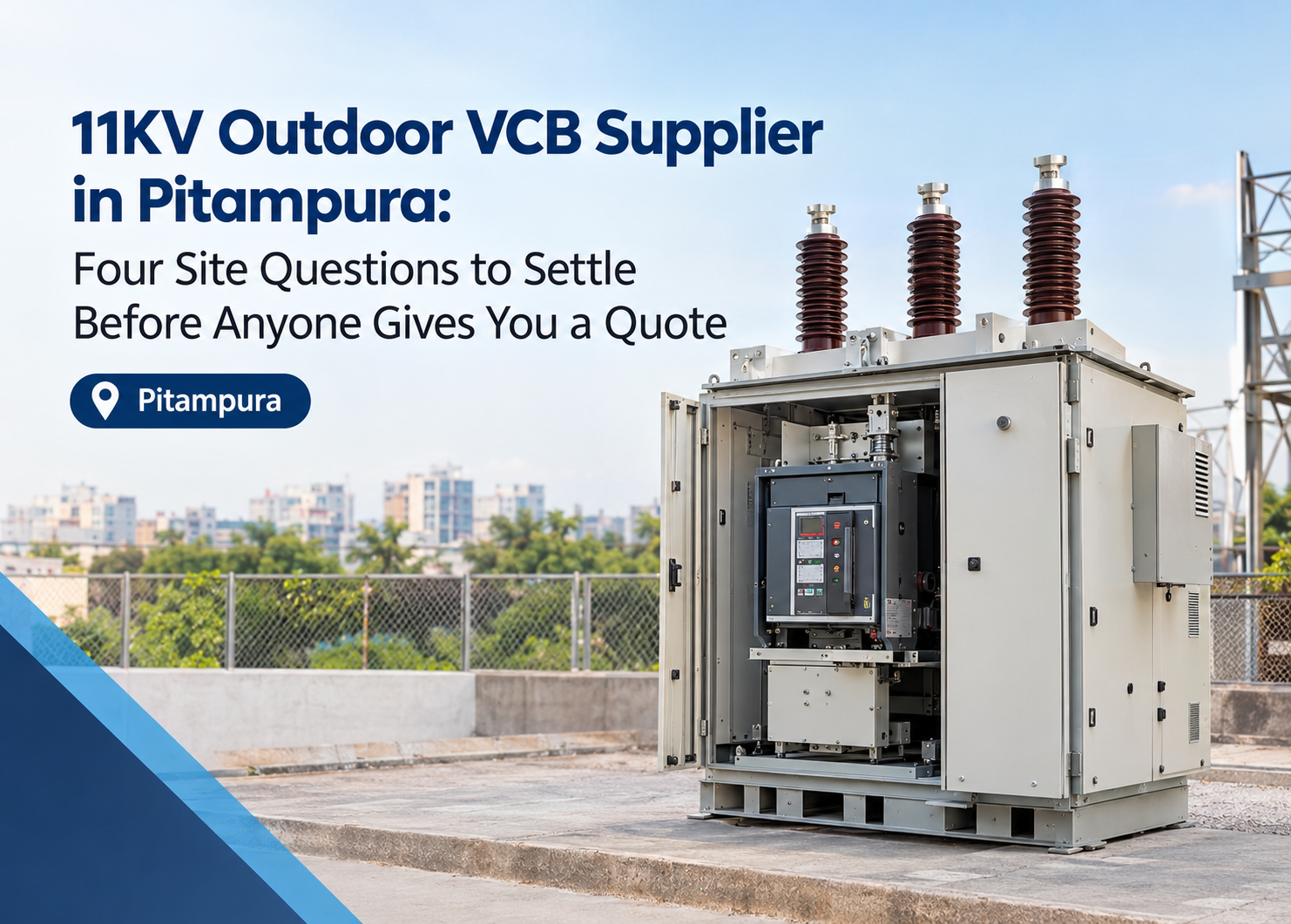
11KV Outdoor VCB Supplier in Pitampura: Four Site Questions to Settle Before Anyone Gives You a Quote

Ask anyone who has commissioned an HT breaker and you’ll hear the same story. The breaker was never the hard part. The hard part was the relay setting nobody wrote down, the battery that wasn’t ready on the day, and the phone that rang out at seven in the evening in June.
That’s why, when you search for an 11KV Outdoor VCB Supplier in Pitampura, price should come third or fourth on your list. A vacuum circuit breaker has one job: open the circuit fast when something goes wrong. Whether it does that properly depends on how well it was matched to your site. A supplier who can stand on that site with you before quoting has a real edge over one who answers from a catalogue.
This guide covers the four questions I’d want answered at the site visit, and the order in which things usually happen afterwards. It’s written for facility heads, electrical contractors and consultants working around Netaji Subhash Place, Rohini, Shalimar Bagh and Ashok Vihar.
Quick read
- Get the fault level at your incoming point in writing.
- Know who is writing the relay settings, and when.
- Check where the tripping power comes from.
- Agree on metering, site tests and handover documents before you order.
Where an 11KV outdoor VCB actually gets used around here
Not every buyer in North West Delhi has the same need.
Commercial towers and office complexes usually add or upgrade an HT connection, and the breaker sits in a ground-level yard or enclosure next to the incoming cable.
Schools, hospitals and campuses often run their own 11KV ring, with an 11KV outdoor VCB feeding one or more transformers.
Small industrial units in nearby clusters such as Wazirpur and Mangolpuri tend to need a breaker that can sit in a yard and take dust and heat without fuss.
Group housing societies come in when load growth (lifts, AC, EV charging) forces a transformer upgrade.
If you already have a proper substation room, an indoor VCB may be tidier. If you want the breaker and controls housed together, a kiosk type is worth a look. For everything else, an open-yard outdoor breaker on a proper stand is the usual answer.
The four site questions
1. What is the fault level at your incoming point?
Fault level is the maximum short-circuit current your breaker must be able to interrupt and withstand, usually quoted in kA for 1 or 3 seconds. Get the figure from your consultant or the distribution company, not from a guess. An under-rated breaker is the one mistake you can’t fix later with a setting. If you want the full picture on ratings, our guide on matching the breaker to the job goes deeper.
2. What will the relay protect, and who writes the settings?
Here’s something people often miss. The breaker doesn’t decide when to trip. The relay does, using signals from the current transformers. So ask three things: is the relay included, what CT ratio is planned, and who supplies the setting sheet?
In many projects the consultant or the distribution company specifies the protection scheme. That’s fine. What matters is that someone owns it, and that the settings work together with the upstream protection. Get the setting sheet on paper before commissioning day, not during it.
3. Where does the tripping power come from?
A spring-operated breaker needs a healthy control supply to close and trip. Most outdoor installations use a battery and charger for this, with the voltage level chosen to match the breaker’s coils. A breaker with a dead battery is a breaker that can’t trip, and that’s the situation you least want during a fault.
Ask how the charger is sized, how long the battery should carry the load if the AC supply fails, and who tests it. It sounds minor. It isn’t.
4. How will it be metered, tested and handed over?
Metering arrangements for HT connections usually follow the distribution company’s rules. In this part of Delhi that’s typically Tata Power-DDL, but requirements change, so confirm the current ones with the concerned office before you freeze the specification.
On the testing side, ask for factory test reports up front. We’ve listed what to look for in our piece on factory tests, documents and site checks. At site, expect insulation resistance, contact resistance, trip timing and relay injection tests before the breaker is energised. At handover, you should receive drawings, the manual, test reports and the relay settings printout. If any of these is missing, say so politely and early.
What a good site visit looks like
A proper visit isn’t a five-minute glance. Here’s what I’d expect the supplier’s engineer to check:
- The incoming cable route and where the termination will land
- Space for the plinth, with enough working clearance in front of the breaker
- Whether an earth pit exists or needs to be built
- Crane access and the final lifting position
- Who and what passes nearby, such as people, vehicles and parked cars
- Photographs from every side, so the drawing matches reality
Two minutes spent on this saves two weeks of redesign. For the space, approval and delivery issues specific to tight Pitampura plots, our outdoor RMU guide for Pitampura covers the same ground and applies here too.
From enquiry to energisation: the usual order
- Site visit and requirement discussion
- Specification freeze (ratings, relay, CTs, control supply)
- Drawings and approvals
- Factory testing and inspection
- Delivery and lifting
- Installation and cable termination
- Pre-commissioning tests
- Statutory inspection and distribution company clearance
- Energisation and handover
Timelines vary a lot from site to site, so I won’t promise a number of days. What I will say is that steps 2 and 3 are where most delays begin, and they’re also the cheapest places to fix things. Our kiosk commissioning guide walks through the later steps in more detail.
After energisation: small habits that keep a VCB healthy
A vacuum breaker is low-maintenance, not no-maintenance. A yearly visit should cover mechanism lubrication, the spring-charging motor, trip and close coil checks, contact resistance, a look at the operation counter, and a battery and charger test. Door seals, earthing and cable box condition matter too, especially after a heavy monsoon. Keep a simple logbook. It helps whoever comes next, including you.
Why a nearby supplier makes all four questions easier
Every item above gets easier when the supplier can reach your site quickly. A local team can visit before quoting, sit through the discom discussion, and show up on commissioning day.
Arpan Power Projects has its registered office at GDITL Tower, Netaji Subhash Place, Pitampura, with a manufacturing unit at Khera Kalan Industrial Area, Delhi. We supply 11KV and 33KV VCBs, RMUs, transformers and compact substations, and our team can look at your drawing or site photos before you commit to anything. Buyers looking for an outdoor VCB supplier in Delhi can browse our 11KV outdoor VCB range to see the available configurations.
Frequently asked questions
Can an 11KV outdoor VCB be installed inside a society or campus in Pitampura?
Usually yes, if there’s a suitable open area with safe clearances and the required approvals. Share the layout with your supplier and confirm with the distribution company before fixing the spot.
Should I choose an open-yard outdoor VCB or a kiosk type?
If space is tight or you want controls housed together, a kiosk type can be neater. If you have room and a simple scheme, an open-yard breaker on a stand works well. A site visit usually settles it in minutes.
Who decides the relay settings?
It depends on the project. The consultant, the distribution company or the supplier may provide them. Ask early, and get the setting sheet in writing before commissioning.
Do I need SCADA or remote operation?
Only if your operation demands it. Tell your supplier at the specification stage, because it changes the relay and control wiring.
Yes. We support enquiries from Rohini, Shalimar Bagh, Ashok Vihar, the wider Delhi NCR and projects across India.
Before you decide
A good 11KV Outdoor VCB Supplier in Pitampura will ask about your fault level, relay and control supply before talking about price. If you’d like a second pair of eyes on a specification or a site, send your details through our contact page. The team at Arpan Power Projects will come back with a clear recommendation.