
Blog
33KV Indoor VCB Supplier in Pitampura: Is Your Switch Room Ready Before the Panel Arrives?

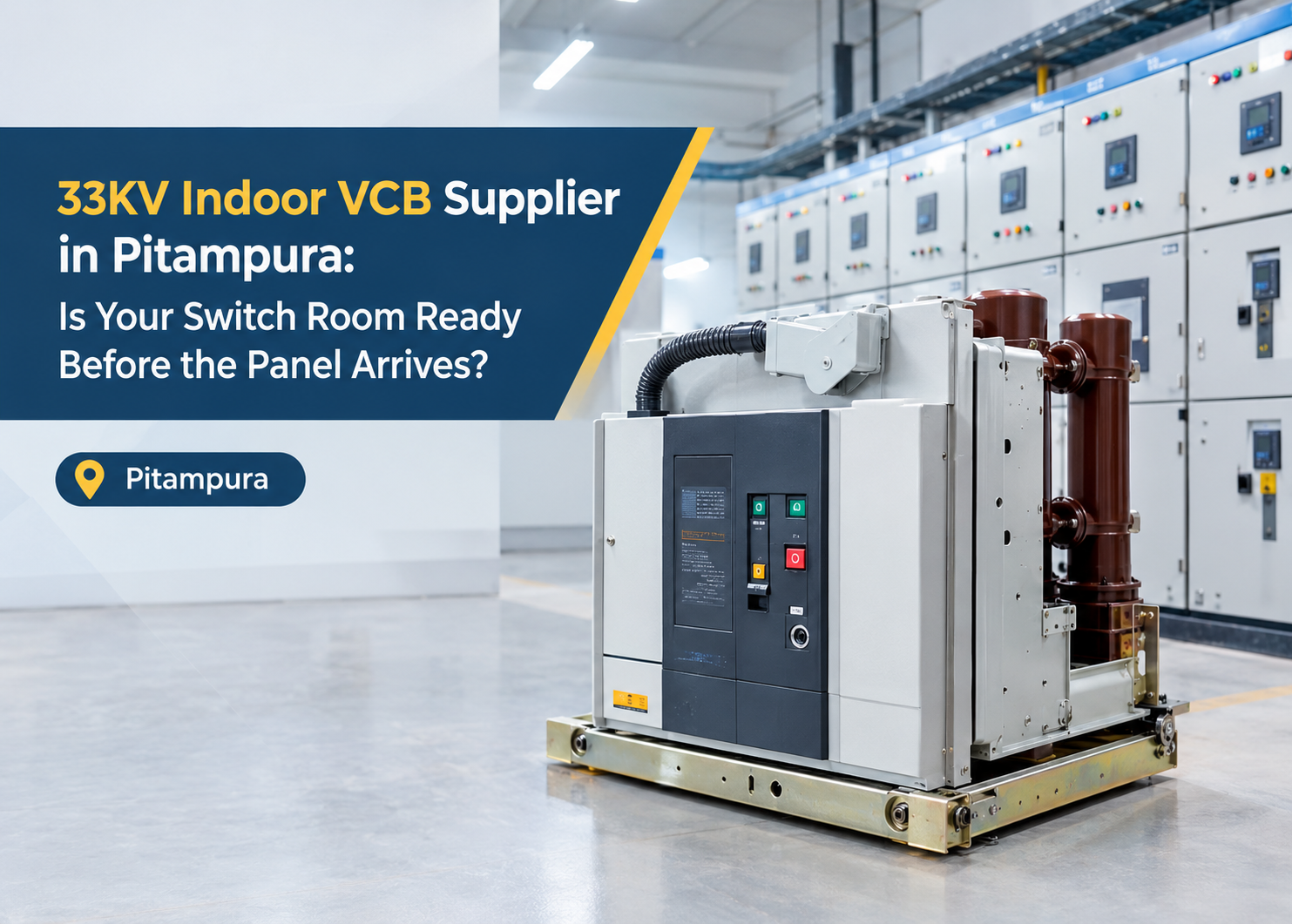
The panel is booked and the delivery date is fixed. Then someone walks into the switch room with a tape measure, and the problems start. The door is too narrow for the breaker truck, the cable trench is too shallow, and the ceiling leaves no room for the arc exhaust.
It happens more often than anyone admits, and it is rarely the supplier’s fault or the buyer’s. It is a planning gap.
So if you are searching for a 33KV Indoor VCB Supplier in Pitampura, remember that the panel is only half the job. The other half is the room it will live in. This guide walks through that second half, with Delhi conditions in mind.
Quick read
- Confirm first that your connection is really at 33kV and not 11kV.
- Get the panel’s dimensioned drawing before you finalise the room layout.
- Plan cable entry early, because 33kV cables are stiff and need space.
- Think about heat, humidity and arc gases, not just floor area.
- Choose a supplier who will actually visit the site before quoting.
First, are you sure it is 33kV?
Most commercial buildings around Netaji Subhash Place and Rohini take supply at 11kV. A 33kV connection usually comes with large loads: big campuses, hospitals, industrial units and bulk consumers. Which voltage applies to you depends on your contracted load and the distribution company’s rules, so get it confirmed in writing before you order anything.
If you are at 11kV, you need an 11KV indoor VCB, not a bigger panel “just in case”. Oversizing wastes money and room space.
If you are at 33kV, you will see the rating written as 36kV on datasheets. That is normal. Equipment for a 33kV system is rated for the next standard voltage class up. Our guide on reading a 36kV datasheet explains the other numbers on that sheet.
What the switch room needs to offer
A 33KV VCB panel is physically bigger than most people expect. Depending on the make and configuration, it can be noticeably deeper and taller than an 11kV panel. Instead of guessing, ask for the general arrangement drawing and test your room against it.
| What to check | Why it matters | What to ask the supplier |
|---|---|---|
| Door and passage width | Panel sections and the breaker truck must reach their final position | Transport dimensions and weight of each shipping section |
| Ceiling height | The panel is tall, and fault gases need an exhaust path | Height with and without the arc duct |
| Floor and cable trench | The base frame must sit level, and cables need room to enter | Foundation drawing with cut-out positions |
| Front and rear clearance | The breaker has to be withdrawn safely | Minimum working clearances from the maker’s drawing |
| Ventilation | Heat builds up in a closed room during 45°C summers | Heat loss figure per panel |
| Lighting, fire safety, signage | Required for safe operation and inspection | Your electrical consultant’s checklist |
I’d also walk the delivery route once. A drawing will not show you the sharp turn near the basement ramp.
Cable entry: the part everyone underestimates
At 33kV, cables are thick, stiff and unforgiving. They cannot be bent sharply, and the bending radius is large. If the trench or cable cellar is too shallow, the installer ends up forcing cables into a tight curve, and that stress stays in the insulation for years.
Before civil work starts, check three things:
- Top or bottom entry, and where the cables come from.
- The bending radius, which you take from your cable maker’s datasheet.
- Enough working space for the termination kits.
Termination is skilled work, and cramped conditions lead to poor workmanship. We covered the testing steps before energisation in From Drawing to Energisation, so I won’t repeat them here.
Heat, humidity and arc safety
Indoor does not mean protected from everything. Delhi gives a switch room a rough calendar: dust before the monsoon, heavy humidity during it, and cold, damp mornings in winter. Condensation inside a panel is a real concern, so ask about anti-condensation heaters and how they are supplied.
Basements and low-lying rooms deserve extra thought. Some parts of North West Delhi see waterlogging in heavy rain, and a switch room below road level needs proper drainage and a sump, or better, a different location.
Then there is arc safety. Ask whether the panel carries an internal arc classification and where the pressure and hot gases would go if a fault ever happened. Panel and room design must work together here. A well-rated panel in a room with no exhaust path is only half protected.
Protection, DC supply and the small things that cause delays
The vacuum breaker does the switching, but the relay decides when. A 33kV VCB panel also needs current and voltage transformers with the right ratios, a reliable DC supply for tripping, and a clear plan for metering and, if required, SCADA.
I’ve seen projects wait weeks because the battery charger or relay settings were left for “later”. Put them on the order list from day one.
Delivery in dense North West Delhi
Heavy vehicles have timing limits in the city, and narrow lanes around markets and housing societies complicate crane positioning. We went through delivery windows and local approvals in our guide to an outdoor RMU supplier in Pitampura, and the same logic applies here. Plan the route, the crane and the unloading point before the truck leaves the factory.
Why a local supplier makes this easier
You can plan all of this from a desk, but it goes better when someone has stood in your switch room. A supplier close to the site can check the room, point out clearance problems early, and be present on commissioning day.
Arpan Power Projects has its registered office at GDITL Tower, Netaji Subhash Place, Pitampura, with a manufacturing unit at Khera Kalan Industrial Area, Delhi. We work as a supplier, channel partner and stockist for HT panels, VCBs, RMUs, transformers and compact substations. We support enquiries from Rohini, Shalimar Bagh, Ashok Vihar, Wazirpur and the industrial belts of Narela and Bawana, as well as projects across India.
For buyers searching for an HT panel supplier in Delhi, that nearness matters most in the first year, when small snags tend to show up.
What to keep ready when you call
- Site address and a few photos of the switch room
- Voltage class and rated current
- Fault level from your system study, if available
- Number of incoming and outgoing feeders
- Panel type, whether withdrawable or fixed
- Relay, metering and SCADA requirements
- Any correspondence with the distribution company
With these details, the quote matches your site instead of a generic catalogue. You can browse the 33KV indoor VCB panel range to see what we offer.
Frequently asked questions
Is a 33kV VCB the same as a 36kV VCB?
Practically, yes. The system voltage is 33kV, and the equipment is rated 36kV so it has the right insulation margin.
Can I use an 11kV indoor breaker on a 33kV system?
No. The insulation, clearances and testing are designed for a specific voltage class, and the two are not interchangeable.
How much room does a 33kV panel need?
It depends on the make and the number of panels. Always ask for the dimensioned drawing, including the operating clearances.
What documents should I ask for?
Type test reports for the breaker and switchgear (the IEC 62271 series is the usual reference), routine test certificates, the general arrangement drawing and the wiring diagram.
Do you supply outside Pitampura?
Yes. We serve Delhi NCR and projects across India.
Before you decide
A good 33KV Indoor VCB Supplier in Pitampura will ask about your room before talking about price. If you want to discuss a project, call +91 98688 64101 or send your requirement through our contact page. The team at Arpan Power Projects will review your layout and come back with a clear recommendation.