

Blog
33KV Indoor VCB Supplier in India: How to Read a 36kV Datasheet Before You Compare Prices

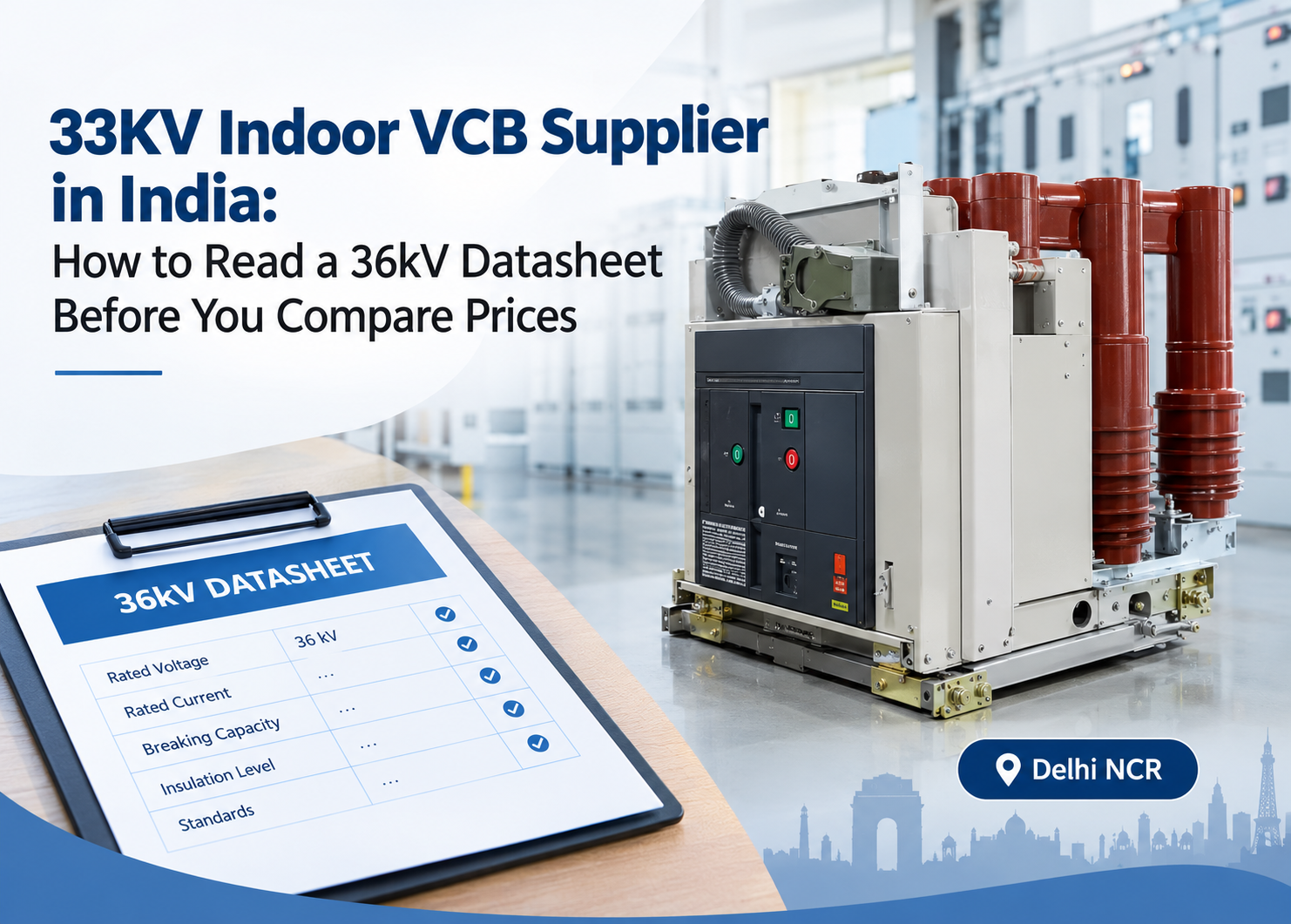
Two quotations for a 33kV panel land on your desk. One is 15% cheaper. Same voltage, same brand of relay, same “indoor VCB” on the cover page. So why the gap?
Nine times out of ten, the answer is sitting in the datasheet, in a line nobody read closely. If you are shortlisting a 33KV Indoor VCB Supplier in India, learning to read that sheet will save you more money than any negotiation. Here is how we go through one at Arpan Power Projects, line by line.
First, 33kV or 36kV? Don’t Let It Confuse You
Your single-line diagram says 33kV. The datasheet says 36kV. Nobody made a mistake. A 33kV network is served by equipment built to the 36kV class, so a 36kV indoor VCB panel and a 33kV indoor panel are the same product. If a quote says 33kV rated voltage, ask the supplier to confirm the actual rated voltage. A panel rated lower than 36kV is not what you want on a 33kV system.
The Ratings That Decide the Price
Most of the price difference hides in these five lines.
1. Rated normal current (A). Common values are 630A, 1250A and 2000A. Choose it for your actual load and future growth, not for the biggest number on the sheet. A 2000A breaker costs more and you may never use that headroom.
2. Short-circuit breaking current (kA) and duration. Usually 25kA or 31.5kA for 3 seconds. This must match or exceed the fault level at your point of supply, which your utility or consultant can tell you. Buying a lower rating to cut cost is a safety problem, not a saving.
3. Short-circuit making current (peak kA). For a 50Hz system this is normally 2.5 times the breaking current. A 31.5kA breaker should show roughly 80kA peak. If the number looks odd, ask why.
4. Insulation levels. Look for the power-frequency withstand and lightning impulse withstand values. Panels meant for polluted or humid sites sometimes need more attention here. If the sheet leaves them out, that is a red flag.
5. Operating duty cycle. This tells you what sequence of open and close operations the breaker is proven to handle, which matters if your scheme uses auto-reclosing.
The Lines That Look Boring but Change Reliability
This is the part most buyers skip, so it is where good suppliers stand out.
- Mechanical and electrical endurance class. IEC 62271-100 classes such as M2 and E2 say how many operations the breaker is designed to survive and how much interrupting wear it tolerates. A site with frequent switching needs a higher class than a standby incomer.
- Capacitive switching class. If you switch cable or capacitor banks, a class such as C2 means a very low chance of restrike. Check whether the quote includes it.
- Ambient temperature and altitude. Standard ratings assume normal service conditions, with ambient up to about 40°C and altitude up to 1,000 metres. Summer rooms in Delhi NCR can run hotter, and hill sites go above 1,000 metres. In both cases ask about derating in writing.
- Internal arc classification. If operator safety matters, ask whether the panel is tested for internal arc and with what rating. Do not assume.
- Enclosure protection (IP) and partitions. These tell you how well dust and small animals stay out, and how well compartments are separated.
- Auxiliary supply. The datasheet should state the DC voltage for trip and close coils, spring-charging motor and relays. Mismatch here causes delays at commissioning.
Standards and Test Reports: Ask for the Paper
A proper sheet names the standards the breaker and panel follow, for example IEC 62271-100 for the circuit-breaker and IEC 62271-200 for metal-enclosed switchgear, or the equivalent Indian standards. Then ask for the type test certificates from a recognised lab. A line on the datasheet that says “as per IEC” is a claim. A test certificate is evidence.
For routine tests done at the factory, see our checklist of tests and documents buyers often skip. It was written for outdoor breakers, but the logic holds for indoor ones too.
Where Price Gaps Really Come From
In our experience, the cheaper quote usually differs in one of these: a lower kA rating than your fault level needs, a breaker with a lower endurance class, missing type test certificates, no internal arc rating, or accessories (relay, meters, DC supply) left out. Sometimes the cheaper quote is genuinely fine. But you can only know by comparing like with like.
Datasheet Done? Now Check the Supplier
A sheet only tells you what the panel can do. It does not tell you who answers the phone after delivery. A dependable 33KV Indoor VCB Supplier in India will share the datasheet and GA drawing before the order, explain any deviations plainly, and support you through installation. Our guide on what a good 33KV indoor VCB supplier helps you get right, from drawing to energisation covers that stage. And if you are still deciding between formats, our 33kV outdoor VCB supplier guide for New Delhi helps you compare. Replacing old oil breakers instead? Read what an indoor VCB supplier asks before quoting.
Looking for a 33kV VCB Panel in Delhi NCR?
Our registered office is in Pitampura, New Delhi, and our manufacturing unit is at Khera Kalan Industrial Area. Buyers looking for a 33kV VCB panel in Delhi NCR can visit, see the equipment and go through the datasheet with our team in person. Other states are handled through dispatch and coordination with your site team.
See the range on our 33KV Indoor VCB Supplier in India product page or the wider Indoor VCB (11-36 kV) page.
Frequently Asked Questions
Is a 33kV VCB the same as a 36kV VCB?
Yes. The system is 33kV and the equipment is built to the 36kV class, so you will see both numbers.
Which short-circuit rating should I choose, 25kA or 31.5kA?
Choose according to the fault level at your supply point, confirmed by your utility or consultant. Never choose it by price.
What does “type tested” mean on a datasheet?
It means a design has passed the full set of tests in the standard at a recognised lab. Ask for the certificate, not just the claim.
Does a higher endurance class always make sense?
Not always. It pays off at sites with frequent switching. For a rarely operated incomer, a lower class can be perfectly fine.
Send Us Your Datasheet
Already holding two or three quotations? Send them to Arpan Power Projects along with your single-line diagram and fault level. We will tell you honestly what each one covers and what it leaves out.