


Blog
Replacing an Old Oil Breaker? What a Good Indoor VCB Supplier in India Will Ask You Before Quoting

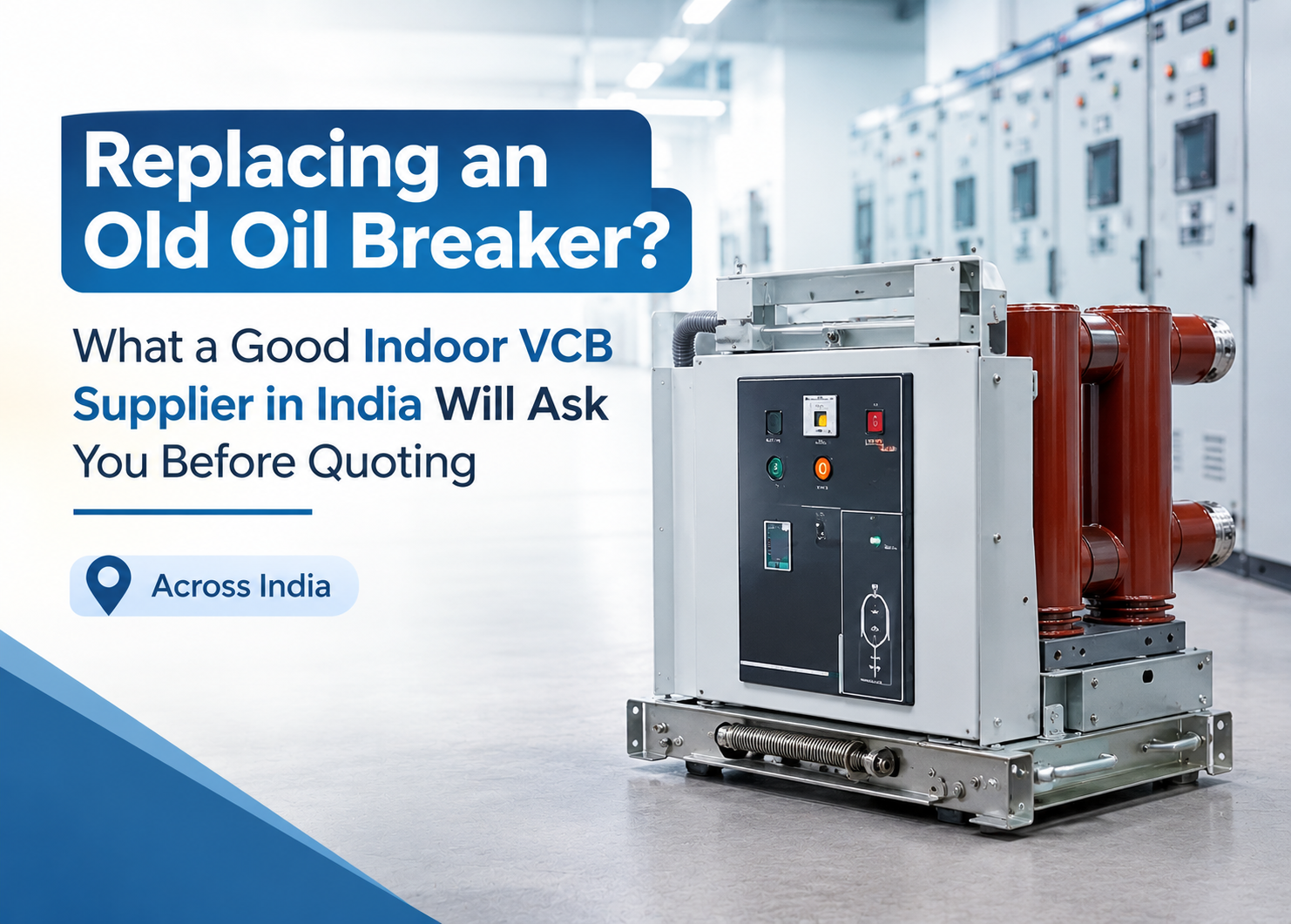
Somewhere in your plant there is probably a switch room that hasn’t changed much since the nineties. The panels are a tired shade of grey, there’s a faint smell of oil that nobody mentions anymore, and the breaker in the incomer carries a nameplate from a maker that stopped selling spares years ago. It still trips. Mostly.
That “mostly” is the whole reason this article exists. Plenty of plants in Delhi NCR and across India are now deciding what to do with their old oil circuit breakers, and the first call usually goes to an Indoor VCB Supplier in India. Fair enough. But if the supplier’s first question is only “how many pieces?”, you’re about to buy the wrong thing.
So here’s what a thoughtful supplier should ask you, and what you should have ready before you pick up the phone.
Why ageing breakers become a problem long before they fail
Old breakers rarely die dramatically. They get slower, fussier and more expensive to keep alive.
Oil needs testing and filtering. Contacts wear. Mechanism grease hardens over the years, and the spare parts you need are either unavailable or “available” at a price that makes you wince. Every maintenance shutdown gets a bit longer than the last one.
The less obvious problem is fault level creep. Every time your plant adds a transformer, or the utility strengthens its network, the short-circuit current available at your busbar goes up. A breaker rated at 250 MVA on an 11 kV bus was sized for roughly 13 kA. It’s not unusual for the same bus to see a good deal more than that today. The breaker hasn’t changed, but the duty it might one day face has.
This is also where a modern vacuum circuit breaker earns its place. The arc is extinguished inside a sealed interrupter, so there’s no oil to sample or top up, and routine upkeep is far lighter. If you want the basics on how the 11KV indoor VCB and 33KV indoor VCB classes differ, we’ve covered that separately in our general guide to indoor vacuum circuit breakers. This article is about the harder question: what do you do with the room you already have?
Retrofit the breaker, or replace the whole VCB panel?
Nobody likes this question, because the honest answer is “it depends”, and it depends on things a brochure can’t tell you.
| Your situation | Usually the better route |
|---|---|
| Cubicle, busbars and insulation are in good shape; fault level is within the busbar rating | Retrofit with a new withdrawable VCB |
| Busbar supports show tracking marks, cracking or heavy corrosion | Replace the panel |
| Cubicle has no arc-fault containment and the room is regularly staffed | Replace the panel |
| Fault level now exceeds what the busbars or cubicle were designed for | Replace the panel |
| Shutdown window is very short and the existing panel is sound | Retrofit, planned bay by bay |
| Relays are electromechanical and the metering is hopelessly outdated | Either, but budget for new relays and wiring |
One point deserves a straight word. A retrofit isn’t just “a new breaker that fits.” The breaker, the cubicle, the shutters and the interlocks all have to work together safely, and type-test evidence normally covers a breaker in its own panel, not in somebody else’s twenty-five-year-old cubicle. A supplier who says “it’ll fit, no problem” without asking for drawings or photos is guessing. A good Indoor VCB Supplier in India will tell you when replacing the whole VCB panel is the safer and, over ten years, often cheaper decision.
What to gather before you ask for a quotation
You don’t need a consultant to collect most of this. A site electrician and a phone camera will get you there.
- Fault level at the bus. Ask your utility or your last system study. This single number decides more than anything else.
- Rated current of each bay. Incomer, bus coupler and feeders are often different. Don’t assume.
- CT ratios and relay type. If the existing current transformers and relays stay, the new breaker has to work with them. If they go, say so upfront.
- Control supply. Is it a DC battery system, and at what voltage? Closing and trip coil ratings must match.
- Room facts. Panel dimensions, cable entry (top or bottom), the door and passage width, and whether the floor can handle a breaker truck on wheels.
- Photos. The nameplate, the front of the cubicle, the inside with the breaker withdrawn, the busbar chamber if it’s safe to open.
If you send these along with a request, the reply you get back will be a lot more useful than a generic price list. Our team at Arpan Power Projects works from exactly this kind of information when someone asks whether to retrofit or replace.
Plan the shutdown like it’s the real project
On paper, swapping a breaker takes hours. In practice, the shutdown is where these jobs go wrong, because the plant manager has promised production that the electrical team never agreed to.
A few habits that make a difference:
- Split the work by bus section wherever the single-line diagram allows it, so part of the plant keeps running.
- Get the new equipment on site and inspected before the shutdown begins. Discovering a dimension problem with the incomer isolated is a miserable way to spend an evening.
- Agree the test list in advance. Insulation resistance, contact resistance, breaker timing, high-voltage withstand and relay secondary injection should all be on paper before anyone starts, not argued about at midnight.
- Keep the old breaker intact until the new one has carried load. It’s your fallback.
If your project involves a 36 kV class panel, our write-up on what a good supplier helps you get right from drawing to energisation goes deeper into that sequence.
What a good Indoor VCB Supplier in India should ask you
Here’s a quick test. After you’ve shared your requirement, a supplier worth working with will come back with questions like these:
- “What’s the fault level, and when was it last confirmed?”
- “Are you keeping the cubicle, or is the panel up for replacement too?”
- “Do your relays and CTs stay, or are they being changed?”
- “What’s your shutdown window, and can we stage it?”
- “Can you send the drawings or photos of the existing panel?”
And they should be able to show you, without fuss, the routine test certificates for what they’re supplying, the type-test reports for the breaker and the panel, and the standards it’s built to. For breakers that usually means IS 13118 and IEC 62271-100, and for the panel, IS 3427 and IEC 62271-200. If you’re after an arc-fault rated design, ask for the internal arc classification in writing rather than taking it on trust.
Equally important, ask who will actually be on the phone when something goes wrong at the site. A supplier who has a real factory and a real service team is easier to hold to account than one who is only forwarding enquiries.
Delhi NCR and beyond
If you’re in Delhi NCR, whether that’s Gurugram, Noida, Faridabad or Ghaziabad, working with a supplier whose factory is nearby makes inspections and quick site visits practical. Arpan Power Projects runs its manufacturing unit at Khera Kalan Industrial Area in Delhi, and supplies HT switchgear to project sites across India, so plants in Gujarat, Maharashtra and elsewhere aren’t left waiting on long coordination chains.
You can look at the 11KV Indoor VCB, the 33KV Indoor VCB, and the wider Indoor VCB range to see what’s available, along with matching control and relay panels if your protection scheme is being upgraded at the same time.
Frequently asked questions
Can I replace an old oil circuit breaker with a VCB in the same panel?
Sometimes. It depends on the cubicle’s condition, its dimensions, the interlocking and the busbar ratings. It should be treated as an engineering job with drawings, not a like-for-like swap.
Will I have to change my relays too?
Often, yes, especially if they’re electromechanical. Numerical relays give you better protection, event records and communication, and they’re usually worth doing in the same shutdown.
How long does a changeover take?
A single bay can be done in a day when everything is prepared. A full room takes longer, and it depends mostly on how well the shutdown is planned, not on the breaker itself.
How much maintenance does an indoor VCB need?
Much less than an oil breaker, since the interrupter is sealed. Mechanism checks, cleaning, lubrication and periodic testing still matter. Follow the manufacturer’s schedule.
What should I send for a retrofit assessment?
Voltage, rated current, fault level, CT and relay details, control voltage, room dimensions, and clear photos of the existing panel and nameplate.
Final thoughts
Upgrading an old switch room isn’t really about buying a breaker. It’s about deciding what to keep, what to retire, and how to do it without stopping the plant for longer than necessary. The right Indoor VCB Supplier in India will help you make that call honestly, even when the answer is to replace more than you hoped.
If you’re weighing this up for your own site, get in touch with Arpan Power Projects with your nameplate details and a few photos. We’ll tell you plainly which route makes sense.