
Blog
11KV Outdoor VCB Kiosk Type: Site Preparation, Commissioning and First-Year Care in Delhi NCR

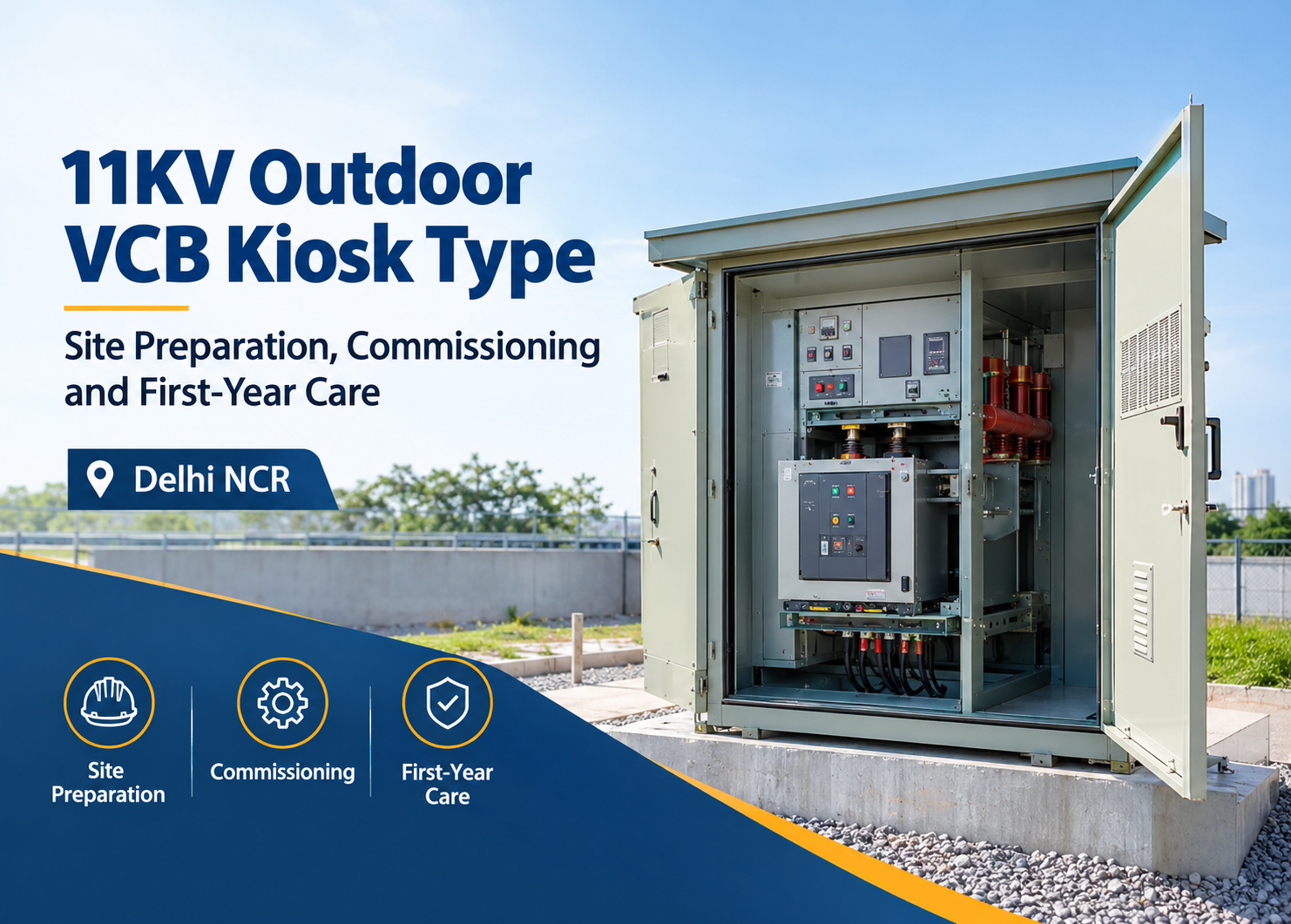
The truck arrives, the crane lifts the kiosk off, and everyone relaxes. The equipment is here, the hard part is over. Except it isn’t.
A 11KV Outdoor VCB Kiosk Type leaves the factory tested and finished, but it only becomes a working protection point once the foundation, earthing, cable termination and relay settings are done properly. In practice, most early problems with outdoor kiosks come from what happens in the two weeks after delivery, not from the breaker itself.
This guide walks through that stretch, step by step, with a Delhi NCR lens. If you are still deciding on ratings and enclosure, our earlier buyer’s guide on choosing a kiosk-type VCB covers that. Here, we assume the unit is ordered and focus on getting it energised safely and keeping it healthy.
Why the Site Matters as Much as the Kiosk
An outdoor VCB kiosk packs a vacuum circuit breaker, relay, CTs, PTs and metering into one weatherproof enclosure. That’s its whole appeal: no switch room, faster commissioning.
But “no switch room” doesn’t mean “no site work.” The kiosk still needs a level base, a clean cable path, a solid earth and a clear working area. Skip any of these and you will pay for it later, usually in the first monsoon.
Before Delivery: Five Things to Sort Out Early
1. A raised, level plinth. Build the foundation above the highest water level the site has seen, not the level it looks like today. Water standing around a kiosk base is a slow, quiet problem. A level surface also matters for door alignment and breaker operation.
2. Cable trench and entry plan. Decide which way incoming and outgoing cables will enter, and where the gland plate sits. Changing this after the kiosk is placed is messy and expensive.
3. Earth pits ready. Earthing should be ready, not “to be done after placement.” More on this below.
4. Crane access and turning space. Check the approach road, gate width and ground strength. A loaded truck on soft, recently filled ground is a common reason for delayed placement.
5. Statutory approvals. For HT installations, the electrical inspectorate’s approval is normally needed before energisation, and requirements vary by state and utility. Ask your consultant or utility office for the exact documents early, because approvals tend to take longer than the civil work.
Unloading and Placement
Use the lifting points the manufacturer provides. Don’t improvise with slings around the roof. Keep the kiosk upright throughout, since tilting can disturb the breaker mechanism and internal components.
Before you sign the delivery receipt, do a quick walk-around:
- Check for dents, scratches that expose bare metal, and damaged gaskets
- Look at door hinges, locks and the viewing window
- Confirm that the nameplate matches your order (voltage, current, fault rating)
- Photograph everything, including the condition of transit locks
If something is wrong, it’s far easier to sort out on day one than three months later.
Cable Entry and Earthing: The Two Jobs That Get Rushed
These two jobs are done last, usually under time pressure, and they decide how safe the installation really is.
Cable entry. Use proper glands and seal every opening after the cables are in. An open cable entry is an invitation to water, dust and, yes, rodents. A small gap that nobody notices in March can become a flashover problem by August.
Earthing. The kiosk body, the earthing switch and the neutral/earth connections should all tie into a properly designed earth system, with at least two separate connections to the enclosure. Many HT installations aim for an earth resistance of around one ohm or lower, but your consultant’s specification and the utility’s rules come first. Measure it after the pit has settled, and keep the test record.
Commissioning: What to Test Before You Energise
A good 11KV Outdoor VCB Kiosk Type has already passed routine tests at the factory. Commissioning is a different job: confirming that everything still works after transport, installation and connection to your network.
| Check | Why it matters |
|---|---|
| Insulation resistance (breaker, busbars, cables) | Catches moisture or damage from transit and handling |
| Cable testing as per the project specification | Confirms terminations are sound before they carry load |
| Breaker open/close operation, manual and electrical | Proves the mechanism and control circuit work together |
| Contact resistance and timing checks | Early sign of a mechanism or contact issue |
| CT ratio and polarity | A reversed CT can make a relay behave wrongly during a fault |
| Relay secondary injection | Verifies the relay actually trips at the set values |
| Interlock and earth switch checks | Protects the people operating the kiosk |
| Space heater and lighting | Prevents condensation, which is a real issue outdoors |
| Earth resistance measurement | Confirms the earth system meets the specification |
The vacuum interrupter itself is sealed, so you can’t “see” its condition. Ask the commissioning team to confirm integrity using the manufacturer’s recommended test method. Keep all test sheets in one file, because they become your baseline for every future inspection.
Relay Settings: Get Them in Writing
A kiosk is only as smart as the relay inside it, and a relay is only as good as its settings. Overcurrent and earth fault settings should be based on a proper coordination study with the upstream and downstream devices, not copied from another site.
Two practical tips:
- Ask for the final settings as a signed document, and keep a copy outside the kiosk
- After any change, record who changed it, when, and why
It sounds boring. It also saves hours of guesswork the day something trips unexpectedly.
Delhi NCR Conditions: What the Weather Does to a Kiosk
Location changes the maintenance plan, and that’s worth planning for rather than discovering.
- Summer heat. Delhi, Gurugram and Noida regularly see very hot, dry spells. Poorly ventilated enclosures run warmer inside, so check that vents are clear and the paint finish is intact.
- Dust and loo. Fine dust settles into vents and on insulators. In industrial areas like Faridabad, Ghaziabad and Bawana, it builds up faster.
- Monsoon humidity. From July to September, condensation is the main enemy. A working space heater, healthy gaskets and sealed cable entries do most of the work here.
- Rajasthan and Punjab sites. Hotter summers in the first, wet-and-humid conditions in the second. Both argue for a surface finish and gasket check before each season.
For sites in coastal or heavily polluted zones, discuss surface treatment with your supplier before ordering, not after rust appears.
First-Year Care: A Simple Routine
Vacuum breakers are low-maintenance, not no-maintenance. A light, regular routine is usually enough.
| When | What to do |
|---|---|
| Monthly | Visual check through the viewing window, heater working, no water marks, door locks intact |
| Before summer | Clean vents, check paint and gaskets, look for hot spots on connections (thermography if available) |
| Before monsoon | Re-seal cable entries, test the space heater, check foundation drainage |
| After monsoon | Inspect for moisture, rust and insect nests; check insulation |
| Yearly | Operate the breaker, test the relay, check the operation counter and mechanism as per the manufacturer’s manual |
Keep a simple logbook. A page with date, observation and signature is all you need, and it’s invaluable when a warranty or service question comes up.
A Quick Word on Choosing Between a Kiosk and Other Formats
Not every outdoor site needs a kiosk. If your layout is a cable ring with several tapped feeders, an RMU is usually the better fit. If you need a complete transformer-plus-switchgear package in one footprint, a compact substation makes more sense. A kiosk with a breaker and relay is right when you need proper relay-based protection on a single outdoor feeder.
For 33kV networks, the same site logic applies with larger clearances. You can look at our 33KV Outdoor VCB options if that’s your voltage level.
Working With a VCB Kiosk Supplier in India
A good VCB kiosk supplier in India doesn’t stop at delivery. The useful ones share the general arrangement drawing before you build the plinth, tell you where the cable entry goes, and answer the phone when commissioning raises a question.
Arpan Power Projects, based in Delhi with a manufacturing unit in Khera Kalan Industrial Area, supplies 11KV and 33KV outdoor kiosk-type VCB units along with RMUs, compact substations and transformers. If you share your voltage level, fault level, incomer and outgoing details and site location, the team can suggest a configuration and the site preparation points that go with it. You can see the range on our 11KV Outdoor VCB Kiosk Type product page.
Frequently Asked Questions
How long does it take to install and commission a 11KV Outdoor VCB Kiosk Type?
Once the plinth and earthing are ready, placement is often done in a day. Commissioning tests, cable work and approvals set the real timeline, so plan these from the start.
Does the kiosk need a roof or shed over it?
Not usually, because it’s built for outdoor use. In very harsh sun, some owners add a simple shade, but check airflow so you don’t trap heat.
Can I commission it without the supplier’s engineer?
Technically a qualified electrical contractor can, but having the supplier’s guidance on the first energisation reduces risk, particularly for relay settings and interlocks.
How often should the relay be tested?
Most owners test it at least once a year and after any major fault. Follow the manufacturer’s manual and your own safety policy.
Is a 11KV Outdoor VCB Kiosk Type suitable for solar plant boundaries?
Yes, it’s widely used as a grid-side protection point. Share the plant capacity and utility requirements so the relay and ratings can be matched.
Final Thoughts
A well-built 11KV Outdoor VCB Kiosk Type can run quietly for years, but only if the first two weeks are handled with care: the right plinth, a solid earth, sealed cable entries, proper commissioning tests and documented relay settings. Do those, add a simple seasonal routine, and the kiosk will do its job without drama.
Planning a kiosk for a site in Delhi NCR, Haryana, UP, Rajasthan or Punjab? Send your requirement to Arpan Power Projects on +91 98688 64101 and get a configuration along with site preparation guidance.