
Blog
How to choose the Right 11KV Outdoor VCB Kiosk Type: A Practical Buyer’s Guide for India

If you have ever stood at an open site, a solar plant, a factory boundary or a construction yard waiting for permanent power, you know the problem. You need protection and switching at 11kV, but you do not have a switch room, and building one takes months.
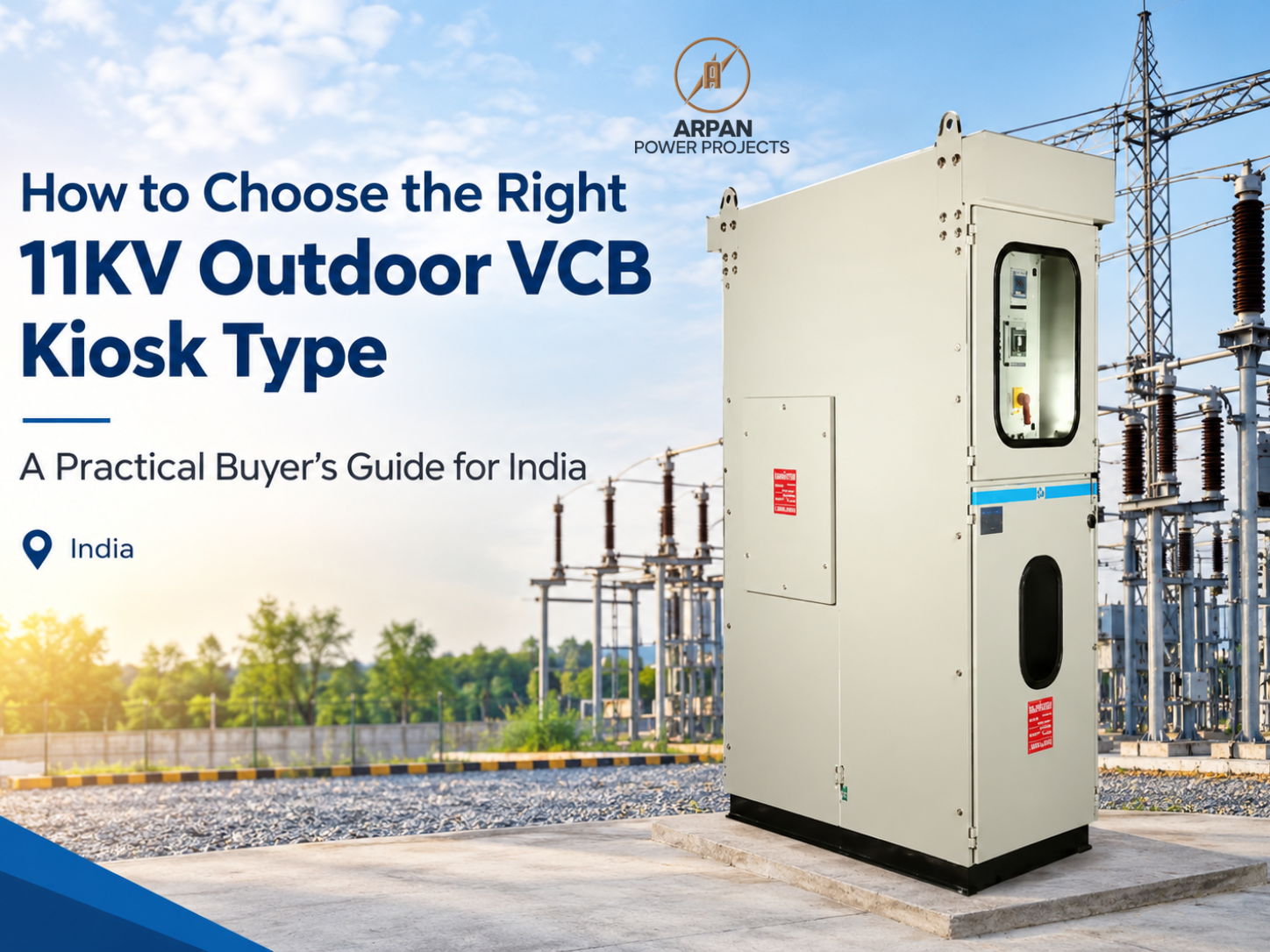
That is exactly the gap a 11KV Outdoor VCB Kiosk Type unit fills. It is a ready-to-install, weatherproof enclosure with a vacuum circuit breaker, relays, CTs and PTs already housed inside, so you can place it outdoors and connect.
I have seen many buyers focus only on price and then regret it a year later when dust, heat or a wrong relay setting caused problems. So instead of repeating a brochure, this guide covers what actually matters when you buy one.
What Is a 11KV Outdoor VCB Kiosk Type?
A 11KV Outdoor VCB Kiosk Type is a sheet-steel enclosure that holds a vacuum circuit breaker (VCB) along with its protection and metering equipment. It is designed to stand outdoors, take rain, dust and heat, and still protect your downstream equipment.
In simple words, it is a “switchgear room in a box.” Inside you typically find:
- A vacuum circuit breaker for switching and fault interruption
- Isolator and earthing switch for safe maintenance
- CTs and PTs for metering and protection
- Protection relay (overcurrent and earth fault at minimum)
- Space heater and lighting to fight condensation
Vacuum interrupters are popular at this voltage level because they need very little maintenance, have a long electrical life and do not rely on gas or oil.
Where Does an Outdoor VCB Kiosk Make Sense?
Not every site needs one. From what I have seen, these are the common uses:
- Solar and renewable plants. The incoming 11kV line needs a protection point right at the plant boundary.
- Industrial plants and factories. A single metering and protection point before the plant’s internal network.
- Temporary or fast-track projects. Construction sites, mining areas and new industrial parks where a civil switch room would delay the schedule.
- Utility and distribution feeders. Sectionalising and protecting long overhead lines.
- Transformer protection. A breaker ahead of a power or distribution transformer where a fuse alone is not enough.
If your layout is a cable ring with several tapped feeders, you will usually be better served by an RMU (Ring Main Unit). For a complete transformer plus switchgear package in one footprint, look at a CSS Compact Substation. A kiosk-type VCB is the right choice when you need a proper circuit breaker with relay-based protection, outdoors.
7 Things to Check Before You Buy
1. Rated voltage and system fault level
For an 11kV network, the equipment is generally rated at 12kV. The short-circuit rating (commonly 25kA or 31.5kA for 3 seconds) must be equal to or higher than the fault level at your point of connection. Ask your utility or consultant for that number. Do not guess it.
2. Rated current
Common ratings are 630A and 1250A. Choose based on your actual load plus future growth, but do not oversize wildly, because bigger is not always better for relay coordination.
3. Enclosure quality and IP rating
This is where cheap units fail. Look at sheet thickness, powder-coating or galvanising, gasket quality, ventilation design and the IP rating (IP54 is a typical starting point for outdoor use). In coastal or dusty regions, ask for better surface treatment.
4. Protection relay and settings
A kiosk is only as smart as its relay. Check whether it offers overcurrent, earth fault and, if needed, other protection functions. Also confirm that settings will be tested and handed over.
5. Applicable standards
Vacuum circuit breakers are covered under IEC 62271-100 and corresponding Indian standards. Ask the supplier for type test reports and routine test records, not just a verbal assurance.
6. Interlocks and safety
Mechanical interlocks between the breaker, isolator and earth switch protect your operators. Do not compromise on this.
7. After-sales support and lead time
A product sitting in a warehouse is useless if nobody can commission it. Check whether the supplier can support installation guidance, spares and service.
Outdoor VCB Kiosk vs. Outdoor VCB Panel: What’s the Difference?
People often use “11KV Outdoor VCB Panel” and “kiosk” interchangeably, but there is a subtle difference. A panel is the switchgear assembly itself. A kiosk is the complete weatherproof housing around it, built so the whole unit can sit outside without an extra building. When you ask a VCB supplier in India for a quote, mention clearly which one you need, along with incomer/outgoing configuration, to avoid confusion.
What About 33KV Requirements?
If your network or plant connection is at 33kV, the logic is the same but the clearances, insulation levels and enclosure size increase. A 33KV Outdoor VCB needs more careful design for creepage, spacing and handling. If you are weighing 11kV against 33kV for a new connection, it is worth discussing it with a manufacturer early, because the choice affects everything downstream.
Common Mistakes I See Again and Again
- Buying on price per unit without comparing enclosure and relay quality
- Ignoring local conditions: heat in Rajasthan, dust in Delhi NCR, humidity near the coast
- Not checking the fault level before finalising the rating
- Skipping the earthing design for the kiosk foundation
- No plan for cable entry and sealing, which later invites water and rodents
Choosing an 11KV Outdoor VCB Supplier in India
When you shortlist an 11KV Outdoor VCB Supplier in India, ask these questions:
- Do they manufacture or only trade?
- Can they share type test reports and drawings (GA, single-line)?
- Can they customise ratings, relay make and incomer/outgoing arrangement?
- What is their delivery and commissioning support across your region?
Arpan Power Projects, based in Delhi with a manufacturing unit in Khera Kalan Industrial Area, supplies 11KV and 33KV Outdoor VCB Kiosk Type units along with RMUs, Compact Substations, Transformers (oil and dry type) and VCB panels. The company states 1500+ substations supplied and exports to 20+ countries, and it serves projects across Delhi NCR, Haryana, Uttar Pradesh, Rajasthan and Punjab. If you share your load, fault level and site conditions, the team can suggest a suitable configuration.
Frequently Asked Questions
Q1. Can a 11KV Outdoor VCB Kiosk Type be installed in heavy rain?
Yes, that is its purpose, provided the enclosure has the right IP rating, proper gaskets and a raised, well-drained foundation.
Q2. Is a VCB kiosk better than an RMU?
Neither is “better.” A kiosk with VCB suits relay-based protection and larger fault duty on a single feeder, while an RMU suits ring networks and compact distribution.
Q3. How much maintenance does it need?
Vacuum breakers need little maintenance, but periodic inspection of the mechanism, contacts, heater, insulation and relay testing is still necessary.
Q4. Can the same kiosk be used for solar plants?
Yes, many solar projects use it as the grid-side protection point. Share your plant capacity so the rating and relay can be matched.
Q5. How do I get a quotation?
Send your voltage level, current rating, fault level, number of incomers/outgoings and site location.
Final Thoughts
A good 11KV Outdoor VCB Kiosk Type is not a place to cut corners. It protects your transformer, your cables and, more importantly, your people. Match the ratings to your network, look closely at the enclosure and relay, and pick a supplier who will still pick up the phone after delivery.
Need a quotation for a 11KV or 33KV Outdoor VCB Kiosk? Contact Arpan Power Projects with your requirement and get a configuration suited to your site.