
Blog
CSS Compact Substation Supplier in India: What Buyers Should Check Before Placing an Order

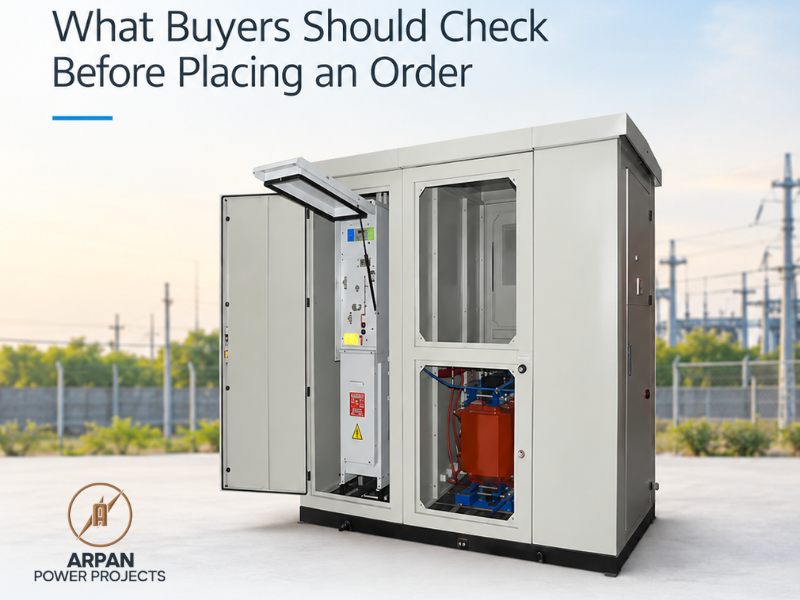
If you have ever waited months for civil work on a conventional substation to finish, you already understand why the compact substation has become so popular. A CSS compact substation packs the HV switchgear, the transformer and the LV panel into a single factory-tested unit. It reaches your site ready to connect.
Choosing the right CSS Compact Substation supplier in India matters more than most buyers expect, though. The unit itself is fairly standard. The difference is in the configuration, the quality of the components and the after-sales support behind it. This guide covers what to look for, based on what we see on real projects.
What Is a CSS Compact Substation?
A CSS (Compact Sub Station), also called a unitized or packaged substation, is a prefabricated power distribution unit. It has three sections in one enclosure:
- HV side: an RMU or a VCB with protection relays and metering
- Transformer: oil type or dry type, in a typical range of 100 kVA to 2500 kVA
- LV side: ACB or MCCB outgoing feeders, with optional APFC for power factor correction
Prefabricated substations are designed and tested to IEC 62271-202, so always ask your supplier for the type test reports.
Why Indian Projects Are Moving to Compact Substations
The main reasons are speed, footprint and safety. A CSS is assembled and tested in the factory, so on site you only connect the incoming and outgoing cables. That saves weeks compared to a brick-and-mortar substation.
You will see CSS units commonly used in:
- Industrial plants and manufacturing units in Gurugram, Noida, Pune and Ahmedabad
- Solar and wind farms
- Metro, railway and airport projects
- Commercial buildings, data centres and hospitals
- Real estate and township developments
Choosing the HV Side: RMU or VCB?
This is where most buyers get stuck, and it’s a good place to get expert advice.
RMU-based CSS works well for ring networks and utility-style distribution. It is compact, sealed and needs very little maintenance. For most city and township projects, an 11KV RMU is the natural choice. For higher-voltage networks, a 33KV RMU is used. If you are sourcing separately, see our guide to an 11KV RMU supplier in India and a 33KV RMU supplier in India.
VCB-based CSS suits projects with a higher fault level or where more advanced protection is needed. It lets you use relay-based protection and gives you more control over the settings. Depending on the site, this can be an 11KV indoor VCB or an 11KV outdoor VCB (available as a kiosk type or a panel), and for higher voltage, a 33KV indoor VCB or 33KV outdoor VCB.
A simple thumb rule: for small loads with a ring network, go with an RMU. For large industrial loads or captive power, use a VCB.
Oil Type or Dry Type Transformer?
The transformer is the heart of your substation, so choose it carefully.
- Oil type: better for outdoor installation, lower cost per kVA and high overload tolerance
- Dry type: preferred indoors, in buildings and in places with strict fire safety norms
Also decide on the tap changer, the vector group and the losses (energy efficiency level) early. These affect your running cost for the next 20 years.
7 Things to Check Before Choosing a CSS Compact Substation Supplier in India
- Component brands: ask for the make of the RMU/VCB, relays, transformer and LV breakers.
- Testing: routine tests should be done before dispatch, with reports provided.
- Customisation: the supplier should adjust the design to your load, not push a fixed model.
- Enclosure and IP rating: it should suit your climate, whether coastal, dusty or high heat.
- Utility approvals: check that the design meets your DISCOM’s requirements.
- Delivery timeline: ask for a realistic schedule, not just a promise.
- After-sales support: ask about commissioning support, spare availability and warranty terms.
Never compare quotes on kVA alone. Two 1000 kVA units can differ a lot in what is inside them.
How We Support Buyers at Arpan Power Projects
At Arpan Power Projects, we work as a supplier, channel partner and stockist for reputed Indian manufacturers of RMU, VCB, transformers and compact substations. That means one point of contact for the complete HV and LV package, whether you need a single unit or a multi-site rollout across Delhi NCR, Maharashtra, Gujarat or South India.
To get an accurate quote, keep these details ready:
- Transformer rating (kVA) and HV/LV voltage
- RMU or VCB preference, or your protection requirement
- Number of LV outgoing feeders
- Indoor or outdoor installation, and site location
- Any DISCOM or client specification
Frequently Asked Questions
What is the difference between a CSS and a normal substation?
A CSS is factory-built, tested and delivered as one unit. A conventional substation is built piece by piece on site.
What voltage classes are available?
Most compact substations in India are supplied for 11 kV and 33 kV systems.
Can a CSS be installed outdoors?
Yes, with the right enclosure and IP rating for your weather conditions.
How much maintenance does a CSS need?
Less than a conventional setup, but routine inspection of the switchgear, transformer and cable terminations is still important.
Do you supply across India?
Please confirm your coverage and delivery areas here before publishing.
Final Thoughts
A good CSS compact substation saves time, space and site risk, but only when the configuration is right. Take the time to compare specifications, not just prices, and pick a CSS Compact Substation supplier in India who answers your technical questions clearly.
Need a quote or technical help? Contact Arpan Power Projects with your load details, and our team will suggest the right RMU/VCB and transformer combination.