

Blog
CSS Compact Substation Supplier in Daryaganj: Size It Right Before You Squeeze It In

A publisher in Daryaganj once told us, half joking, that his building “runs on prayers and extension boards.” Three floors of printing machines, a new air-conditioning plant on the roof, and a transformer that was installed when computers were still a rumour. The question wasn’t really where to put a new substation. It was how big it should be, and whether it could be ready before the next festive printing season.
That is a very different problem from the one most guides describe. If you’re searching for a CSS Compact Substation Supplier in Daryaganj, you’ve probably already worked out that a built-up substation room is out of the question. What’s left is the part nobody explains well: sizing the load, matching the unit to what your building actually does all day, and planning the weeks between the purchase order and the day the lights stay on.
This guide covers exactly that.
What a compact substation actually gives you
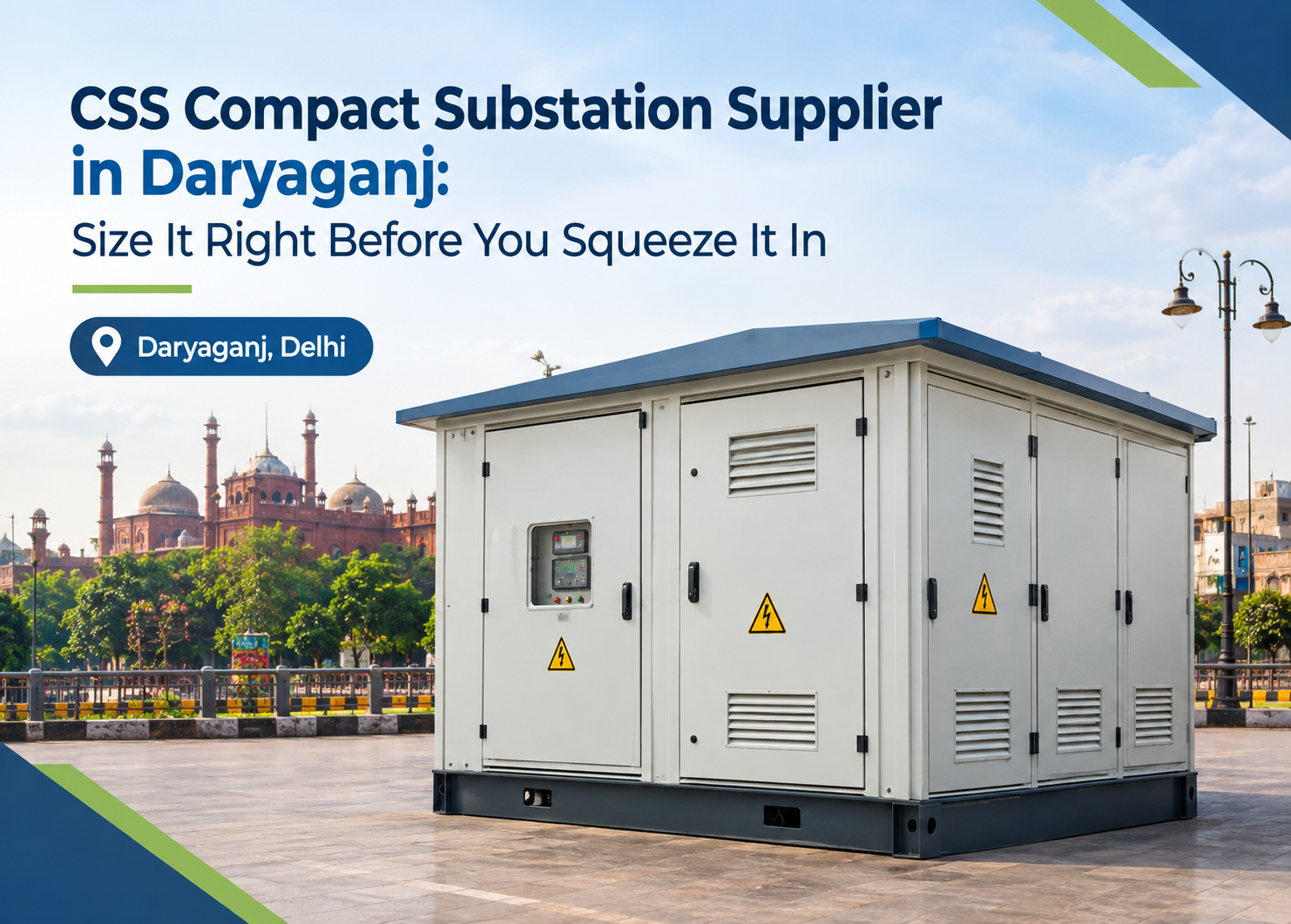
A compact substation (also called a packaged substation, prefabricated substation or unitized substation) puts three things inside one factory-built enclosure: the HV switchgear, the distribution transformer and the LV panel. It is assembled and tested at the workshop, then lifted onto a plinth at your site. Prefabricated HV/LV substations of this kind are covered by the IEC 62271-202 standard, so that is a good reference point when you read a supplier’s documents.
For a compact substation in Daryaganj, the real benefit isn’t just the smaller footprint. It’s that most of the work happens away from your lane. Less civil work, fewer trades on site, and less disturbance for the shops and offices next door.
Start with the load, not the box
Here’s the mistake we see most often. People begin by asking “what is the smallest unit that will fit?” It’s better to ask “what will this building draw in three years?”
Old Daryaganj buildings tend to grow their loads quietly. A floor gets converted to offices. Someone adds a lift. A server room appears on the second floor. None of it was in the original wiring, and the old transformer takes the strain until it doesn’t.
Before you talk to any supplier, do a basic load survey:
- Connected load by floor and by use (lighting, AC, lifts, machines, UPS)
- Maximum demand from your recent electricity bills, if you have them
- Planned additions over the next few years
- Critical loads that cannot go down (servers, medical equipment, cold storage)
Common transformer ratings for these units are 315, 500, 630, 1000 and 1600 kVA, though availability varies by manufacturer. Your electrical consultant should confirm the final kVA, because too small means overheating and trips, and too big means paying for capacity you may never use.
Your building’s personality decides the configuration
Two buildings with the same kVA can need very different units. In and around Daryaganj, we usually see three load types.
The motor-heavy printing or workshop building. Large motors draw a heavy surge when they start. Ask your supplier how the transformer and protection will handle starting currents, and whether power factor correction should be included on the LV side.
The hotel, guest house or office block. Here the load is peaky. Air conditioning, lifts and water pumps all kick in together on a hot afternoon. A transformer with sensible overload margin and good ventilation design matters more than squeezing the last few percent off the price.
The mixed-use or newly rebuilt building. Shops below, offices above, maybe a small hospital or clinic on one floor. This is where the HV side choice matters. An RMU-based arrangement is sealed and compact, which suits most commercial and residential loads. A VCB-based arrangement gives relay-based protection and adjustable settings, useful where fault levels are higher or the supply authority asks for it.
Oil type or dry type: the Daryaganj answer
If the unit sits inside a building, in a basement or under a staircase-side enclosure, dry type is the safer conversation to start with because of fire norms. If you have an open rear yard or a plot corner with proper clearance, an oil type transformer is often possible and tends to cost less per kVA.
In a market full of paper, packaging and stock, fire risk deserves a straight conversation. Whatever you choose, get it checked against your consultant’s specification and the fire requirements that apply to your building.
The neighbours test
This is the part that gets forgotten until the first complaint. In Old Delhi, your substation has neighbours on three sides, and some of them share a wall.
Before you finalise the position, ask these questions:
- Hum and heat. Transformers hum, and they give off heat. How far is the nearest occupied room, and where will the warm air go?
- Oil and drainage. If it’s an oil type, is there a proper containment arrangement? Where does water go during a heavy monsoon?
- Delivery window. Lane timings and vehicle restrictions mean the crane and truck may only get a short slot. Fix the unloading point and time with your supplier in advance, and check what local permissions apply for road occupation.
- Visibility and access. Can an operator reach the unit safely and quickly? Can the DISCOM’s team?
None of these is hard to solve on paper. All of them are painful to solve after the unit has arrived.
A realistic timeline from enquiry to energisation
People always ask “how long will it take?” The honest answer is that it depends on the rating, the configuration and the manufacturer’s schedule. What we can describe is the order of events, because that’s where delays hide.
| Stage | What happens | Common delay |
|---|---|---|
| 1. Load and site details | You share kVA, voltage, drawings and photos | Missing load data |
| 2. Site-fit check | Dimensions, clearances and delivery route reviewed | Route not measured |
| 3. Configuration freeze | Make list, test plan and document list agreed in writing | Changes after the order |
| 4. Manufacture and testing | Unit built and tested at the works | Late specification changes |
| 5. Plinth and cable work | Done while the unit is being built | Started too late |
| 6. Delivery, placement, commissioning | Crane, positioning, inspection, energising | Paperwork not ready |
The trick is running stages 4 and 5 side by side. If your plinth is ready when the unit arrives, you save weeks.
Approvals: who to speak to, and when
Daryaganj falls under BSES Yamuna Power Limited (BYPL), but please confirm this for your own address. Load sanction, metering arrangements and the electrical inspector’s approval before energisation all follow their own process, and requirements can vary from project to project. Fire clearance may also apply depending on the building.
The rule we repeat to every customer: start the DISCOM conversation before you place the order. Rules and forms change from time to time, so confirm the current requirements with the concerned offices rather than relying on an old checklist.
Why a supplier within reach matters here
A compact substation is not a one-time purchase. Sooner or later someone needs a site visit, a relay setting changed or a spare part in a hurry. If your supplier is a phone call and a drive away, those problems get solved quickly. If they are a dispatcher in another state, they wait.
Arpan Power Projects is a supplier, channel partner and stockist of compact substations, RMUs, VCBs and transformers. Our registered office is at Netaji Subhash Place, Pitampura, and our manufacturing unit is at Khera Kalan Industrial Area, Delhi. That keeps us practical distance from Central Delhi, including Daryaganj, Delhi Gate, Ajmeri Gate and Chandni Chowk.
We start with plain questions: what is the load, where will the unit stand, how will it reach the spot, and what protection do you want? Then we come back with a configuration, a make list for the main components and a test plan. We won’t always be the cheapest quote, but we aim for the one that still matches the product when it reaches your gate.
If you’d like to compare offers properly, our guide on why two compact substation quotes for the same kVA never match shows what to line up side by side. For an installation walk-through, see our site engineer’s installation checklist. And if your site is in North West Delhi instead, our local guide to a CSS compact substation supplier in Pitampura covers that area.
What to keep ready before you call
- Site address with a few photos of the intended spot
- Expected kVA and a rough load list
- HV and LV voltage (for example 11 kV / 415 V)
- Indoor or outdoor preference
- RMU-based or VCB-based HV side
- Oil type or dry type, as per your consultant
- Any DISCOM correspondence you already have
Send these through our contact page, or browse our CSS compact substation range first.
Frequently asked questions
How do I know what kVA I need for a compact substation in Daryaganj?
Start from your maximum demand and connected load, then add headroom for planned growth. Your electrical consultant should confirm the final rating.
Can a compact substation go inside an old building?
Sometimes, if ventilation, fire safety, drainage and access are all proper. Share photos and measurements first, because every building is different.
Is a compact substation better than a conventional substation?
For tight sites, usually yes, since it needs no separate built-up room and a lot of the work is done at the factory. You still need working clearance, cable entry space and safe access.
Do you supply outside Daryaganj?
Yes. We support enquiries across Delhi NCR and other parts of India.
Final word
The best CSS Compact Substation Supplier in Daryaganj is the one who asks about your load before talking about price, and who puts the answers in writing. Measure the lane, size the kVA honestly, start the paperwork early, and the unit itself will rarely be the problem.
Planning a project? Share your kVA, voltage and site address with Arpan Power Projects, and our team will suggest a configuration that fits your load and your site.