
Blog
11KV Outdoor VCB Kiosk Type Explained: What Is Actually Inside the Box You’re Paying For?

Imagine a purchase officer comparing two quotations. Both say “11KV Outdoor VCB Kiosk Type”. Both show the same voltage. One is noticeably cheaper, and nobody on the team can say why.
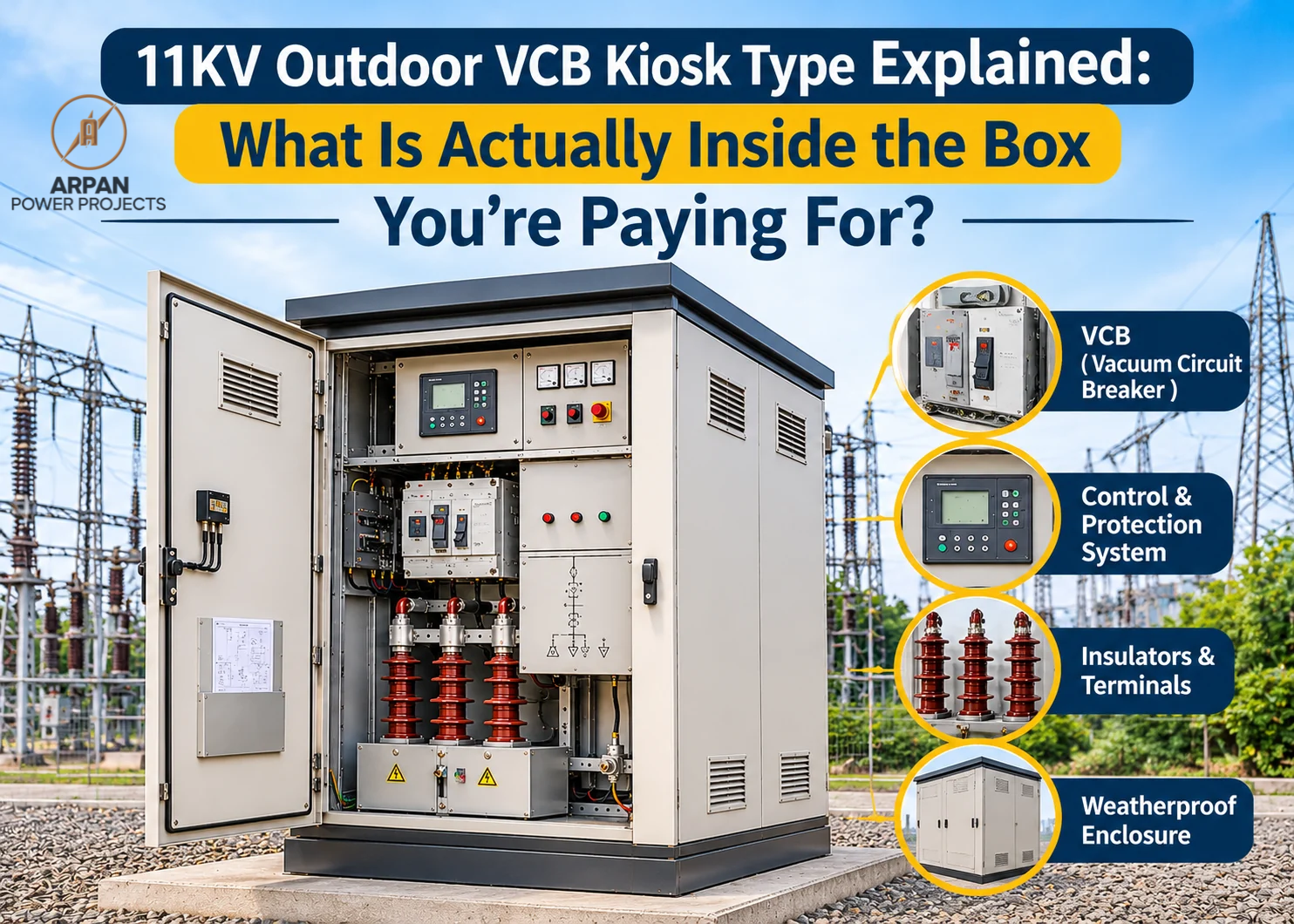
That is a fair question, because from the outside a kiosk looks like a grey metal enclosure on a concrete plinth. The real difference sits behind the door: the breaker, the relay, the metering, the wiring and the way they are all packed together.
This guide opens the box. By the end you will know:
- what a kiosk-type outdoor breaker actually contains
- how each part works, in plain language
- what to prepare before asking for a quotation
- which questions separate a dependable unit from a risky one
It is written for buyers, site engineers, consultants and contractors working on projects in Delhi NCR and across India.
What Is an 11KV Outdoor VCB Kiosk Type?
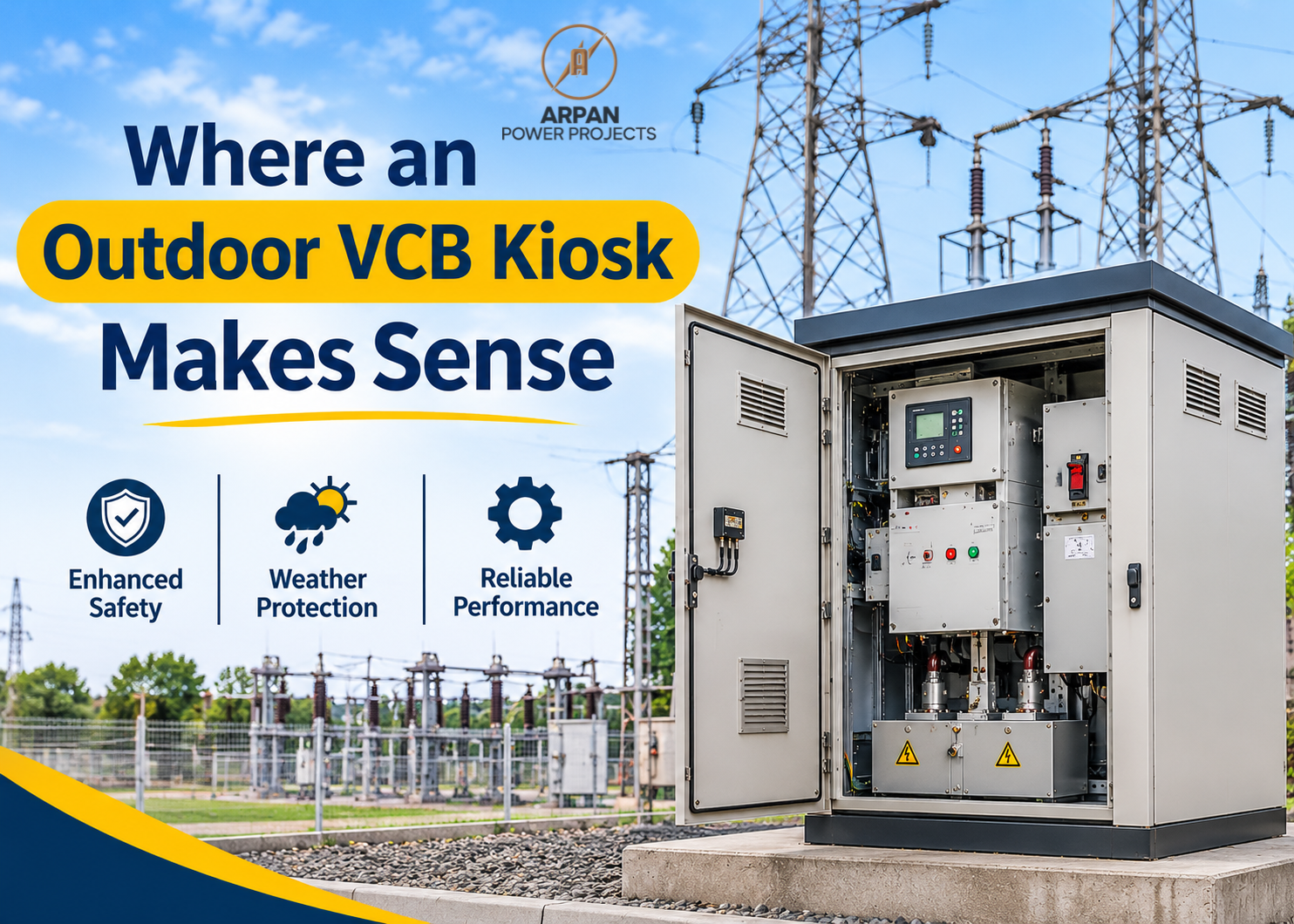
An 11KV Outdoor VCB Kiosk Type is a ready-built enclosure that houses a vacuum circuit breaker (VCB) together with its protection relay and metering. It is designed for outdoor use, so it does not need a separate switchgear room.
The assembly is built and tested at the factory and arrives at your site as one unit. That is the main reason people choose it. Less civil work and less on-site assembly generally mean a shorter route from delivery to commissioning.
Here is how the product is described on the manufacturer-facing product page:
- compact, weatherproof switching solution for outdoor power distribution
- vacuum interruption technology
- integrated protection relay and metering
- viewing window for visual inspection
- compact footprint, quick installation and commissioning
- low maintenance requirement
- customisable ratings and protection
- 11KV, with 33KV also available
Think of it as a small, self-contained switching station for one feeder: the breaker to open and close the circuit, the relay to decide when, the metering to show what is happening, and the enclosure to protect all of it.
A Quick Word on Why “Kiosk” Matters
The word “kiosk” tells you something about the design philosophy. In a conventional arrangement, you build a room, install a panel, bring cables in and finish the civil work around it. With a VCB kiosk, the “room” is already part of the product.
That changes three things for a buyer:
- Where it can go. It can sit closer to the load or the incoming line, in the open.
- How long site work takes. More of the work is done in the factory under controlled conditions.
- What you must check. Since the enclosure is part of the equipment, its build quality matters as much as the breaker inside.
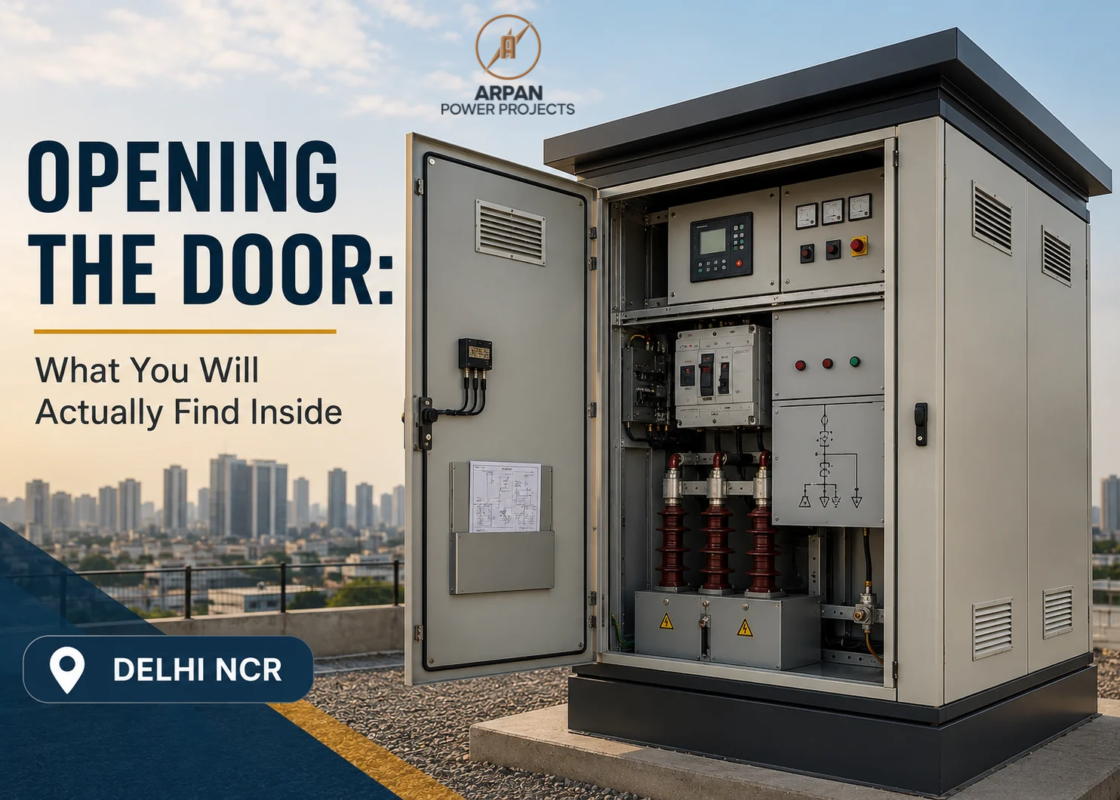
Opening the Door: What You Will Actually Find Inside
1. The weatherproof enclosure
The metal enclosure is the part everyone sees and the part people judge least. Its job is simple: keep dust, rain and heat away from the breaker and the relay, because that equipment has to work reliably for years.
Things worth checking:
- Do the doors close firmly and seal properly?
- Is there a sensible arrangement for heat to escape without letting rain or insects in?
- Can an operator open it safely and still read the instruments?
- Is the finish suitable for open-air exposure?
- Are the cable entry points planned, or left as an afterthought?
A kiosk that gives trouble in the field often does so because of the enclosure, not the breaker. A door that does not seal today becomes a damp relay next monsoon.
2. The vacuum circuit breaker
This is the working heart of the kiosk. When a fault occurs, the breaker has to open the circuit quickly and extinguish the arc.
Inside a VCB, the contacts sit inside a sealed vacuum interrupter. When the contacts separate, the arc that forms has very little to sustain it, and it dies out quickly at the natural current zero. The sealed design is the reason vacuum breakers are widely known for dependable fault clearing with modest maintenance.
You do not need to memorise the physics. What matters for a buyer is this: the breaker must be rated for your voltage, your load current and, most importantly, your fault level.
3. The operating mechanism
The breaker needs stored energy to open and close its contacts. In medium-voltage breakers this is usually handled by a mechanism that is charged either by a motor or by hand. The exact type varies by design, so ask your supplier what mechanism is fitted and how it is charged and operated.
Why this matters on a kiosk: the unit is outdoors and may be at a remote corner of the site. You want to know how it behaves if the auxiliary supply is unavailable, and what the operator can do in that situation.
4. The protection relay
The breaker does not decide when to trip. The relay does. It continuously watches the current, and when a reading crosses its setting for long enough, it sends a trip command to the breaker.
This is why the relay deserves as much attention as the breaker itself. A perfect breaker with wrong relay settings will either trip when it should not, or fail to trip when it should.
Common protection functions on an 11KV feeder include overcurrent and earth fault protection, but the actual scheme depends on your network and what your utility or consultant requires. Ask your supplier what protection the kiosk is configured with, and agree the settings with whoever manages the upstream system.
5. Current and voltage measurement
For the relay and the meters to “see” the network, the kiosk uses instrument transformers. A current transformer (CT) scales the line current down to a small, measurable value. A voltage transformer (VT or PT), where fitted, does the same for voltage.
The accuracy and ratio of these devices affect both protection and metering. If a CT ratio is wrong for your load, the relay’s readings will be wrong too, and every setting built on them goes with it. So confirm CT ratios against your actual load and fault level, not against a default.
6. Metering and indication
Metering gives operators a clear picture of what the feeder is doing. Without it, you are guessing at loading and unable to spot a problem until it trips.
The product page lists integrated protection and metering as part of the standard description. The exact meters, display and functions should be confirmed against your requirement, particularly if you need metering for billing or energy monitoring.
7. The viewing window
A small feature that earns its place. A viewing window lets staff check the state of the equipment without opening the enclosure. For routine rounds, that means a quick, safer look instead of a full inspection each time.
8. Wiring, terminals and earthing
The least glamorous part of the kiosk and one of the most important. Neat, well-labelled control wiring makes commissioning and fault-finding faster. A solid earthing arrangement protects people and equipment.
Open the door at your factory inspection, or ask for photographs, and look at the wiring. Tidy work inside usually reflects tidy work everywhere else.
How the Whole System Works Together
Here is the sequence, in plain steps:
- Current flows through the kiosk to the load.
- The CT measures it and feeds the relay.
- The relay compares what it sees with its settings.
- If a fault pushes the current beyond the setting for long enough, the relay sends a trip signal.
- The breaker’s mechanism opens the contacts inside the vacuum interrupter.
- The arc is extinguished, the fault is isolated, and the rest of the network is protected.
- Operators read the indication, investigate the cause and re-energise once it is safe.
Every step depends on the one before it. A weak link anywhere, whether a loose CT connection, a wrong setting or a worn mechanism, can break the chain.
Why Vacuum Technology Suits an Outdoor Kiosk
Outdoor equipment cannot be babysat. Nobody wants a maintenance team opening a kiosk every few weeks.
A sealed vacuum interrupter suits that reality. It is closed off from dust and moisture, and fault clearing does not depend on oil or gas that needs topping up. That is why vacuum circuit breaker designs are widely used in medium-voltage outdoor installations and why the product page highlights low maintenance and long service life.
It also helps with safety. Because the arc is contained and extinguished inside the interrupter, the design avoids the open-arc behaviour associated with older breaker types.
Where an Outdoor VCB Kiosk Makes Sense
According to the product page, the kiosk suits a wide range of outdoor medium-voltage applications:
- Industrial plants and factories, where a feeder needs protection close to the load
- Solar and wind power projects, where equipment is spread across open land
- Substations and utility distribution networks
- Infrastructure, commercial and construction projects
- Complete power packages, used alongside compact substation solutions
The common thread is a site where building a dedicated switchgear room is slow, costly or simply impractical, and where a compact, factory-tested unit is an easier fit.
It is not the right answer for every site. If you already have a proper switch room and plan to install several panels in a lineup, an indoor arrangement may be more natural. A good supplier will tell you that honestly rather than push a kiosk on you.
Reading the Specification Without Getting Lost
The product page lists the core specification:
- Rated voltage: 11KV (33KV also available)
- Breaker type: vacuum circuit breaker
- Installation: outdoor kiosk type
- Protection: integrated protection relay and metering
- Rated current: as per project requirement
- Breaking capacity: as per project requirement
That last pair matters. “As per project requirement” means those two numbers are yours to define, and no supplier can guess them. Before you ask for a quotation, gather the following.
Voltage level. 11KV, or 33KV if your network needs it.
Load current. What the feeder will carry today, with sensible room for growth. Do not size only for the present.
Fault level. The short-circuit level at your connection point. This usually decides the breaker’s breaking capacity, and your utility or consultant can help you get the figure.
Protection requirement. What your network and utility expect the relay to do, including any specific schemes.
Metering requirement. Whether you only need local indication or also need metering for billing and monitoring.
Site details. Where the kiosk goes, how cables will arrive, what the ground looks like and how a crane or truck can reach it.
Share these, and the quotation you receive will be about your project rather than a generic one.
Site Preparation: What Happens Before the Kiosk Arrives
A factory-built unit still needs a site that is ready for it. The kiosk may be compact, but the preparation is not trivial.
A proper base. The kiosk needs a stable, level foundation designed for its weight and for cable entry. Ask your supplier for the base and cable-entry details early, so civil work can be finished before the unit arrives.
Cable route. Decide how incoming and outgoing cables will reach the kiosk, and make sure the route is clear and the cable size is known.
Earthing. A sound earthing system is essential. Plan it as part of the site work, not as a last-minute addition.
Access. Think about how the unit will be lifted and positioned, and how operators and maintenance staff will reach it afterwards. Leave enough working space around the doors.
Safety and security. Consider fencing, signage and protection from vehicles or accidental contact, according to your site rules.
A walk around the location with your contractor, before the order is placed, will save more time than any other single step.
Commissioning: Making Sure It Works Before It Goes Live
Because the unit is tested at the factory, commissioning on site is mostly about confirming that nothing was disturbed in transit and that everything is connected correctly.
Typical commissioning checks include:
- visual inspection for transport damage
- checking that cable terminations are correct and tight
- verifying earthing connections
- confirming relay settings against the agreed protection scheme
- checking CT and meter connections
- operating the breaker manually and electrically, where applicable
- confirming indications and alarms behave correctly
- following your utility’s or consultant’s requirements before energising
Exact procedures depend on the project and on your utility, so treat this list as a starting point and follow the documented process for your site.
Maintenance: Low Does Not Mean Zero
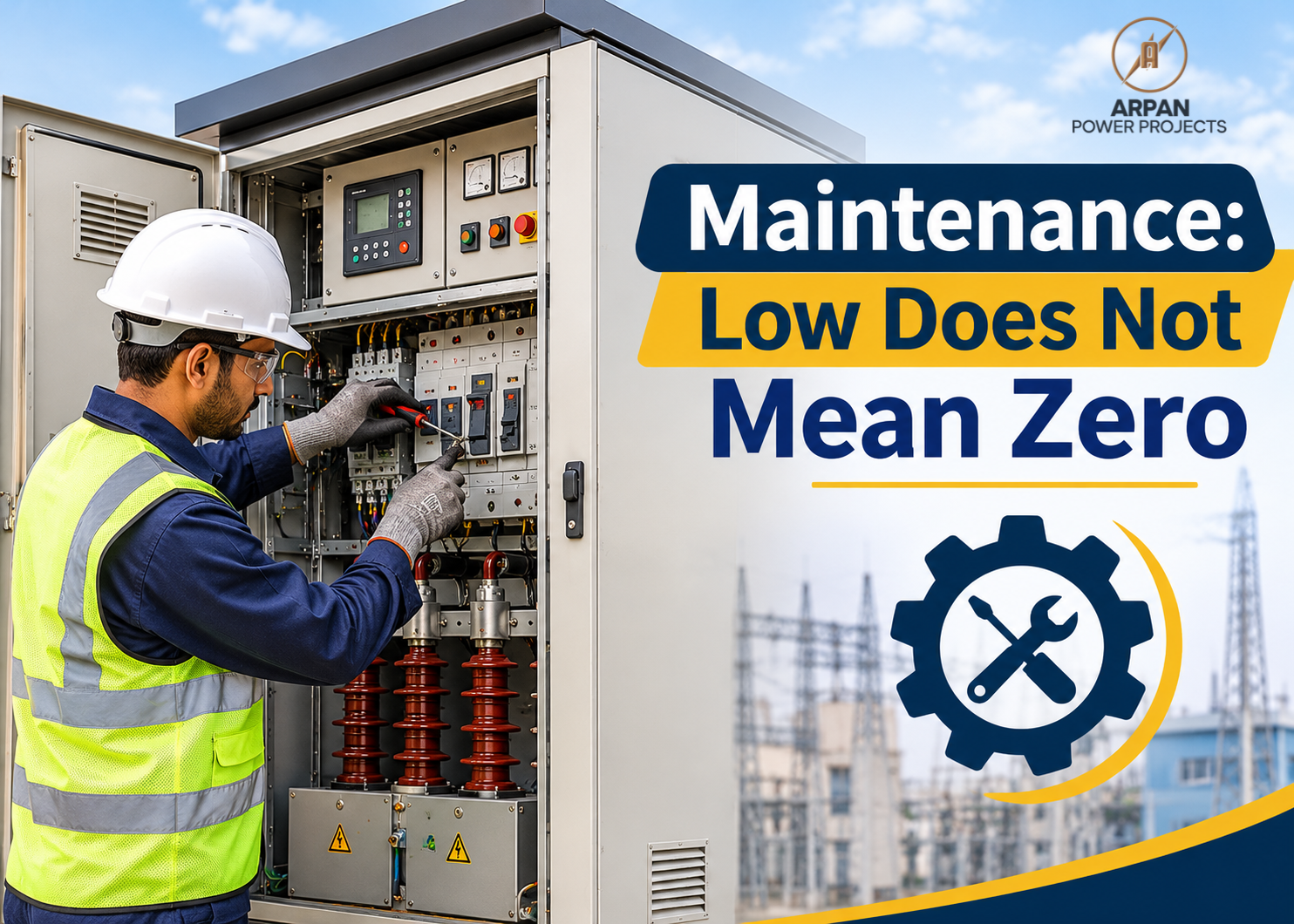
The product page describes a low maintenance requirement, which is a genuine advantage of vacuum technology. But “low” is not “none”, and outdoor equipment deserves a routine.
A sensible approach includes:
- Regular visual rounds. Use the viewing window and instruments to check for anything unusual.
- Enclosure check. Look at door seals, vents, hinges and the general condition of the finish.
- Cleanliness. Keep the area around the kiosk free of debris and vegetation.
- Periodic testing. Have the breaker, relay and protection tested by qualified people at intervals recommended by the supplier and your own policy.
- Record keeping. Log relay settings, test results and any operations or trips. A simple record becomes very valuable when something goes wrong.
Only qualified, authorised personnel should open or work on HT equipment. Follow your safety procedures and the supplier’s instructions.
Delhi NCR Conditions Worth Keeping in Mind
Outdoor equipment in Delhi NCR sees a wide range of weather through the year: strong summer heat, monsoon rain and humidity, and dusty or foggy conditions at other times. You do not need exact numbers to plan sensibly, just awareness that the enclosure will be tested by all of it.
That is one more reason to ask about the enclosure’s finish, sealing and ventilation, and to confirm that the unit is configured for your site conditions. A kiosk that looks fine in a workshop must still cope with an open yard.
Common Mistakes Buyers Make
Choosing by voltage alone. “11KV” tells you very little. Current rating, fault level and protection all shape the right unit.
Ignoring the relay. Many buyers spend an hour on the enclosure and two minutes on protection. It should be the other way round.
Not sharing the fault level. Without it, the breaker’s breaking capacity is a guess.
Forgetting the people. Someone will operate this kiosk. Make sure they can read the instruments, understand the indications and know whom to call.
Skipping the site check. Even a compact kiosk needs a proper base, cable route and access for lifting and servicing.
Comparing quotations line by line without comparing contents. Two kiosks with the same headline voltage can contain very different equipment.
A Simple Checklist for Your Request for Quotation
When you contact a supplier, include as much of this as you can:
- Voltage: 11KV or 33KV
- Rated current
- Fault level or short-circuit rating needed
- Protection requirement and any utility specifications
- Metering and indication requirement
- Application: industrial, solar, utility, infrastructure and so on
- Site location and access
- Cable size and entry direction
- Any special conditions, such as heavy dust or coastal air
- Required delivery location and timing
A complete enquiry gets a faster and more accurate reply, and it shows the supplier you know what you are buying.
Why Buyers in Delhi NCR Talk to Arpan Power Projects
Arpan Power Projects supplies HT switchgear with dependable technical support and a strong focus on quality. The team helps you select the right rating, protection scheme and enclosure for your site, and supports you from enquiry to commissioning.
The registered office is at Netaji Subhash Place, Pitampura, New Delhi, and the company serves customers across India, including Delhi NCR. If you are comparing options, you can also browse the HT Panel / VCB range, which covers related breakers and panels for different installation needs.

Quick Glossary
VCB (vacuum circuit breaker): a breaker that interrupts current inside a sealed vacuum interrupter.
Kiosk: a ready-built outdoor enclosure that houses the breaker and its associated equipment.
Relay: the device that detects a fault and tells the breaker to trip.
CT (current transformer): scales line current to a level that relays and meters can read.
VT or PT (voltage transformer): does the same for voltage.
Fault level: the maximum short-circuit current the network can deliver at a point.
Breaking capacity: the highest fault current a breaker can safely interrupt.
Frequently Asked Questions
What is an 11KV Outdoor VCB Kiosk Type used for?
It is used to switch, protect and isolate 11KV outdoor electrical networks in places such as substations, industrial plants, solar projects and utility distribution systems.
Does it need a separate switchgear room?
No. The breaker, relay and metering sit inside one weatherproof enclosure, so it can be installed outdoors without a dedicated room.
Is a 33KV version available?
Yes. The kiosk is also available for 33KV systems. Share your requirement for a customised quotation.
Can the ratings and protection be customised?
Yes. Ratings, protection relay and metering can be configured to match your project requirements.
What information do I need to share to get a quotation?
Your voltage, current, fault level, protection requirement and site details. The more complete this is, the more accurate the quotation.
Why is a vacuum breaker preferred for outdoor use?
The vacuum interrupter is sealed, so it is protected from dust and moisture, and it generally needs little maintenance compared with older designs.
Does a kiosk need maintenance?
Low maintenance is not zero maintenance. Regular visual checks, enclosure inspection, record keeping and periodic testing by qualified people are all sensible.
Can I install an outdoor kiosk myself?
Installation and commissioning of HT equipment should be done by qualified, authorised personnel following your utility’s and consultant’s requirements.
Final Thoughts
A kiosk looks simple from outside and is anything but inside. The breaker, the relay, the instrument transformers, the metering, the wiring and the enclosure all have to work as one system, and it pays to understand each part before you sign.
If you are planning an 11KV Outdoor VCB Kiosk Type for a site in Delhi NCR, click the Request Quotation button on the product page, or call Arpan Power Projects on +91 98688 64101. Share your voltage, current, fault level and site details, and the team can guide you from there.