

Blog
33KV Outdoor VCB in Daryaganj: Can an Open-Yard Breaker Really Fit on a Plot This Tight?

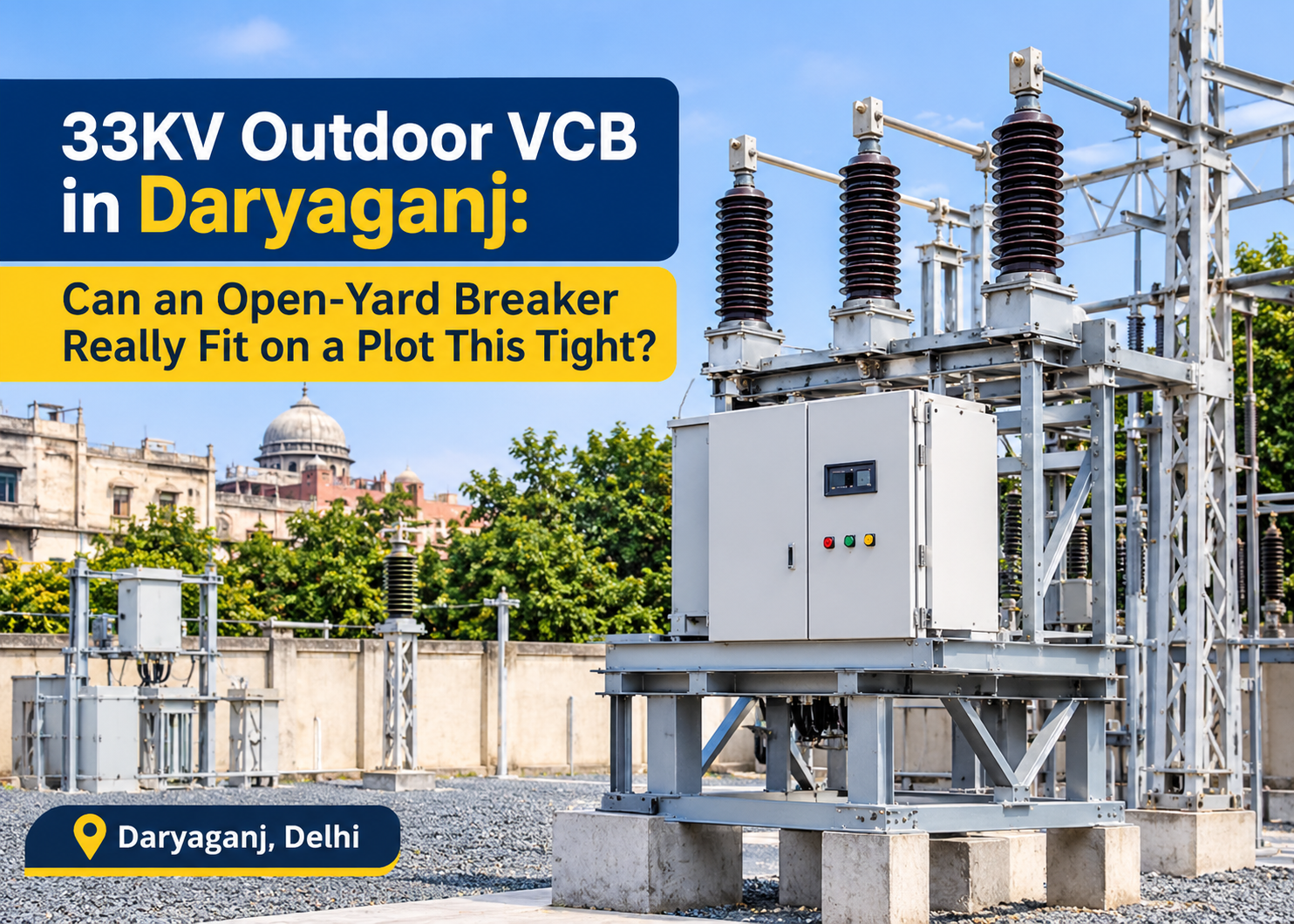
Here is a scene that plays out in Old Delhi more often than anyone admits. A consultant’s drawing shows a neat outdoor bay for a 33KV Outdoor VCB in Daryaganj. The “yard” on paper looks generous. Then someone walks the site with a measuring tape and finds a shared courtyard, a staircase on one side, a neighbour’s wall on the other and a drain line right where the plinth was supposed to go.
Nobody did anything wrong. Drawings just don’t argue back. Space does.
If you are planning a 33kV outdoor vacuum circuit breaker in this part of Delhi, the breaker itself is rarely the hard part. The hard part is deciding whether your plot can host it safely, and whether you can reach it, maintain it and switch it a few years from now. This guide walks through that decision the way we usually talk it through with buyers.
Why Anyone Chooses Outdoor in a Dense Area
An outdoor breaker saves you from building a dedicated switch room. There is no panel lineup to house, no room ventilation to design and no roof to carry. For a plot that already has some open ground, that is a real saving in time and civil cost.
A 33KV outdoor VCB also makes sense when the incoming supply arrives overhead or through a nearby termination point, and the breaker sits close to it as the first point of control. That is a typical layout for institutions, large commercial campuses and industrial users.
The catch in Daryaganj is that open ground is rare, shared and often disputed. So the question is not “indoor or outdoor?” in the abstract. It is “do I have enough clear, usable, legally mine space to go outdoors?”
The Three Tests We Run Before Recommending Outdoor
1. The space test
A 33kV installation is not just the breaker. Around it you need an isolator, current and voltage transformers, a lightning arrester, cable termination, earthing connections and a fenced working area with safe walking space.
Air clearances at this voltage are set by the applicable safety regulations and your utility’s requirements. Please don’t treat any number you read online, including ours, as final. Your electrical consultant or the electrical inspector will confirm the exact distances for your layout. What we can tell you from experience is that buyers underestimate three things:
- The gap between the live parts and the boundary wall
- The working space needed to operate and maintain the breaker without standing under or next to live equipment
- The space for earthing pits and cable trenches, which usually show up late in the drawing
2. The maintenance test
A vacuum breaker is low-maintenance, but low is not zero. Someone will need to inspect the operating mechanism, check the control cabinet, test the relay and clean insulators. Ask yourself a plain question: if this breaker needs attention at 6 in the evening, can a technician reach it, stand safely and work without a crane or a neighbour’s permission?
In lanes around Netaji Subhash Marg and Ansari Road, even a basic tool trolley can become a negotiation. If maintenance access is awkward on day one, it will be worse in year ten.
3. The approvals test
Outdoor 33kV equipment has to satisfy your distribution utility, the electrical inspector where applicable and, depending on the building, local authority conditions. Start this conversation early. A breaker that is perfectly specified but cannot be energised is just an expensive object sitting on a plinth.
Outdoor vs Indoor on a Tight Plot: A Quick Comparison
| Question | Outdoor VCB | Indoor VCB panel |
|---|---|---|
| Needs a built switch room | No | Yes |
| Needs open, fenced ground | Yes, more than most expect | Much less |
| Exposure to weather and dust | Higher, needs a good enclosure and IP-rated control box | Protected inside the room |
| Civil work | Plinth, fencing, trenches | Room, flooring, ventilation |
| Best when | There is a real open yard | Space is scarce and a room can be carved out |
Be honest with yourself here. If your only available space is a corner of a covered building, an indoor panel may be the better answer, even though the outdoor breaker looked cheaper on a spreadsheet. We have a separate guide for that situation on 33KV Indoor VCB Supplier in Daryaganj.
What to Specify So the Breaker Matches the Site
Once outdoor is confirmed, keep the specification simple and specific. At minimum, write down:
- Voltage class: a 33kV system normally calls for a 36kV rated breaker
- Rated current and short-circuit breaking capacity: commonly 1250 A and 25 kA or 31.5 kA for 3 seconds, but match this to your actual fault level and utility advice
- Insulation level and creepage: Delhi air carries dust and moisture, so ask what the insulators are designed for
- Operating mechanism and control supply: spring-charged is common, and the auxiliary supply should be defined upfront
- Protection: over-current and earth-fault relay settings should be coordinated with the utility, not guessed
- Enclosure rating of the control cabinet, so rain and dust don’t end up inside it
If you want a look at how we describe the product itself, see our 33KV Outdoor VCB page.
Delivery to Daryaganj: Plan the Last Stretch
Arpan Power Projects is registered at Netaji Subhash Place, Pitampura, and our manufacturing unit is at Khera Kalan Industrial Area in Delhi. That puts dispatch to Central and Old Delhi within a manageable distance, but the final few hundred metres are always the unpredictable part. Narrow lanes, market-day crowds and time-restricted vehicle entry can all change the delivery plan.
Our usual advice is to confirm the unloading point, the lifting arrangement and the delivery window before the vehicle is even loaded. It saves the kind of phone calls nobody enjoys.
A Short Pre-Order Checklist
Before you place an order for a 33KV outdoor VCB in Daryaganj, check that you have:
- A measured site drawing with boundary walls, adjacent structures and trench routes
- Clearance confirmation from your consultant against the applicable regulations
- A defined maintenance path with enough standing and working space
- The utility’s technical requirements and relay coordination details
- A delivery and lifting plan for the last stretch
- Test reports and routine test documentation requested in your purchase order
Frequently Asked Questions
Can a 33KV outdoor VCB be installed in a small commercial plot in Daryaganj?
Sometimes, but only if the plot has enough open, fenced space for the breaker, its associated equipment, safe clearances and a maintenance path. If it doesn’t, an indoor panel in a small switch room is usually safer.
Is outdoor VCB more affordable than an indoor panel?
It can save on building a switch room, but fencing, plinth, earthing and trench work add cost. Compare the full installed cost, not just the equipment price.
Who decides the final clearances?
No. The arc is interrupted inside a sealed vacuum interrupter, so there is no oil to handle or top up, which is one reason maintenance is lighter than with older breaker types.
Who decides the final clearances?
The applicable safety regulations, your utility and the electrical inspector. Your consultant applies them to your layout. A supplier’s catalogue should never be the final word.
Talk to Someone Before You Commit
If you are still deciding between outdoor and indoor for a Daryaganj site, send us your plot layout, fault level and incoming supply details. The team at Arpan Power Projects will tell you plainly whether outdoor makes sense, or whether you should look at another option. Call +91 98688 64101 or use the contact page, and we will help you sort the specification before you spend on the wrong equipment.