

Blog
11KV RMU Supplier in Daryaganj: Fuse or Vacuum Breaker? The Protection Choice Hiding Behind Your Ring Main Unit

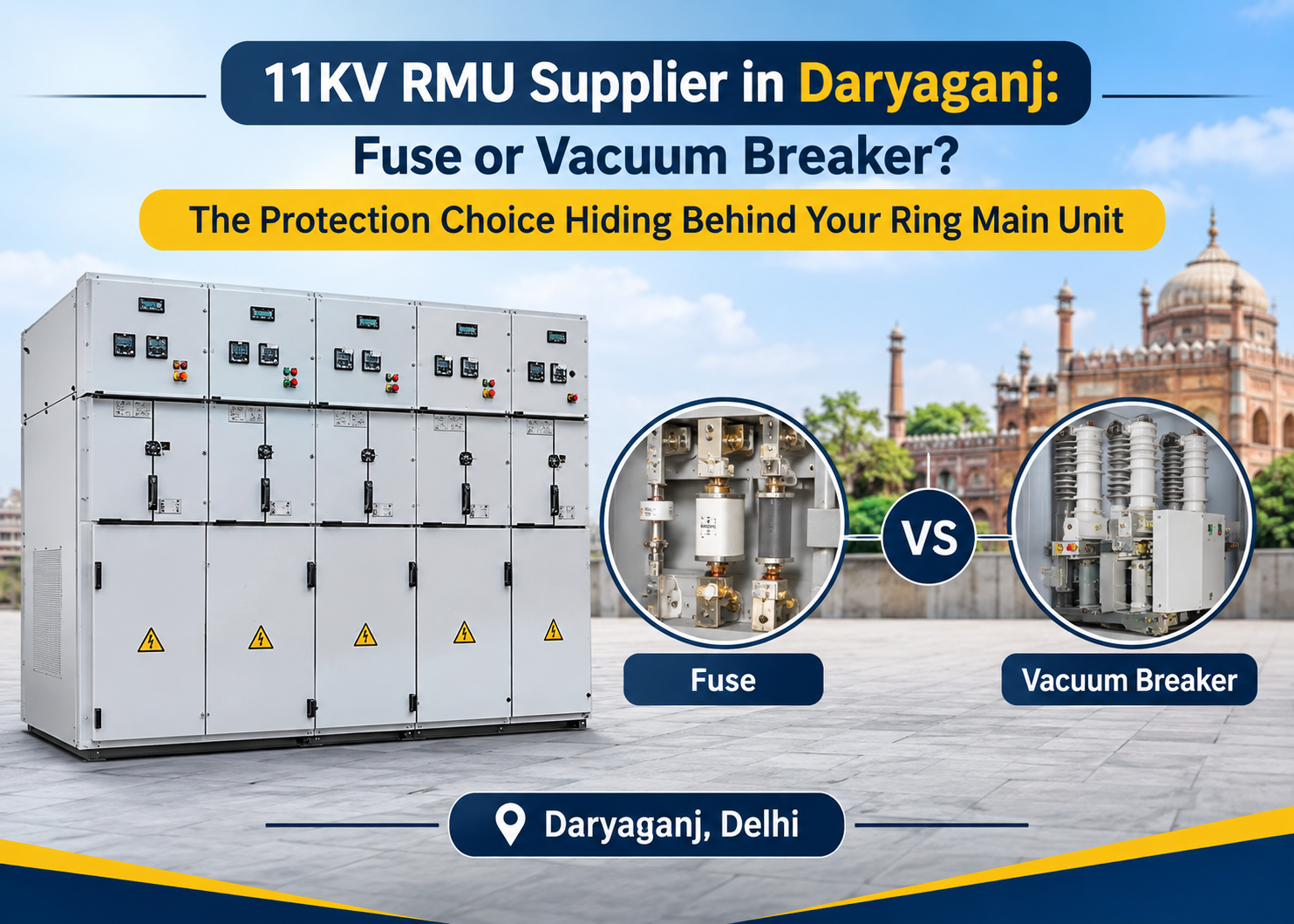
A typical 11kV ring main unit packs three jobs into one compact box. Two panels sit in the ring and pass power along. The third panel feeds your transformer. If you want the ring idea explained properly, our article on what happens to a building when one cable in the ring fails walks through it.
The two ring panels are usually load break switches. They are built to switch current, not to clear a fault. The transformer panel is where protection lives, and it comes in two flavours. On a quotation you will see them abbreviated:
- CCF: two cable switches plus a fuse switch for the transformer.
- CCV: two cable switches plus a vacuum circuit breaker with a protection relay.
So when one supplier quotes CCF and another quotes CCV for the same transformer, they are not quoting the same thing. A good part of the price gap starts right here.
The fuse switch: compact, simple and honest about its limits
In a fuse switch, HRC (high rupturing capacity) fuses do the fault clearing. When one blows, a striker pin trips the switch so all three phases open together. That matters, because a transformer left running on two phases is a problem of its own. Fuses are quick on heavy short circuits, the panel is compact, and the upfront cost is lower.
It suits smaller transformers and simple loads. The trade-offs are real, though:
- A fuse works once. After it operates, someone has to fit a new one of the same type and rating.
- The protection curve is fixed by the fuse you picked. You can’t fine-tune it for earth faults.
- Low-level overloads are not what fuses are good at, so other protection has to cover that.
- Remote visibility is limited, and the available fuse ratings cap the size of transformer it can serve.
Great when matched to the job. Awkward when pushed past it.
The vacuum breaker panel: more control, more cost
A vacuum circuit breaker panel adds current transformers and a protection relay. The relay watches the current and trips the breaker on overcurrent or earth fault, at settings you can adjust. Once the cause is found and fixed, the breaker is closed again. No fuses to hunt for. Remote trip, event records and SCADA connection are usually available as options.
The cost isn’t only the higher price. The relay needs a dependable auxiliary supply, or a self-powered scheme. Its settings have to be coordinated with the upstream network, and it needs periodic testing. And a breaker that can be closed again also means someone can close it again onto a fault, so your operating procedure should say who may do that and what must be checked first.
Settings matter as much as the hardware. We explained this for outdoor equipment in why relay settings matter as much as the breaker itself, and the same logic applies here.
Fuse switch vs vacuum breaker at a glance
| What you are comparing | Fuse switch (CCF) | Vacuum breaker with relay (CCV) |
|---|---|---|
| Upfront cost | Lower | Higher |
| After a fault | Replace the fuses, then restore supply | Find the cause, then close the breaker again |
| Protection settings | Fixed by the fuse you choose | Adjustable overcurrent and earth fault |
| Remote trip and monitoring | Limited | Usually available, SCADA-ready options |
| Best suited to | Smaller transformers, simple loads | Larger transformers, critical loads, planned growth |
| What needs looking after | Fuse stock, striker, mechanism | Relay testing, auxiliary supply, mechanism |
Which one suits a Daryaganj building?
There’s no universal rule, but a few patterns keep showing up.
A small office, showroom or publishing house with one modest transformer. A fuse switch is often enough, provided the right spare fuses live on site and someone knows who to call. Don’t pay for features you’ll never use.
A hotel, clinic or any building where a few hours of outage costs real money. Lean towards the breaker. Adjustable protection, event information and restoring supply without a hunt for fuses are worth the extra.
A building that is going to grow. Another floor, a new lift bank or a server room on the roadmap? Think five years ahead. Changing the protection design later often means a shutdown and new equipment, and an HT room is no place for jugaad.
One more check before you decide. Your consultant and the distribution company may specify what they accept at your connection. Daryaganj is served by BSES Yamuna Power Limited, so confirm their current requirements before you freeze the specification, not after the unit reaches the lane. The final protection scheme should always be approved by your electrical consultant.
Five questions to put to any 11KV RMU supplier in Daryaganj
- “Which protection do you recommend for my transformer, and why?” A supplier who answers before asking your kVA rating is guessing.
- “What are the fuse make and rating, or the relay make and settings?” For fuses, ask where spares can be bought. For a relay, ask who sets it and who tests it.
- “Can I see type test reports and the routine test certificate?” Look for compliance with IEC 62271-200 or its Indian counterpart, IS 3427, for metal-enclosed switchgear. A certificate for the exact unit you are buying is worth more than a brochure.
- “What is included in the price?” Cable end boxes, interlocks, earth switch, padlock provision and labels sometimes sit quietly in the extras column.
- “Who will brief our operators at handover?” The best panel in the world is only as safe as the person standing in front of it.
How we look at it at Arpan Power Projects
At Arpan Power Projects, we ask for the transformer kVA, the system fault level and the number of feeders before suggesting a configuration. Sometimes the right answer is the simpler fuse switch. Sometimes it’s a breaker. We would rather tell you that before the order than discover it at commissioning.
Our registered office is at Netaji Subhash Place, Pitampura, and our manufacturing unit is at Khera Kalan Industrial Area. For an RMU supplier in Delhi serving Daryaganj, Ansari Road, Chandni Chowk or Delhi Gate, that keeps the team within reach when a drawing needs discussing or a unit needs a look.
You can see the available configurations on our 11KV RMU page. If you’d rather have the transformer, ring switching and LV panel arrive as one package, our note on sizing a compact substation for Daryaganj is worth a read. And if you aren’t sure the ring should be 11kV at all, this comparison of 33kV and 11kV helps settle that first.
Frequently asked questions
Is a fuse switch or a vacuum circuit breaker better for an 11KV RMU?
Neither wins everywhere. A fuse switch is the leaner choice for smaller transformers and simple loads. A vacuum circuit breaker with a relay is the better pick when downtime is expensive, the transformer is larger, or you want adjustable protection and remote operation.
Can I switch from a fuse switch to a breaker later?
Often not as a simple swap. Many compact RMUs are built as sealed blocks, so changing the transformer feeder type can mean a new unit. Ask whether the model is extensible, and decide on protection now rather than later.
Do I need SCADA or remote operation on a single-building RMU?
Not always. If you manage several sites, or your distribution company asks for it, specify motor operators and SCADA-ready options at the order stage, because adding them afterwards is harder.
Can I send site photos and a single-line diagram for a first opinion?
Yes. Photos of the room, the transformer kVA, the voltage level and the feeder count are enough for Arpan Power Projects to start a recommendation, and a site check can confirm the rest.
Final word
The best 11KV RMU Supplier in Daryaganj isn’t the one with the lowest number on page one of the quote. It’s the one who asks about your transformer, your load and your downtime before talking about price. Share your requirement through our contact page or call +91 98688 64101, and Arpan Power Projects will come back with a recommendation built around your site.