

Blog
11KV RMU Supplier in South Delhi: What Actually Happens to Your Building When One Cable Fails?

Picture a housing society in Vasant Kunj on a hot June night. A contractor digging for a drain nicks a buried cable two lanes away, and the feeder trips. Whether your lights are back in ten minutes or ten hours depends on a grey metal box most residents have never noticed. It’s the ring main unit.
That’s why choosing an 11KV RMU supplier in South Delhi matters more than the number at the bottom of a quotation. A bad choice does not show up on day one. It shows up on the night the cable fails.
What a ring main unit does, in plain words
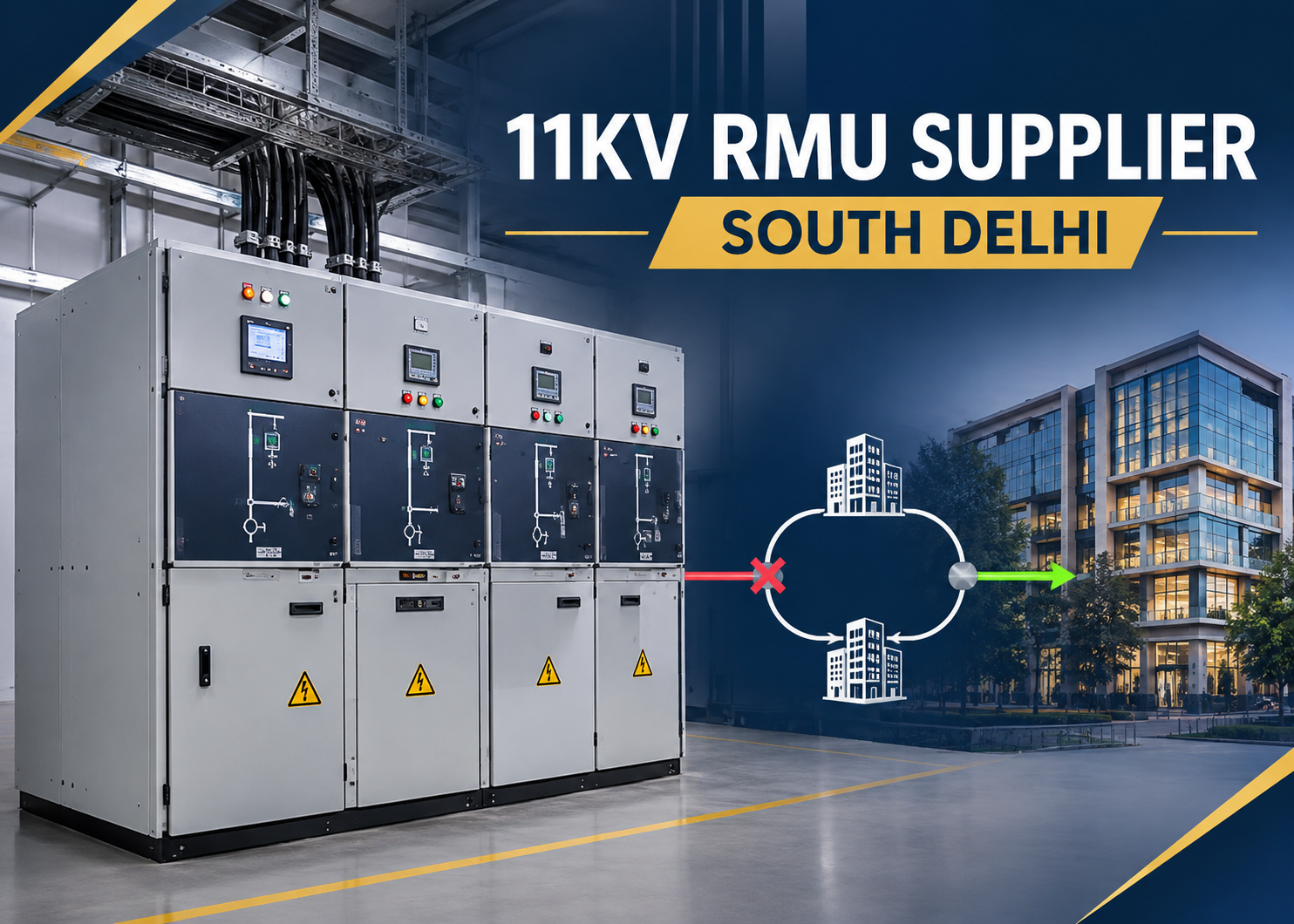
A ring main unit (RMU) is compact switchgear that sits on an 11kV cable network and does two jobs. It lets you isolate or reroute a section of cable, and it feeds and protects the transformer that steps power down for your building.
The “ring” is the useful part. Instead of one cable running to you and stopping, power can reach your RMU from either direction. If the cable on one side is damaged, the faulty section is switched out and supply comes back through the other side. Without a ring you wait for the repair crew. With one, you mostly wait for someone to operate a switch.
Most modern units are the SF6 ring main unit type. The live parts sit inside a sealed gas-filled tank, which makes the unit compact and generally less bothered by damp and dust than open air-insulated gear. If you want the technical side of the unit itself, our 11KV RMU page goes through it.
Why South Delhi puts its own pressure on an RMU
Equipment that works fine in an open industrial yard can struggle in these neighbourhoods:
- Load keeps growing. Saket, Greater Kailash, Defence Colony and Hauz Khas have a lot of older buildings that now run far more air-conditioning, lifts and EV chargers than they were planned for.
- Space is awkward. Basements, narrow side setbacks and shared society land mean the RMU often has to fit where it can, not where it should.
- Neighbours notice everything. In a residential colony the equipment has to be tidy, safe to walk past and not an eyesore.
- Downtime is expensive. Hospitals near Saket, malls in Vasant Kunj and hotels around Nehru Place can’t treat a long outage as a nuisance. And the industrial pockets around Okhla can’t afford to lose a shift.
- Monsoon is real. Low-lying basements and waterlogged stretches are part of the planning, not an afterthought.
None of this is exotic. It just means a good RMU supplier in Delhi should ask about your site before talking about price.
Getting the configuration right
RMUs are described by letter codes. “C” is a cable switch, “F” is a fuse-protected transformer feeder and “V” is a vacuum breaker. A three-way unit is commonly two cable switches plus one transformer feeder.
Here is how to think about it without a drawing in front of you:
- Two incoming/outgoing cable ways let you stay on the ring. If you only need a dead-end connection, you are giving up the main benefit.
- One transformer feeder per transformer. If the building will add a second transformer in a few years, ask now about a spare way or an extendable board.
- Fuse or breaker on the transformer side. A fuse is simple and common for smaller transformers. A vacuum breaker with a relay gives you adjustable protection and is worth considering for larger or more critical loads.
- Fault level. Check the short-circuit rating the unit must withstand against what your DISCOM gives you for that point. Don’t assume.
That last point is where mismatches creep in, so write it into the order. If you are also wondering whether you need 33kV at all, we looked at that in Do You Really Need 33kV, or Is 11kV Enough?
Indoor or outdoor: a South Delhi reality check
An indoor RMU suits a proper switch room. The room needs ventilation, cable entry space and clear working room in front of the panel. A basement can work, but only if you have thought honestly about water, because a flooded basement and an energised RMU do not mix.
An outdoor RMU sits on a plinth in the open, free-standing or inside a compact substation. Raise the plinth above the local flood level, keep cable entries sealed and leave room to open the doors and operate the switches. Ask for the enclosure details too, since a thin sheet-metal box in a monsoon is a bad bet. We cover that side in how to pick an outdoor RMU that survives monsoon, dust and 45°C summers.
If you are weighing a packaged option, our guide to a compact substation for South Delhi neighbourhoods covers that side of it.
Fault indication and remote operation
Two small features make a big difference after a fault:
- Fault passage indicators tell the crew which section failed, so they are not testing cable after cable in the dark.
- Motorised operation with SCADA or remote control lets the ring be reconfigured without someone standing in front of the unit. It’s optional, but it’s much easier to specify now than to retrofit.
What to ask any supplier before you order
When you shortlist an 11KV RMU supplier in South Delhi, a few direct questions sort the serious ones from the rest:
- Can you share type-test and routine-test reports for the exact unit?
- What is the short-circuit rating, and for how long?
- Is the gas tank sealed for life, and how do I see the gas status?
- Who attends if the unit trips after commissioning, and how fast?
- What does the warranty cover, and are spare parts available locally?
Suppliers who answer these in writing, without fuss, are usually the ones who will still pick up the phone later. If you want a longer checklist for sizing the unit and vetting the company behind it, see How to Size Your Ring Main Unit and Vet the Company Behind It.
Paperwork and approvals
Most South Delhi connections need your DISCOM’s approval of the drawing and technical details, and in much of the region that is BSES Rajdhani. Their requirements can differ by project, so confirm the current checklist with them before the order goes out. It’s far cheaper to correct a drawing on paper than to correct a unit on site.
Keep a simple file: approved drawing, test reports, warranty, operation and maintenance notes and contact details for support. It will save someone a very annoying evening years from now.
How we work
Arpan Power Projects supplies 11KV RMU units for networks across India, including projects in South Delhi. Our manufacturing unit is at Khera Kalan Industrial Area, Delhi, which keeps us close to the NCR. You tell us the site and the feeders. We recommend a configuration, give you a quotation against it and support you through installation and commissioning.
We ask for your feeder count, indoor or outdoor choice, remote-operation needs and whether you want room to extend, because those four answers decide most of the configuration. If you are comparing options, our 11KV RMU Supplier in India page has the full range, including indoor, outdoor and Safelink ring main units. You can also browse the whole RMU category.
A few quick questions
Do I need an RMU if my building already has a transformer?
Usually yes. The RMU is what connects the transformer to the 11kV network and protects it. Without it, a transformer fault can affect the whole feeder.
Is an SF6 unit safe for a residential area?
Sealed SF6 units are widely used in urban networks because the gas stays inside a closed tank. Ask the supplier for the sealing and gas-monitoring details so you can see it for yourself.
How early should I involve the supplier?
Before the civil work is finished. Plinth size, cable trench and clearances are all easier to change on paper.
The short version
A ring main unit is one of those things you only think about when it fails. The right 11KV RMU supplier in South Delhi will help you choose a configuration that matches your real load, your real site and your DISCOM’s requirements, and will still be reachable after the unit is energised. If you are planning a new connection or replacing an old unit, send your requirement through our contact page or call +91 98688 64101 and we will take it from there.