

Blog
33KV Outdoor VCB in Pitampura: What Delhi’s Fog, Dust and Monkeys Do to an Open-Yard Breaker

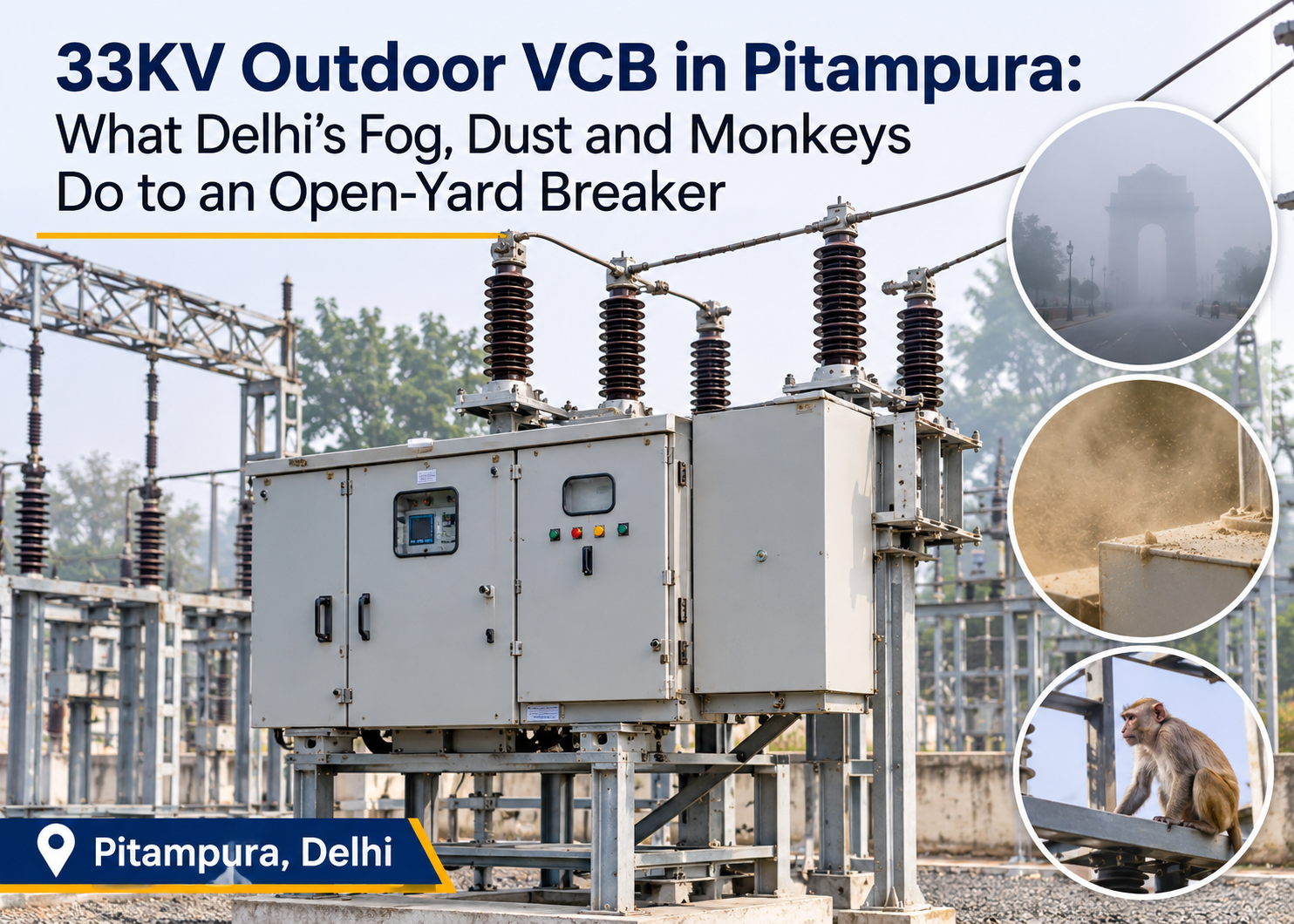
Anyone who has walked a substation yard in North West Delhi in January knows the scene. Fog sits low, the insulators look damp, and somewhere a bird is eyeing a live bushing. That is the real test for a 33KV Outdoor VCB in Pitampura, and it rarely shows up on a datasheet.
Most buyers compare ratings and prices. Fewer ask how the breaker will behave after three monsoons and two dusty summers. This guide covers what we think matters when you plan an open-yard 33KV outdoor VCB for a site in Pitampura or the surrounding North West Delhi belt.
Does Your Pitampura Project Actually Need a 33KV Outdoor VCB?
Let’s start with an honest question. Most buildings around Netaji Subhash Place take supply at 11 kV, and an 11 kV panel is usually the right answer for them. A 33KV outdoor vacuum circuit breaker makes sense in a different set of situations:
- A bulk consumer or institutional campus that receives supply at 33 kV
- A substation upgrade where an existing breaker is being replaced
- A private substation that steps 33 kV down to 11 kV
- Solar or other generation connecting to a 33 kV network
If your plot is tight and your load is modest, a 33 kV breaker may be more than you need. If your utility has asked for 33 kV incoming protection, you’re in the right place. When in doubt, check the sanctioned supply voltage before anything else.
What the Breaker Does, in Plain Words
A 33 kV network is normally served by 36 kV class equipment. Inside a vacuum circuit breaker, the arc is interrupted in a sealed vacuum chamber, so there is no oil to top up, test or dispose of. The breaker switches load current and clears faults on lines, feeders and transformers. The outdoor version is built to do this without a building around it.
That last part is the catch. Once you remove the walls, the weather becomes part of the design.
Three Things Delhi Throws at an Outdoor Breaker
1. Winter fog and dust on the insulators
Delhi’s dust and winter fog mix into a thin conductive film on insulator surfaces. In bad conditions that film can cause surface discharge or, in the worst case, a flashover. The defence is the insulator creepage distance, which is the length of the surface path along the insulator.
Creepage is usually specified in millimetres per kV, and standards such as IEC 60815 grade sites by pollution level. Heavy pollution sites commonly specify around 25 mm/kV. Don’t take that number from us as final. Ask for the creepage value on your datasheet and match it to your site’s pollution class.
2. Monsoon moisture in the control cabinet
The bushings get the attention, but the control cabinet is where many outdoor problems start. Humid air, condensation and poor cable gland sealing can damage relays, terminals and wiring. Look for a well-sealed cabinet, a proper space heater and good ventilation design.
3. Birds, monkeys and general wildlife
It sounds like a joke until you see a fault report. Birds and monkeys can bridge gaps between live parts, especially on yards with thin clearances. Bird guards, covered terminations and a properly fenced yard are cheap compared to an unplanned outage. Raise this at the design stage, because it is much harder to fix after the structure is standing.
The Yard Matters as Much as the Breaker
A good 33 kV outdoor circuit breaker can still underperform on a badly prepared yard. Before the breaker arrives, check these:
- Foundation and support structure: Is the steelwork designed for the breaker’s weight and the forces during operation?
- Clearances: Phase-to-phase and phase-to-earth clearances should follow CEA safety regulations and your utility’s requirements.
- Earthing: A weak earth mat turns a routine fault into a safety problem. Test it before commissioning.
- Drainage and gravel: Water pooling near the base is a slow, quiet enemy.
- Access: Can a crane and a maintenance team actually reach the breaker?
Many delays on outdoor jobs start here, not at the factory.
Don’t Forget the Relay, CTs and Control Panel
A breaker only trips when told to. The protection relay reads current through current transformers and sends the trip signal. So when you ask for a 33KV Outdoor VCB, also ask whether you need:
- Current transformers sized for your fault level and metering class
- A relay suited to your protection scheme (overcurrent, earth fault and so on)
- A control and relay panel with indication and, if required, remote operation or SCADA connectivity
It’s far easier to finalise this as a single package than to chase compatibility later.
A Pre-Order Checklist
Settle these before you ask for a quote:
- System voltage and fault level (commonly 25 kA or 31.5 kA for 3 seconds, but confirm yours)
- Rated current of the feeder or transformer
- Mounting arrangement and whether a support structure is included
- Pollution level and the creepage distance you need
- Protection relay, CT and control panel requirements
- Site access, crane route and commissioning timeline
- Your utility’s approval and inspection requirements
Having these ready can save a week of back-and-forth.
How We Handle Pitampura Enquiries
At Arpan Power Projects, our registered office is at Netaji Subhash Place, Pitampura, and our manufacturing unit is at Khera Kalan Industrial Area, Delhi. That means a site visit in North West Delhi is a short drive, not a logistics exercise. We usually begin by asking about your voltage, fault level and yard conditions, and then suggest a configuration. You can read the specifics on our 33KV Outdoor VCB page.
If your project needs a full package, you can also look at our compact substation range or our transformers.
Frequently Asked Questions
Can a 33KV Outdoor VCB be used inside a building?
It isn’t designed for that. If the equipment will sit in a switch room, an indoor panel is the right choice. We cover that in our 33KV Indoor VCB maintenance guide.
Is a 33KV Outdoor VCB the same as a 36 kV breaker?
Usually yes in practice. A 33 kV system is served by 36 kV class equipment, so check the rated voltage on the datasheet.
How often does it need maintenance?
Vacuum breakers need less routine work than oil breakers, but insulator cleaning, cabinet checks and mechanism inspection should still be scheduled. Delhi’s dust makes the insulator part more important than people expect.
Does it come with a protection relay?
The relay is often a separate item. Confirm in writing whether the relay, CTs and control panel are in the scope of supply.
What should I send for a quotation?
Share voltage, rated current, fault level, mounting arrangement, protection needs and site location in Pitampura or nearby.
Final Word
A 33KV Outdoor VCB in Pitampura works best when the breaker, the yard and the protection are planned together. Ask about creepage, cabinet sealing and clearances early, and the rest of the job gets easier.
If you’d like a second pair of eyes on your requirement, Arpan Power Projects is happy to talk it through. Call +91 98688 64101 or use our contact page to share your site details.