
Blog
11KV Outdoor VCB Kiosk Type in North Delhi: The Shutdown Window, the Switching Plan and the Operator Nobody Briefed

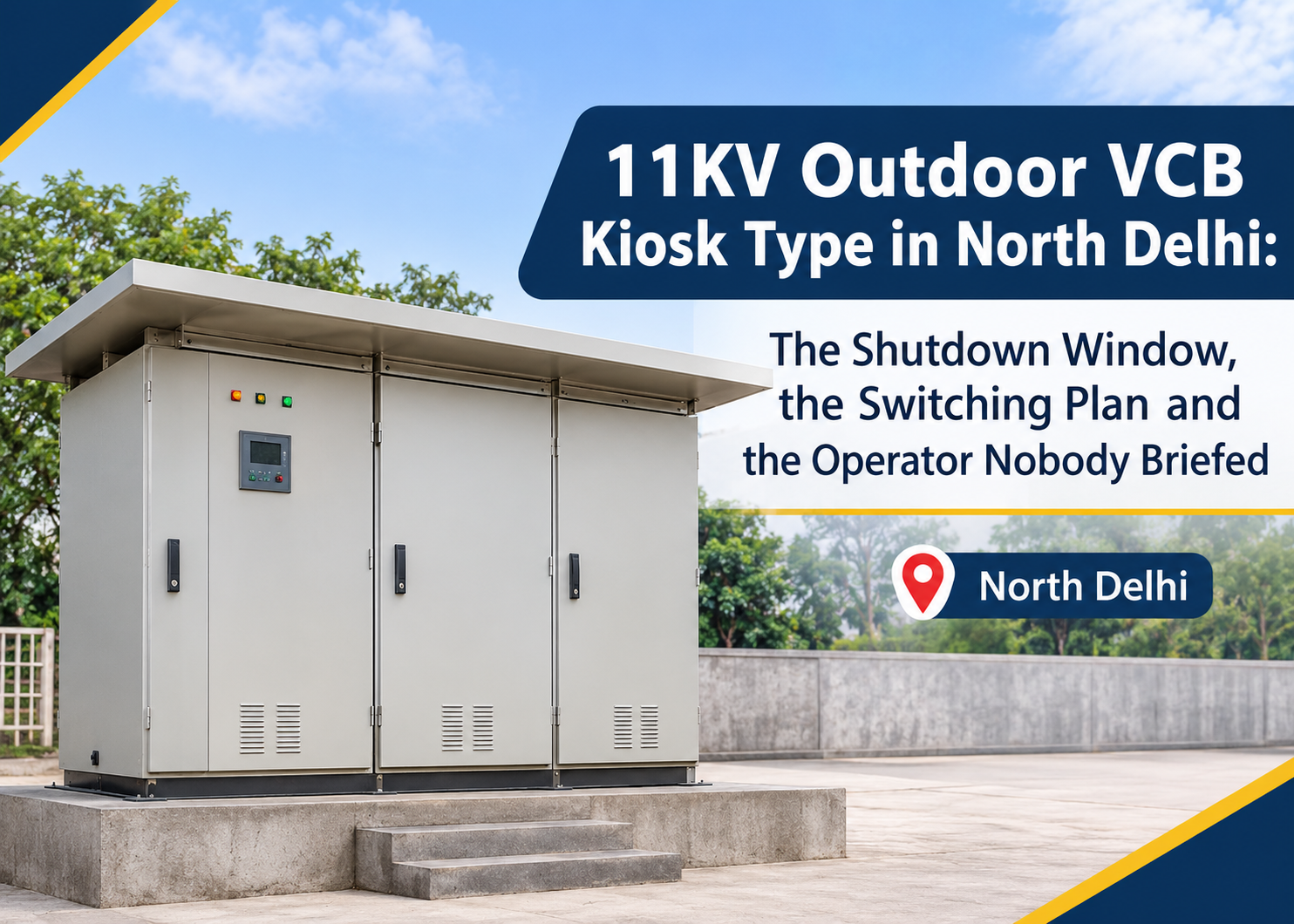
Most kiosk articles end on the day the enclosure is lifted onto its plinth. For the person who has to run it every day, that’s only chapter one.
Picture a mid-sized unit in Bawana or Narela. The crane has come and gone, the photos are taken, and everyone is pleased. Three weeks later the night supervisor asks a simple question: “Which button do I press, and who is allowed to open this door?” Nobody has a clear answer.
This guide is about that second half of the story. If you’re planning an 11KV Outdoor VCB Kiosk Type in North Delhi, the equipment is only part of the job. The shutdown, the switching plan and the people who will operate it matter just as much. (If you’re still deciding whether a kiosk suits your site at all, our kiosk type and panel buying guide covers the basics.)
Quick read
- Most North Delhi jobs are upgrades on a live site, so the shutdown plan matters as much as the kiosk.
- Write the switching sequence on one page, before the equipment arrives.
- Ask for features that help the operator: viewing window, clear indication, manual trip, proper interlocks.
- Name the authorised operators and brief them before energisation.
Why North Delhi kiosk jobs are mostly “live-site” jobs
Think of Rohini, Narela, Bawana, Azadpur, Wazirpur or Model Town. Few of these jobs start on a bare plot. A factory adds a production line. A cold storage doubles its chambers. A hospital wing or school campus needs more load. The old arrangement is still feeding something important, and nobody wants it off for a week.
So the real question isn’t only “which outdoor VCB kiosk should we buy?” It’s “how do we swap or add the HT kiosk without stopping the business?” That is a planning problem, and it is easier to solve on paper than at 2 a.m. on a Sunday.
Start with the shutdown window
Most of North and North-West Delhi is served by TPDDL, but boundaries can vary, so confirm with the concerned utility office for your address. Then raise three things early:
- Which feeder or incomer will be isolated, and for how long you realistically need it.
- The preferred day and time. Many industrial users choose a weekly off or an off-shift.
- Written confirmation of the approved window, and any conditions attached.
If you run a DG set for critical loads, be careful. The changeover must make sure the DG can never feed back into the grid while people are working on the line. That is a safety point, not a formality.
Write the switching plan on one page
A good switching plan is boring and clear. Ours usually looks something like this:
| Stage | What happens | What to confirm |
|---|---|---|
| Before the shutdown | Kiosk placed, cables laid and tested, relay settings ready | Setting sheet and CT ratio agreed in writing |
| Isolation | Incoming supply isolated, earthed and tagged | Person in charge named, permit signed |
| Connection | Terminations made, earthing checked | Cable tests and insulation values recorded |
| Pre-energisation | Breaker operated manually, protection checked | Trip and close tested, interlocks proven |
| Energisation | Supply restored in a planned sequence | Utility and site team on the same call |
| First week | Watch loading, temperature and indication | Logbook started, issues noted |
Print it. Pin it up. Have the same sheet in the hands of the electrician, the site manager and the supplier’s engineer. For the broader physical sequence on site, our kiosk installation and commissioning guide goes step by step.
Specify the kiosk for the person who will operate it
This is the part most specifications skip. A kiosk is not only protected equipment. It is a workplace for whoever opens that door. When you compare offers, look for:
- A viewing window so the breaker status and relay display can be read without opening the door.
- Clear mechanical ON/OFF and spring-charged indication. Nobody should guess.
- A manual trip option that works if the control supply fails.
- Door-to-breaker interlocks and provision for padlocks.
- Proper earthing points and a visible earthing arrangement.
- A single-line diagram and nameplate fixed inside or on the door.
- Internal lighting and enough clear working space in front of the kiosk.
The breaker itself should be tested to the relevant standard, such as IEC 62271-100 or IS 13118, and the enclosure’s ingress protection (IP) rating should be stated clearly. Don’t settle for “outdoor type” without a rating on paper. If you want to understand rated current and fault level choices, read our guide on matching the breaker to the job.
Brief the operator before energisation
Under Indian electrical safety rules, only competent and authorised persons should operate HT equipment. In practice, many sites have a general electrician but no one formally nominated for the kiosk. Fix that before day one:
- Name two authorised people, so there is cover when one is on leave.
- Agree how permits and lock-out or tag-out will work.
- Keep a shock-treatment chart, danger boards, an insulating mat and a suitable fire extinguisher nearby.
- Walk the operator through the manual trip, the indication and the emergency procedure with the supplier’s engineer present.
- Start a simple logbook from day one. It becomes the site’s memory.
Twenty minutes of briefing saves hours of confusion, and in the worst case, prevents an accident.
Dust, rodents and cable entry: the unglamorous checks
Industrial belts in North Delhi bring dust and, in some units, process fumes. Ask about door gaskets, ventilation with filters and the paint or coating system. Weather is a separate topic, and we’ve covered it in our North Delhi outdoor VCB panel guide.
Cable entry deserves a mention too. Bottom entry is common, so ask for a proper gland plate and sealing of all openings. Rodents love a warm, dark cable trench, and a small gap is enough for them.
Spares and support after the handover
A vacuum breaker needs little maintenance, but “little” is not “none”. Agree upfront on a small spares kit: trip and closing coils, indication lamps, fuses and a spare battery or charger module if the design uses one. Ask who attends if the breaker fails to close at night, and how fast.
This is where location helps. Arpan Power Projects supplies 11KV and 33KV VCBs, RMUs, transformers and compact substations. Our manufacturing unit is at Khera Kalan Industrial Area, and our registered office is at Netaji Subhash Place, Pitampura, both inside North Delhi’s belt. Our team can review your single-line diagram and site photos before quoting. You can see the available configurations on our 11KV outdoor VCB kiosk type product page.
Frequently asked questions
Can a kiosk be installed without a long shutdown?
Often the outage can be kept short if the kiosk is placed, cabled and tested in advance, and only the final termination and energisation need the supply off. The exact duration depends on your site and the utility’s approval.
Who should operate an outdoor VCB kiosk?
Only a competent, authorised person. Name them in writing, train them on the specific kiosk and keep a log of operations.
Do I need inspection before energising?
For HT installations, the statutory electrical inspector’s clearance is typically required before energisation. Confirm the exact requirement for your site and connection.
What spares should I keep?
At minimum, a trip coil, a closing coil, indication lamps, fuses and a spare battery or charger module where applicable. Your supplier can suggest the right list for the model.
Does Arpan Power Projects support North Delhi enquiries?
Yes. We handle enquiries across North and North-West Delhi, the wider Delhi NCR and projects across India.
Before you finalise
A good 11KV Outdoor VCB Kiosk Type in North Delhi is judged by how smoothly it goes live and how calmly your team runs it years later. Plan the shutdown, write the switching sequence, ask for operator-friendly features and brief the people who will use it. If you’d like a second opinion on your specification or site, share your details through our contact page and the team at Arpan Power Projects will get back to you with a clear recommendation.