

Blog
Outdoor RMU Supplier in India: How to Pick a Ring Main Unit That Survives Monsoon, Dust and 45°C Summers

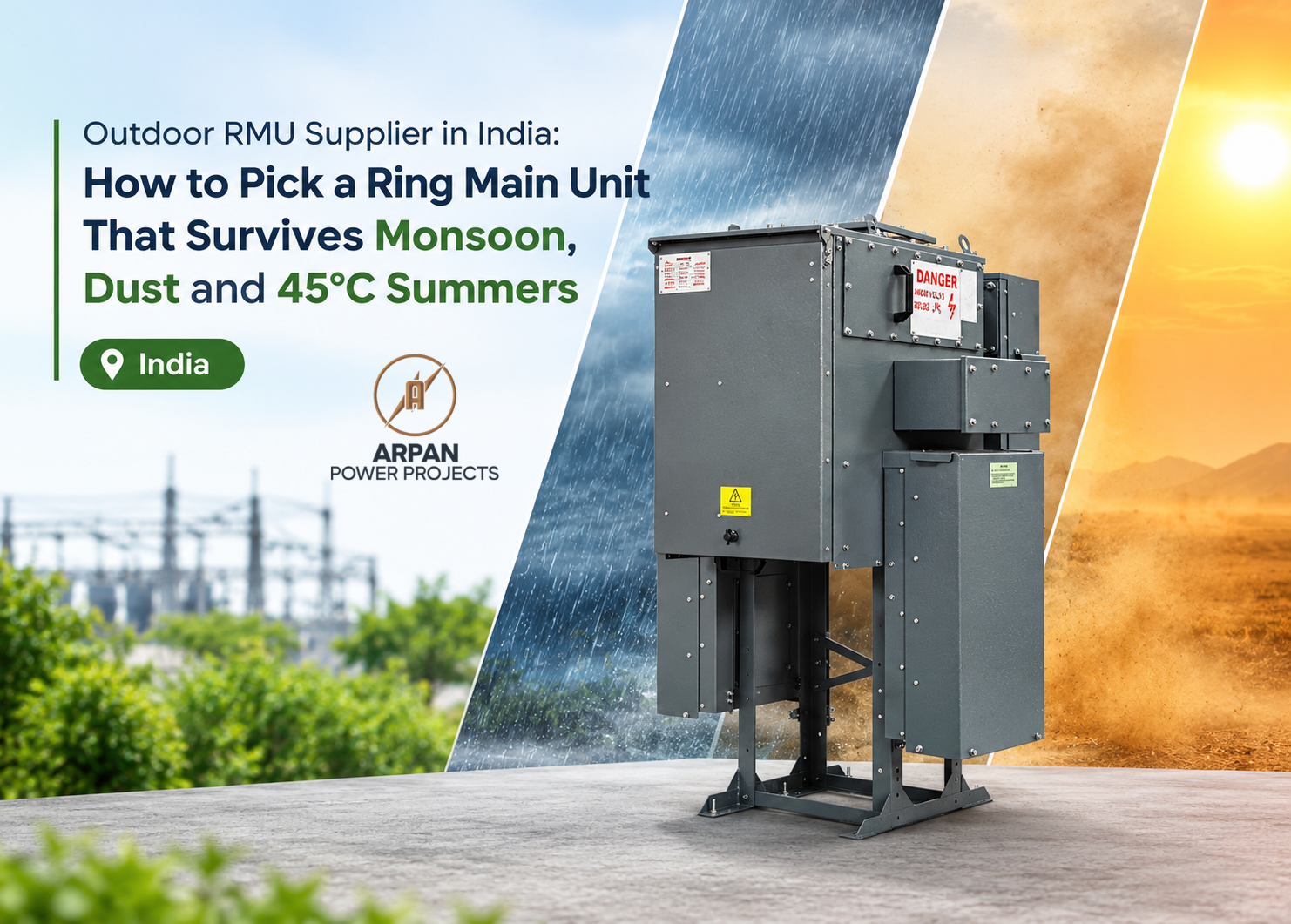
A ring main unit can pass every test in the factory and still struggle after one rainy season in a roadside pit in Noida. Water gets in, heat builds up, dust settles, and a rodent finds the one cable opening nobody sealed. These are mostly site failures, not switchgear failures.
So when you start looking for an Outdoor RMU Supplier in India, “who is cheapest?” is the wrong first question. Ask who has thought about where the unit will actually stand.
This guide covers what changes when an RMU goes outdoors, what Indian weather does to it, and the checks worth making before you place an order.
The short version:
- An outdoor RMU needs a proper weatherproof enclosure, not an indoor unit put in a shed.
- Ask for type test reports, the IP rating of the enclosure, and the SF6 gas tank sealing details.
- Plan the plinth, cable entry and earthing before the unit arrives.
- Choose a supplier who will still answer the phone after commissioning.
What an outdoor ring main unit actually is
A ring main unit (RMU) connects, isolates and protects sections of a cable ring network from one compact, factory-built assembly. An outdoor ring main unit does the same job but is built for open-air installation: free-standing on a plinth, inside a kiosk, or as part of a compact substation.
The switching core is often the same as an indoor version. The difference is everything around it:
- the enclosure and its coating
- ventilation and condensation control
- cable entry and sealing
- the lockable, vandal-resistant door and mechanism cover
In our experience, this is where buyers compare the wrong things. Two quotes can show the same switch ratings, yet one unit has a 2 mm powder-coated sheet and open cable entry while the other has a properly sealed design. The price gap is real, and it is usually justified.
Why Indian conditions change the specification
IEC standards assume “normal service conditions” for outdoor equipment: ambient temperature up to 40°C, with a 24-hour average not above 35°C, and altitude up to 1,000 m. Much of India goes beyond that every summer.
Heat. Delhi NCR, Rajasthan and parts of central India regularly cross 45°C. Add direct sun on a metal enclosure and the internal temperature climbs further. If your site is hotter than the standard assumes, tell the supplier. Derating and a double-roof or sun-shield design may be needed.
Monsoon and waterlogging. Low-lying plots in Gurugram, Mumbai or Chennai can sit in standing water for days. Raise the plinth above the highest water mark ever seen at that location. Many engineers go 300 to 600 mm, depending on the site. A sealed gas tank survives immersion better than an air-insulated cable chamber, but the mechanism box and cable compartment still need to stay dry.
Dust and pollution. In winter, NCR air is full of fine particulate. Construction sites add cement dust on top. Dust and moisture together create tracking paths on insulation. Check the enclosure IP rating and the quality of door gaskets.
Coastal salt air. Near Mumbai, Gujarat, Chennai and the Konkan belt, ordinary painted mild steel corrodes fast. Ask about the coating system, the material (galvanised, aluminium-zinc, stainless), and any salt-spray test results.
Common outdoor RMU configurations
You will see letter codes on a single-line diagram. Here is a plain-English reading of the most common ones for 11KV outdoor RMU networks.
| Configuration | What it means | Typical use |
|---|---|---|
| CCF | Two ring cable switches plus one fuse-switch for a transformer | A single distribution transformer on the ring |
| CCV | Two ring switches plus one vacuum circuit breaker | Transformer feeders needing relay protection or higher fault duty |
| CCCF | Three cable switches plus one fuse-switch | Ring junctions with an extra outgoing feeder |
A 33KV outdoor RMU is less standardised and usually project-specific, so share your single-line diagram early. If you’re weighing the two voltage classes, our 33KV RMU buyer’s guide covers the differences.
Eight checks before you shortlist a supplier
1. Type test reports. Ask for test reports against IEC 62271-200 (metal-enclosed switchgear) and the relevant switch standards such as IEC 62271-103 and 62271-105. Reports from recognised labs, such as CPRI Bengaluru or ERDA Vadodara, carry more weight than a line on a datasheet. Check that the report matches the exact model you’re buying.
2. IP rating of the enclosure. An SF6 ring main unit usually has two protection levels: the sealed gas tank, which is typically rated much higher, and the outer enclosure. For outdoor use, IP54 is a common minimum for the outer enclosure. Ask which rating applies to which part.
3. Sealed gas system. A sealed-for-life SF6 tank means no gas handling at site. Ask for the guaranteed leakage rate and the position of the gas pressure indicator, and whether you can read it without opening anything. Some projects now ask for SF6-free alternatives, so raise it if that applies to you.
4. Internal arc classification. Outdoor units sit near people, vehicles and footpaths. Ask for the IAC rating and where the pressure is released: into the cable trench or away from the operator.
5. Corrosion protection. Get the coating system in writing: material, thickness and pre-treatment. This one detail separates a 25-year unit from a 7-year unit on the coast.
6. Cable entry and sealing. Bottom entry through a gland plate is common. Ask how the supplier seals against water, rodents and termites, because open knock-outs are how small animals get in.
7. Remote operation and fault indication. Many outdoor RMUs are unmanned. Motorised switches, SCADA readiness and fault passage indicators save hours of patrolling a ring to find a fault. Confirm what’s included and what’s optional.
8. After-sales support. Ask who commissions the unit, how quickly spares ship, and who you call at 11 pm during a fault. Suppliers who answer this clearly tend to be the ones who stay in touch.
Site preparation: the part buyers forget
Most delays happen on the civil side, not at the factory. Before delivery, sort out these points:
- Plinth and trench: dimensions per the drawing, with cable bending radius allowed for
- Earthing: pits ready and resistance values measured, not guessed
- Access: crane or lifting arrangement and a clear route for the delivery vehicle
- Clearances: working space in front of the unit for safe operation
- Fencing and signage: especially if the unit is near a public road
For the full sequence on the civil side, see our site engineer’s installation checklist. It applies equally to a free-standing RMU.
What to send when you request a quotation
A vague enquiry gets a vague price. Include these details:
- Voltage class (11KV or 33KV) and rated current
- Number of cable feeders and transformer feeders
- Fault level from your system study
- Installation type: free-standing, kiosk, or inside a compact substation
- Remote operation or SCADA needs
- Spare ways for future expansion
- Site location and whether it’s coastal, flood-prone or dusty
With this, a supplier can quote the same specification as everyone else and outdoor RMU price in India comparisons stop being apples to oranges. For a similar approach on breakers, see our RFQ guide for outdoor VCBs.
How Arpan Power Projects approaches outdoor RMU orders
At Arpan Power Projects, we supply ring main units, VCBs, compact substations and transformers from our base in New Delhi, with a unit at Khera Kalan Industrial Area. Most outdoor RMU conversations begin with one question from us: where exactly will it stand? Once we know the location, feeder count and fault level, we can recommend between our outdoor ring main unit, the Safelink RMU for compact modular needs, or an RMU inside a compact substation.
We work with clients across Delhi NCR, including Noida, Gurugram and Ghaziabad, and on pan-India projects. If you’re also comparing 11KV RMU and 33KV RMU options, we can walk you through both.
Frequently asked questions
Can I install an indoor RMU outdoors if I build a shed around it?
It’s not a good idea. A shed doesn’t replace a rated enclosure. Condensation, dust, rodents and temperature swings are still there, and the warranty may not cover it. If the site is outdoors, specify an outdoor-rated unit from the start.
Is SF6 or solid dielectric better for an outdoor RMU?
SF6 sealed units are widely used because they are compact and proven. Solid dielectric and SF6-free designs are growing, especially on projects with environmental targets. A good supplier will explain the trade-offs for your site, not just push one option.
How long does an outdoor RMU last?
With the right specification, good coating and routine inspection, 20 to 25 years is a reasonable expectation. Real life depends on climate, load and maintenance.
How much maintenance does a sealed outdoor RMU need?
Much less than open switchgear, but not zero. A yearly check of the gas pressure indicator, mechanism operation, cable box, door seals and earth connections is sensible.
Which ratings are typical for an 11KV outdoor RMU?
It’s commonly a 12 kV class unit with a 630 A busbar, but the fault rating and internal arc class should come from your own system study, not a generic number.
Do you deliver outside Delhi NCR?
Yes. Share your site location and requirement through our contact page and our team will respond with a recommendation and quotation.
Before you request quotes
An outdoor RMU is a long-term asset standing in the open for two decades or more. Spend an extra hour on the site conditions, the test reports and the cable entry details, and you will usually save months of trouble later