

Blog
11KV Outdoor VCB Supplier in India: Match the Breaker to the Job, Not the Catalogue

Two sites can order the “same” 11kV outdoor breaker and end up with very different results. One runs quietly for years. The other trips on the first heavy fault, or never trips when it should. The breaker was not defective in either case. It was simply specified for the wrong job.
This guide is for engineers, contractors and purchase teams looking for an 11KV Outdoor VCB Supplier in India. It will not tell you which brand to buy. It shows how to decide what the breaker must do at your site, so that the quotation you receive actually fits it.
First, what an outdoor VCB actually does
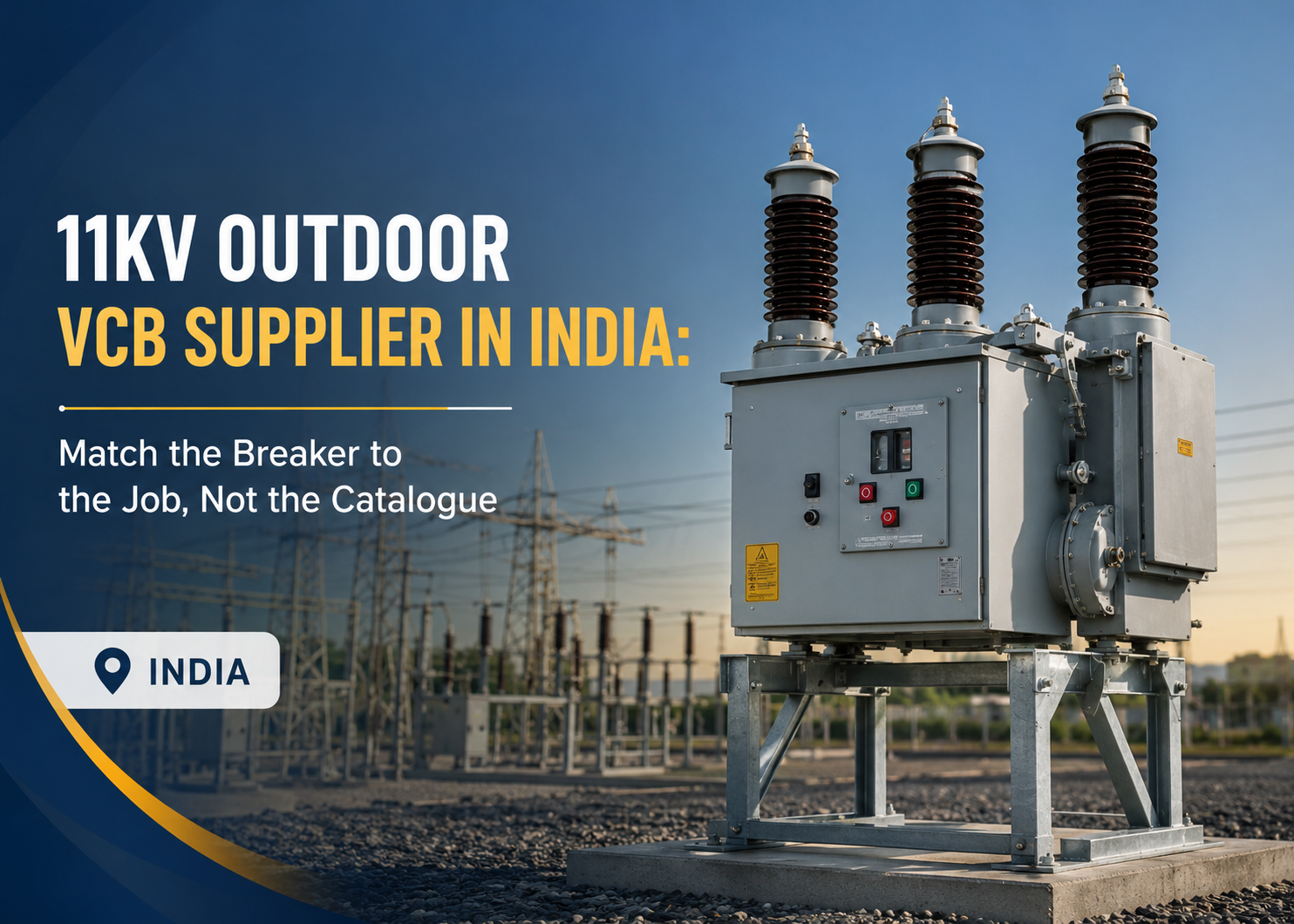
An outdoor vacuum circuit breaker switches and protects an 11kV line. In normal service it carries load current. In a fault it opens fast enough to clear the fault before cables, transformers or busbars are damaged. The arc is extinguished inside a sealed vacuum interrupter, so there is no oil to maintain and no gas to refill.
An outdoor unit sits in weather, which affects the enclosure, the insulation and the way the breaker is wired and operated. Catalogue photos rarely show this, but your site conditions decide most of it.
Step 1: Start with the fault level, not the current
Most buyers begin with the load current. It is the wrong starting point. Begin with the short-circuit breaking capacity.
- Find the fault level at your point of connection. Your DISCOM, consultant or design engineer should have this figure.
- Common 11kV ratings are 16 kA, 20 kA, 25 kA and 31.5 kA for 3 seconds.
- Choose a rating above the fault level at your location, not just above what feels safe.
An undersized breaker may look fine on a quotation, and nobody finds out until the first major fault. Over-specifying has a cost too, but under-specifying is the more expensive mistake.
Step 2: Then decide the rated current
Typical 11kV VCB ratings are 630 A and 1250 A. To pick one:
- Work out the full-load current of the transformer or feeder it protects.
- Add headroom for future load, but avoid doubling it. A very large breaker on a small load can make protection settings harder to coordinate.
- Remember that the nameplate rating is for a reference ambient temperature. At 45°C and above, which is normal in Delhi NCR summers, ask the supplier how the rating behaves under your conditions.
Step 3: The protection side most people skip
A breaker without the right relay is just a switch. So ask about:
- Overcurrent and earth-fault relay. Is it a numerical relay with IDMT curves? Can it be set to your utility’s coordination requirements?
- CT ratio and burden. The current transformers must suit both the relay and the load range. A wrong CT ratio is one of the most common reasons settings never work as designed.
- Trip and control supply. Confirm the DC voltage and whether the spring-charged mechanism can be charged manually if the auxiliary supply fails.
- Operating duty. Check the rated operating sequence. Auto-reclosing duty needs a different sequence from ordinary feeder protection.
Step 4: Conditions outdoors change the specification
A breaker that works in an air-conditioned switch room can struggle outside. For a project in Delhi NCR, think about:
| Condition | What to ask the supplier |
|---|---|
| Summer heat | Temperature rise and current rating at your ambient |
| Dust and winter fog | Creepage distance of insulators for your pollution level |
| Monsoon humidity | Enclosure protection class, gaskets, anti-condensation heater |
| Birds, insects, rodents | Cable entry sealing and ventilation guards |
Ask for the enclosure’s ingress protection rating in writing rather than accepting “weatherproof” as an answer.
Step 5: Match the type to the application
The right outdoor VCB depends on where it sits in your network:
- Substation incomer or transformer protection. Needs reliable relay protection and a clear short-circuit rating.
- HT consumer connection. Metering CTs and PTs and the utility’s technical requirements usually shape the design.
- Solar or captive power plant. Look closely at fault contribution from the generation side and at the operating sequence.
- Long rural or industrial feeders. Auto-reclosing duty may matter more than anything else.
If your project needs a compact, factory-wired enclosure, the 11KV Outdoor VCB Kiosk Type is worth reading about separately, because kiosk design brings its own checks.
Step 6: Confirm the standard and the paperwork
The relevant standards are IEC 62271-100 and IS 13118 for AC circuit breakers. Ask for the type test reports for the exact rating you are buying, not for a similar one. For the factory tests and the documents that should come with the order, our guide on what most buyers skip at the factory and on site goes through them one by one.
Choosing your 11KV Outdoor VCB Supplier in India
Once your specification is clear, the supplier question becomes much simpler. A good 11KV Outdoor VCB Supplier in India will:
- Ask for your fault level, load and site conditions before quoting.
- Send a technical datasheet that lists ratings, relay make and enclosure details.
- Point out where your specification looks inconsistent instead of simply agreeing.
- Support you after dispatch with commissioning guidance and spares.
At Arpan Power Projects, we work as a supplier, channel partner and stockist of HT switchgear, including 11KV and 33KV VCBs, RMUs and compact substations. Our registered office is in Netaji Subhash Place, Pitampura, New Delhi, and our manufacturing unit is in Khera Kalan Industrial Area, Delhi. If you are comparing quotations, our note on what really drives the price and how to write an RFQ will help you ask for comparable offers.
A short checklist before you request a quote
- Fault level at the point of connection, in kA
- Rated voltage and current required
- Relay type, CT ratio and DC control voltage
- Site location and pollution level
- Application: incomer, feeder, solar, or consumer connection
- Applicable standard and test reports required
Frequently asked questions
What is the typical rating of an 11kV outdoor VCB?
Most are rated 12 kV, 630 A to 1250 A, with short-circuit ratings from 16 kA to 31.5 kA. The right values depend on your network.
Can the same VCB be used indoors and outdoors?
Not usually. Outdoor units are designed for weather exposure, so the enclosure and insulation differ from an indoor panel.
Does an outdoor VCB need regular maintenance?
The vacuum interrupter is sealed, so maintenance is light compared with oil breakers. The mechanism, contacts of the isolator, wiring and enclosure still need periodic inspection.
How do I check a supplier is genuine?
Ask for type test reports, a datasheet for the exact rating, references and a clear warranty and service contact.
Talk to Arpan Power Projects
If you have your fault level and load details, send them to us for a proper recommendation. View the 11KV Outdoor VCB product page to share your requirement. Arpan Power Projects will help you match the right breaker to your site in Delhi NCR and across India.