
Blog
CSS Compact Substation Supplier in South Delhi: How to Fit a Substation Into a Neighbourhood That Notices Everything

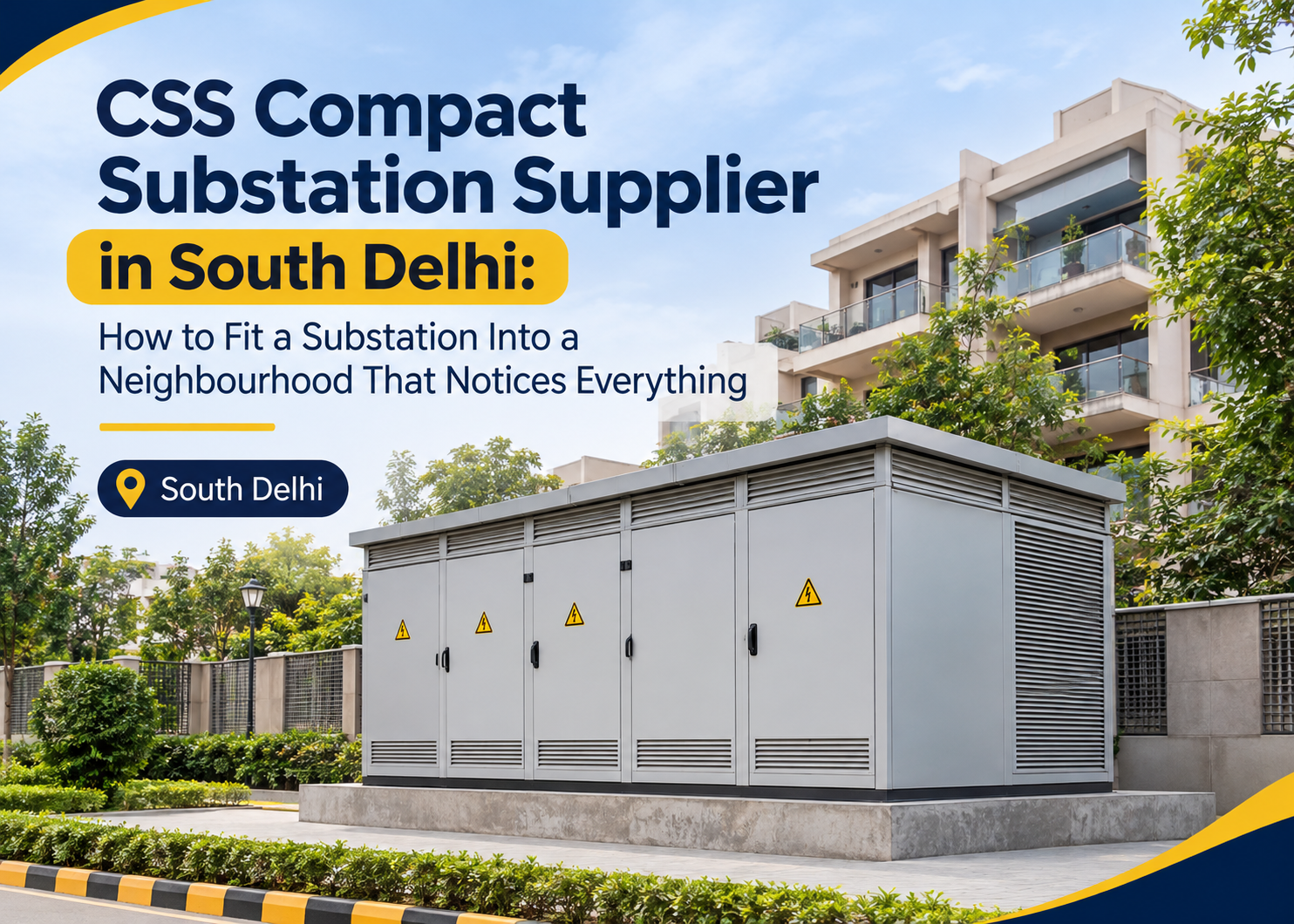
Here’s a scene that plays out more often than it should. A housing society in Vasant Kunj has doubled its load in five years. Split ACs in every flat, EV chargers in the basement, a second lift, a bigger DG set. The old transformer is humming harder every summer. Everyone agrees a new substation is needed. Then someone points at the only spare patch of land: a strip along the boundary wall, six metres from a neighbour’s bedroom window.
That is the real problem of compact substations in South Delhi. Space is tight, yes, but the bigger challenge is that people live, work and sleep right next to the equipment. If you’re searching for a CSS Compact Substation Supplier in South Delhi, this guide covers what actually decides whether a unit goes in smoothly or turns into a year-long complaint.
Why South Delhi is a different kind of project
Take a walk through Saket, Greater Kailash, Hauz Khas or Vasant Kunj. You’ll see residential societies, private hospitals, schools, malls, showrooms and embassies-adjacent offices, all packed close together. Further out, Chhatarpur and Mehrauli have farmhouse clusters with their own heavy loads. Okhla brings in industrial units with a completely different set of needs.
What these places share is an audience. A substation here is rarely invisible. Residents’ welfare associations ask questions. Neighbours notice noise at night. Building owners care how the unit looks from the road. A project that ignores this usually gets stuck, however good the equipment is.
So the brief for a compact substation in this part of Delhi is broader than “give me 630 kVA”. It is “give me 630 kVA that is quiet, tidy, safe and approved without drama.”
So, what exactly is a compact substation?
A compact substation, also called a packaged substation or prefabricated substation, brings the HV switchgear, the distribution transformer and the LV panel into one factory-built enclosure. It is assembled and tested in the workshop, then lifted onto a prepared plinth at your site. The relevant standard for prefabricated HV/LV substations is IEC 62271-202, and a serious supplier should be able to talk you through it.
Compared with a built-up substation room, a compact sub station saves floor area and civil work, and the plinth can be prepared while the unit is still being built. For crowded South Delhi plots, that time saving matters as much as the space saving.
Five questions to settle before you ask for a quote
1. Where will the hum go?
Every transformer hums. The question is whether that hum reaches a bedroom. Place the unit away from sleeping areas where you can, and ask the supplier for the sound level of the transformer in writing. Don’t treat it as a footnote. On a plot with a close neighbour, the noise figure and the orientation of the unit can matter more than a small price difference.
2. Oil type or dry type transformer?
For a basement, podium or a unit tucked into a building, most consultants lean towards a dry type transformer because of fire-safety concerns. Hospitals and malls usually fall in this group. For an open corner of a plot, an oil-filled transformer is often a sensible, economical choice. In both cases, your consultant’s specification and the fire requirements for your building should have the final say.
3. What does the monsoon do to your plot?
South Delhi has its share of low-lying spots and waterlogged underpasses. A plinth that looked generous in April can look very different after a July downpour. Decide the plinth height relative to the road and drain level, and make sure cable entries are properly sealed. It costs almost nothing at the design stage and a lot afterwards.
4. Are you sizing for today or for 2030?
This is where we see the most regret. A society sizes for its current load, then adds EV charging and more air-conditioning, and the unit is full within a few years. Ask your consultant to include a realistic growth margin, and ask the supplier about the overload capability of the transformer. Common ratings run from 500 to 1600 kVA at 11 kV, but the right number comes from your load calculation, not from a catalogue.
5. Who approves what?
Much of South Delhi is served by BSES Rajdhani (BRPL), though you should confirm this for your own address. Load sanction, metering and the electrical inspector’s approval before energisation each follow their own process, and housing societies often need their own committee or RWA sign-off first. Start these conversations before you order, not after the unit arrives.
What different South Delhi sites should prioritise
| Site type | What to focus on |
|---|---|
| Residential societies (Vasant Kunj, GK, Saket) | Low noise, neat finish, RWA approval, growth margin |
| Hospitals and institutions | Dry type transformer, reliability, quick service response |
| Commercial buildings and malls (Nehru Place, Saket) | Fire norms, delivery access, minimal downtime |
| Farmhouses (Chhatarpur, Mehrauli) | Outdoor weather protection, long cable runs, load growth |
| Industrial units (Okhla) | Protection settings, fault level, overload capacity |
What to ask any supplier before you commit
Skip the brochure and ask for these:
- A GA drawing with working clearances, not just the outer dimensions
- A written make list for the RMU or VCB, transformer and LV panel
- Type test reports and a factory test plan
- The guaranteed loss figures and the sound level of the transformer
- A dated schedule covering manufacture, delivery and commissioning
- Who you call, and how fast they respond, after the unit is energised
If you’re comparing several offers, our guide on how to compare compact substation quotes fairly explains why two quotes for the same kVA rarely match. And once the unit is ordered, the site engineer’s installation checklist walks you through foundation to energisation.
Why a Delhi-based supplier makes a difference
A compact substation needs people after it’s installed. Relay settings change, a tap needs adjusting, a fault needs attending. When the supplier is in the same city, a site visit is a matter of days, not weeks.
Arpan Power Projects is based in Delhi, with its registered office at Netaji Subhash Place, Pitampura, and a manufacturing unit at Khera Kalan Industrial Area. We are in north Delhi, but the whole of Delhi is one working area for us, and we visit South Delhi sites before quoting. We work as a supplier and channel partner for reputed Indian manufacturers of RMU, VCB, transformers and compact substations, so the HV, transformer and LV package comes through one point of contact.
A site visit before the quote usually settles what no drawing can: whether the crane can reach, how close the neighbour’s wall is, and whether the plinth needs to go higher. If your project also needs outdoor HT switchgear, our notes on the 11KV outdoor VCB kiosk type in South Delhi cover that side.
Frequently asked questions
Is a compact substation allowed inside a South Delhi housing society?
Usually yes, but it depends on your load sanction, the society’s own approvals and the DISCOM’s requirements. Involve the RWA or managing committee early. Surprises at that stage cost far more time than the substation itself.
Can a compact substation be installed in a basement?
It can be, with a dry type transformer, proper ventilation and fire safety measures approved by your consultant and the authorities. An outdoor plinth is often simpler where the space exists.
Does a compact substation make noise?
The transformer produces a low hum, as all transformers do. Placement, enclosure design and the transformer’s rated sound level decide whether it is noticeable. Ask for the figure in writing.
Do you supply only in South Delhi?
No. We supply across Delhi NCR and to other states. The checks in this guide apply wherever the project is.
Before you decide
A good CSS Compact Substation Supplier in South Delhi is not the one with the glossiest catalogue. It’s the one who visits the plot, asks about your neighbours, and gives you the noise figure, the clearances and the paperwork in writing before you pay anything.
Planning a project? Share your kVA, voltage and site address with Arpan Power Projects through our contact page, or browse our CSS compact substation range first. We’ll suggest a configuration that suits your load and your neighbourhood.