

Blog
11KV Indoor VCB in Pitampura: How Many Panels Do You Really Need?

A contractor near Netaji Subhash Place once showed us a tender drawing with a single line: “11kV indoor VCB panel, 1 no.” The building had two transformers, a future expansion floor and a hospital-grade backup requirement. One panel was never going to do the job.
This happens more often than you’d expect. People spend weeks comparing ratings and brands, and the basic question of how many VCB panels the building actually needs gets answered by guesswork. This guide helps you answer it properly for an 11KV Indoor VCB in Pitampura, whether you’re building in Pitampura, Rohini, Shalimar Bagh, Ashok Vihar or Prashant Vihar.
Quick answer: A typical 11KV indoor VCB lineup has one incomer panel, one outgoing panel per transformer, and a spare bay for the future. Add a bus coupler if you have two incoming sources. Metering is usually a separate cubicle, as per your distribution company’s rules.
What one “panel” actually means
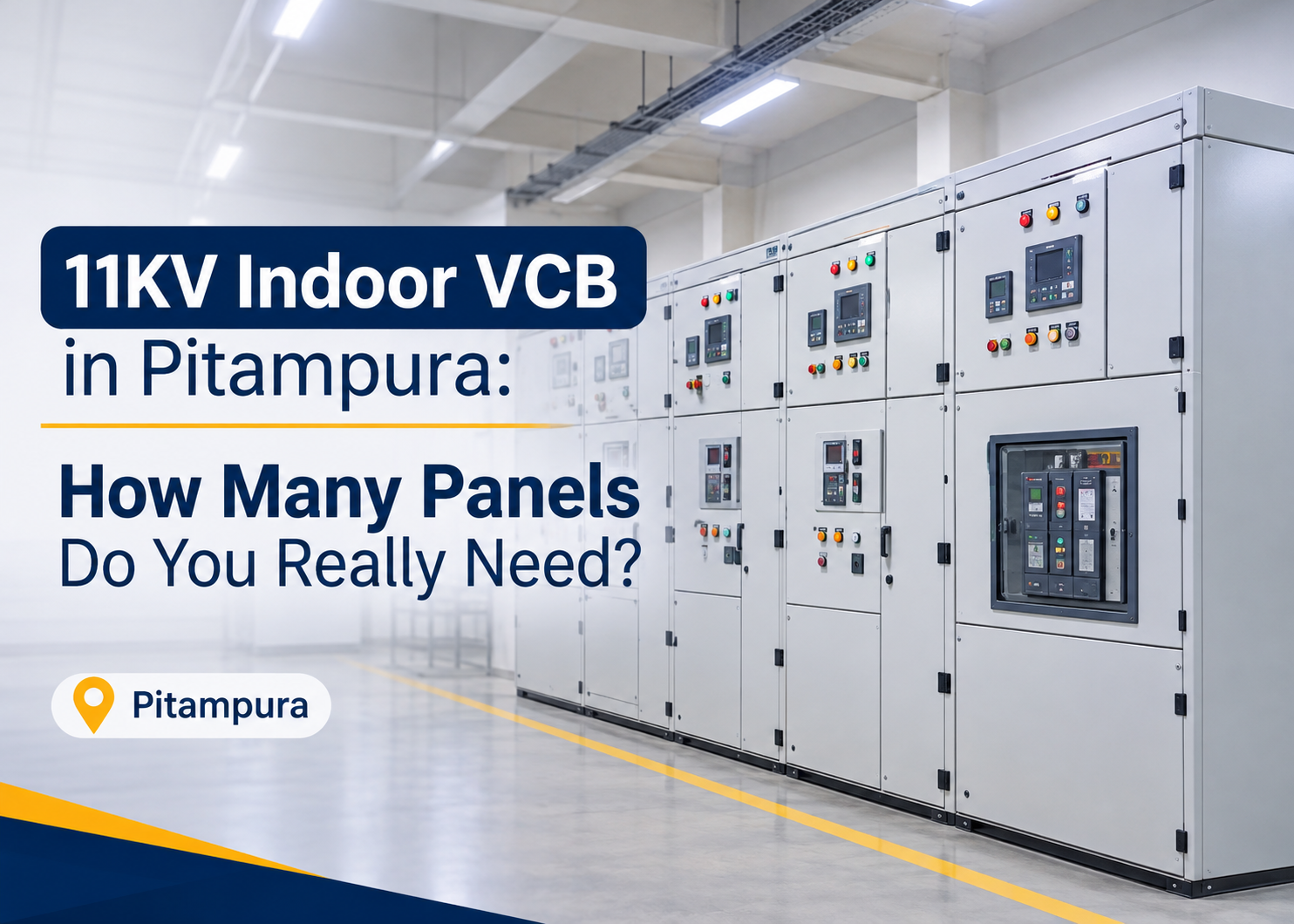
When people say “one VCB,” they often mean the breaker. When a supplier says “one panel,” they mean a complete cubicle with the vacuum circuit breaker, busbars, current transformers, protection relay and wiring. An 11KV VCB panel lineup is a row of these cubicles joined by a common busbar.
Each cubicle does one job. That’s why the count matters.
| Panel (bay) | What it does | When you need it |
|---|---|---|
| Incomer | Receives the 11kV supply and isolates the whole building | Always |
| Transformer feeder (outgoing) | Protects and switches one transformer | One per transformer |
| Bus coupler | Joins or separates two busbar sections | Only with two incoming sources |
| Metering cubicle | Houses CTs/PTs for energy metering | Where the utility asks for it on the consumer side |
| Spare feeder | Ready slot for a future transformer | Strongly recommended |
Most HT panel confusion disappears once you see it as a list of jobs rather than a list of products.
A worked example from a typical Pitampura building
Take a commercial tower with two 1600 kVA transformers on a single 11kV supply. The lineup would normally look like this:
- One incomer panel
- Two transformer feeder panels
- One spare feeder panel
- A metering cubicle, if your distribution company requires it
That’s a four-panel lineup, with metering as a possible extra cubicle. Now change one fact. The same tower is a hospital with two independent 11kV sources. You now need two incomers and a bus coupler, with interlocks so the two sources can’t be paralleled by accident (unless the utility has approved that). The lineup grows to six panels or more.
Same building size, very different panel count. That’s why a drawing review should come before a quotation.
Don’t over-rate the breaker: 11kV currents are small
Here’s something that saves real money. At 11kV, the current drawn by even a big transformer is modest.
| Transformer size | Approx. full-load current at 11kV |
|---|---|
| 630 kVA | about 33 A |
| 1000 kVA | about 53 A |
| 1600 kVA | about 84 A |
| 2000 kVA | about 105 A |
Two 1600 kVA transformers together draw roughly 170 A. The common 11KV indoor VCB ratings of 630 A and 1250 A leave plenty of headroom. So the incomer rating is rarely the hard part. The short-circuit rating is. Values like 25 kA or 31.5 kA for 3 seconds are often quoted, but treat them as examples, not defaults. The right figure comes from your actual system fault level, which your consultant or the distribution company can confirm.
If you want a deeper look at ratings and features, our 11KV indoor VCB selection guide covers them.
The relay: where “it keeps tripping” usually starts
A transformer feeder has a quirk. When you energise a transformer, it draws a short burst of inrush current, often several times its rated current (8 to 12 times is a common figure). If the relay’s instantaneous setting is too sensitive, the breaker trips the moment you close it, and the panel gets blamed for a settings problem.
Two habits prevent this:
- Agree the relay settings with your consultant before energisation, not on the day.
- Ask for a numerical relay with overcurrent and earth-fault functions on every feeder, and keep a record of the final settings.
Also check that the relay and the trip coil work with your control supply. The DC supply (often 110V or 30V) has to match your battery system.
Plan the spare bay before you need it
Adding a panel to a lineup later is possible only if the busbar was designed for it. Ask your supplier two things in writing: whether the busbar can be extended at either end, and whether the end panel has side-cover provisions for it. A spare bay costs far less on day one than a rebuilt lineup three years later.
Safety features worth asking about
An indoor VCB lineup should give your operators clear, safe sequences. Look for:
- Withdrawable breaker truck with proper racking interlocks
- Earth switch interlocks so a live feeder can’t be earthed
- Clear mimic diagram on each panel front
- Internal arc classification if the room is crowded or shared with other services
Standards to quote in your enquiry: IEC 62271-100 or IS 13118 for the breaker, and IEC 62271-200 or IS 3427 for the metal-enclosed 11KV switchgear. Ask for type and routine test reports too.
What drives the price of an 11KV indoor VCB panel
Two quotes can differ by 10 to 15 percent for the same-looking lineup. The gap usually comes from:
- Number of panels and bays
- Short-circuit rating and busbar size
- Relay brand and features
- Enclosure and arc protection level
- Test reports, spares and site support in the scope
Compare the full package, not just the headline figure. And if you’re replacing an ageing breaker instead of building new, our guide on replacing an old oil breaker with a VCB covers that case separately.
Common planning mistakes
Counting breakers instead of bays. One transformer feeder is one panel, whatever the transformer size.
Skipping the spare bay. Expansion floors and new tenants always arrive.
Copying ratings from an old drawing. Loads and fault levels change.
Ignoring the second source. A hospital or data room needs the coupler and interlock logic designed in from the start.
Assuming the DG sits on the 11kV bus. Most building DG sets run at 415 V on the LV side, so they don’t need an 11kV bay unless your design says otherwise.
Why local support matters for Pitampura projects
When a lineup is planned properly, most of the problems are already solved on paper. The rest get solved on site, and that’s where a nearby team helps. Someone can review your single-line diagram before the order, attend the energisation, and respond when a coil or a mechanism part needs replacing.
Arpan Power Projects has its registered office at GDITL Tower, Netaji Subhash Place, Pitampura, and a manufacturing unit at Khera Kalan Industrial Area, Delhi-110082. We work as a supplier, channel partner and stockist for VCBs, HT panels, RMUs, transformers and compact substations. You can see the product details on our 11KV Indoor VCB page or browse the full HT Panel and VCB range.
For room clearances and access planning, which this guide deliberately skips, read our switch room planning guide for Pitampura.
What to send us for a proper recommendation
- Single-line diagram, even a rough one
- Number and size of transformers
- Supply voltage and number of incoming sources
- System fault level, if known
- Control supply voltage and relay preference
- Future expansion plans
With these, the team at Arpan Power Projects can suggest a panel count and layout that fits your building, not a catalogue.
Frequently asked questions
How many panels does an 11KV indoor VCB lineup need?
At minimum, one incomer plus one feeder per transformer. Add a bus coupler for two sources, a metering cubicle if your utility requires it, and a spare bay for expansion.
What rating is common for an 11KV indoor VCB in Pitampura?
Normal current ratings of 630 A and 1250 A are common for buildings. The short-circuit rating must come from your actual fault level, not a default.
Is a metering panel part of the VCB lineup?
Often it’s a separate cubicle, and requirements depend on your distribution company. Confirm the current rule with the concerned office before finalising the layout.
Can I add a panel to an existing VCB lineup later?
Only if the busbar and end panel were designed for extension. Ask for this provision at the ordering stage.
Does a 11KV VCB panel need a separate relay for each feeder?
Yes, each incomer and feeder normally has its own protection relay, set according to the load and your consultant’s coordination study.
Final thoughts
Choosing an 11KV Indoor VCB in Pitampura starts with a simple count: how many jobs does your lineup need to do? Get that right, size the short-circuit rating from real data, agree relay settings early and keep one bay spare. Most of the pain people feel later is avoided here.
To talk through your project, send your requirement through our contact page. The team at Arpan Power Projects will respond with a recommendation based on your site, not a price list.