

Blog
Indoor VCB Supplier in Pitampura: Plan the Switch Room Before the Panel Arrives

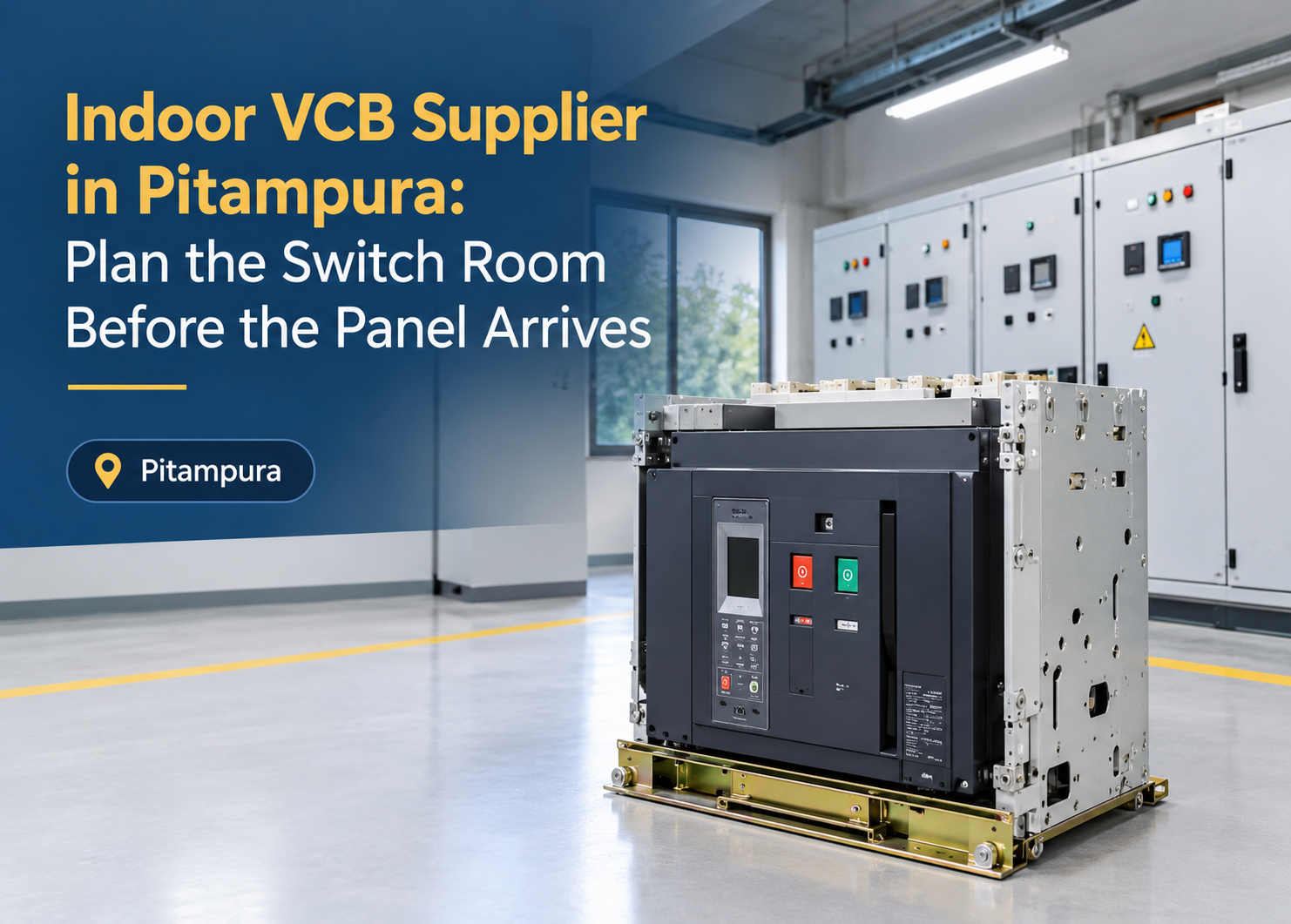
Picture this. A new HT panel reaches a commercial tower near Netaji Subhash Place. The truck is on time, the paperwork is fine, and then somebody notices that the basement ramp is too steep, the lift is too small, and the breaker truck cannot be pulled out because the wall is 400 mm too close.
Nobody in that story bought the wrong breaker. They simply chose the equipment before they looked at the room.
That is the mistake I see most often when people go hunting for an Indoor VCB Supplier in Pitampura. The conversation starts with price and rating, and the room, the access route and the after-sales visit get discussed too late. This guide flips the order. It is written for facility heads, electrical consultants and project managers working in Pitampura, Rohini, Shalimar Bagh, Ashok Vihar and the rest of North West Delhi.
Quick read
- Measure the switch room and the access route before you finalise the indoor VCB panel.
- Match the voltage class to your supply: 11KV indoor VCB for most buildings, 33KV indoor VCB for larger campuses and bulk-supply sites.
- Put short-circuit rating, relay type and test reports in writing.
- Confirm utility and electrical inspector requirements early.
- Pick a supplier who will visit the site and still pick up the phone after commissioning.
Why indoor switchgear makes sense in Pitampura
This part of Delhi is dense. Office towers, hospitals, schools, group-housing societies and shopping complexes sit shoulder to shoulder, and most of them have the same problem: no spare open land. The HT equipment goes into a basement, a ground-floor room or a dedicated substation block.
That suits a vacuum circuit breaker well. The contacts sit inside a sealed vacuum interrupter, so the breaker needs very little maintenance compared with the old oil-type designs. Keeping the whole panel indoors also protects it from what Delhi throws at equipment every year: 45°C summers, monsoon humidity and the fine dust that comes with winter smog.
Indoor does not mean problem-free, though. A badly planned switch room can hurt a good panel just as much as bad weather can.
What an indoor VCB panel actually does
In plain words, an indoor VCB panel is a metal-enclosed cubicle that holds the breaker, the busbars, the instrument transformers and the protection relay. The breaker is usually withdrawable, meaning it sits on a truck that can be racked in and out. That is what lets your electrician isolate it and test it safely without shutting the whole building down for long.
The breaker’s job is simple to describe and critical to get right. In normal operation it switches load. During a fault, the relay sends a trip signal and the breaker clears the fault current within a few cycles.
You will mostly meet two classes:
- 11KV (12kV class): the everyday choice for commercial buildings, hospitals, institutions and industrial units. See our 11KV Indoor VCB range.
- 33KV (36kV class): used on large campuses, bulk-supply consumers and bigger substations. See our 33KV Indoor VCB range.
If you want the technical side of ratings and features in more depth, our 11KV indoor VCB selection guide covers it. Here I want to stay on the practical, on-site questions.
The switch room comes first
Ask any site engineer who has handled a few HT installations and they will tell you the same thing: most delays come from the room, not the panel. Walk through this list before you issue an enquiry.
| What to check | Why it matters | What to ask your supplier |
|---|---|---|
| Front and rear clearance | The breaker truck has to be pulled out and turned. Tight rooms make routine work unsafe. | A dimensioned layout drawing with the minimum operating and withdrawal space |
| Ceiling height and cable entry | Bottom cable entry needs a trench or cable chamber of the right depth. | Recommended trench depth and cable bending radius |
| Access route | A single panel can weigh several hundred kilograms. Lifts, ramps and door frames often can’t take it. | Shipping dimensions and weight per panel section |
| Ventilation and temperature | Standard ratings assume an ambient of up to 40°C. Delhi summers go beyond that, and a closed basement runs hotter. | Whether the current rating needs derating at your room temperature |
| Humidity and water | Basements can sweat in monsoon, and some low-lying areas see waterlogging. | Panel space heaters, and a raised plinth or sealed cable trench |
| Fire safety | Electrical rooms need their own rules: no water pipes overhead, sealed cable openings, suitable extinguishers. | What fire and safety provisions your consultant expects |
| Earthing and floor | Poor earthing is the quiet cause of nuisance trips and real danger. | Earthing arrangement and floor loading per panel |
Here is a small trick I like. Take your phone, photograph the room from the door, the access path and the cable entry point, and share those with the supplier before the quotation stage. Five minutes of looking at real photos saves weeks of redesign.
Choosing between 11KV and 33KV
For most Pitampura projects, the question answers itself. Your supply voltage and your connection agreement decide the class, not your preference. A hospital or an office tower fed at 11kV will want an 11KV panel. A very large campus or a bulk-supply connection at 33kV needs a 36kV-class panel.
What people get wrong is the next step. They pick the class correctly and then copy the current and fault ratings from an old drawing. Ask your electrical consultant for the actual system fault level instead. A breaker that is undersized for the fault current is a safety problem, and one that is oversized for no reason is just money spent. Our datasheet guide for 36kV panels shows how to read the numbers before comparing prices.
What to put in writing before you order
A verbal “yes, it will be fine” is not a specification. Ask for these items on paper:
- Rated voltage and normal current of the breaker and busbars.
- Short-circuit breaking capacity and duration, for example 25 kA or 31.5 kA for 3 seconds. Use your own system fault level here, not a catalogue default.
- Operating mechanism and control supply. Spring-charged mechanisms are common, and the DC control voltage (often 110V or 30V) must match your battery system.
- Protection relay type and settings support. A numerical relay with overcurrent and earth-fault functions is a typical starting point.
- Interlocks that stop the breaker from being racked or earthed in an unsafe sequence.
- Applicable standards, such as IEC 62271-100 and IS 13118 for the breaker, and IEC 62271-200 or IS 3427 for the metal-enclosed switchgear.
- Type test and routine test reports. If internal arc protection matters in a crowded building, ask for the internal arc classification too.
A supplier who answers these calmly and quickly is usually one who has handled real installations. A supplier who changes the subject to discounts probably hasn’t.
Approvals: do the paperwork early
HT installations need clearance from the electrical inspector before energisation, and the local distribution company has its own technical requirements. In this part of Delhi that is generally Tata Power-DDL, but rules and procedures get updated, so confirm the current requirement with the concerned office before you finalise the specification.
We have written about the approval and delivery side in more detail in our Pitampura outdoor RMU guide. Much of that applies to indoor projects as well, especially the advice about delivery timing for heavy vehicles in Delhi.
Why a local Indoor VCB Supplier in Pitampura makes a real difference
Two quotations for the same ratings can sit 10 to 15 percent apart, and people usually grab the cheaper one. The gap tends to reveal itself months later.
With a local supplier, someone can come and measure the room before quoting. Someone can be on site on commissioning day when the relay settings need a last-minute tweak. And when a trip coil fails or a closing spring stops charging, a short drive beats a courier and a phone queue.
After commissioning, a yearly check keeps the panel healthy. In practice that means cleaning, checking the mechanism and lubrication, measuring contact resistance and timing, insulation testing, and a secondary injection test on the relay. Keep a few critical spares handy, such as coils and the spring-charging motor.
If your project is about swapping an old oil-type breaker for a modern one, the questions are a little different. We’ve covered them in our guide on replacing old oil breakers with a VCB.
How Arpan Power Projects works with Pitampura buyers
Arpan Power Projects has its registered office at GDITL Tower, Netaji Subhash Place, Pitampura, and a manufacturing unit at Khera Kalan Industrial Area, Delhi. We work as a supplier, channel partner and stockist for VCBs, HT panels, RMUs, transformers and compact substations, and we support enquiries from Pitampura, Rohini, Shalimar Bagh, Ashok Vihar, Model Town and across Delhi NCR.
Most conversations begin with a few plain questions. Where is the switch room? How will the panel reach it? What is the supply voltage? What is the fault level? From there we can suggest the right breaker class and panel layout from our HT Panel / VCB range. If you also need a transformer and switchgear in one package, a compact substation may be quicker to commission.
What to keep ready when you call
- Site address, plus photos of the switch room and access route
- Supply voltage (11KV or 33KV) and rated current
- System fault level, if you have it
- Number of incoming and outgoing feeders
- Control supply voltage and relay preference
- Any correspondence with the distribution company
- Your target date for energisation
With these in hand, the quotation you receive will match your building, not a generic datasheet.
Frequently asked questions
Can an indoor VCB panel be installed in a basement in Pitampura?
Yes, as long as the room has proper ventilation, protection from water ingress, safe access for moving the panels and the clearances the layout drawing asks for. Check basement drainage and humidity before you finalise the location.
What is the difference between an indoor and an outdoor VCB?
An indoor VCB panel is built for a protected room, while an outdoor version has a weatherproof enclosure for open locations. If you have a dedicated switch room, indoor is usually simpler and easier to maintain.
Should I choose an 11KV or a 33KV indoor VCB?
It depends on your supply voltage and connection agreement. Most commercial and institutional buildings run on 11kV. Share your connection details with your supplier and your consultant before deciding.
How often does an indoor VCB need maintenance?
Vacuum breakers need far less upkeep than oil breakers, but an annual inspection and test is a sensible habit. Follow the manufacturer’s maintenance schedule and your site’s safety rules.
Can you supply outside Pitampura?
Yes. We serve other parts of Delhi, the wider NCR and projects across India.
Before you decide
A good Indoor VCB Supplier in Pitampura will ask about your room, your fault level and your timeline before they talk about discounts. That is the best sign you are dealing with people who have done this before.
If you’d like to talk through a project, call +91 98688 64101 or send your requirement through our contact page. The team at Arpan Power Projects will come back with a recommendation based on your site, not just a price list.