
Blog
11KV Outdoor VCB Supplier in India: What Really Sets the Price, and How to Write an RFQ That Gets Honest Quotes

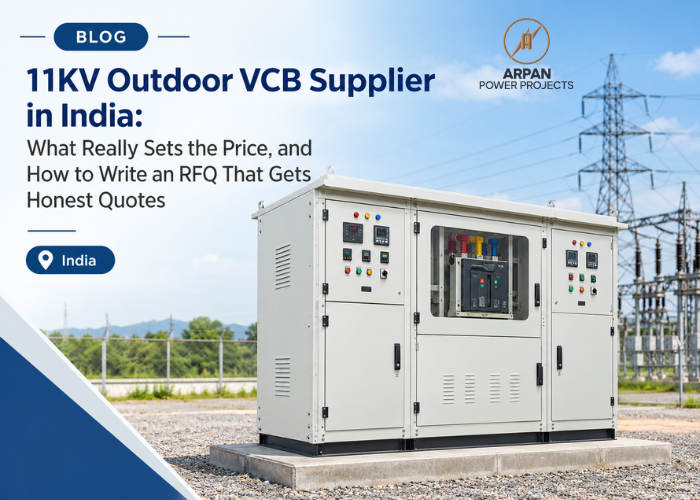
Ask five suppliers what an 11 kV outdoor breaker costs and you will get five numbers that cannot be compared with each other. One includes the relay. Another does not. A third quotes the breaker alone and forgets the support structure. By the time the purchase order is cleared, the cheapest quote has quietly become the most expensive one.
This is not a guide on how to shortlist a vendor, and it is not a list of factory tests. We have already written about how to choose the right 11KV outdoor VCB supplier in India and about the tests, documents and site checks buyers skip. This one is about the commercial side: what drives the price, why quotes differ, and how to write an enquiry that makes every 11KV Outdoor VCB Supplier in India answer the same question.
We will not print a price list here, and you should be a little wary of anyone who does. An outdoor vacuum circuit breaker is configured to a site, not picked off a shelf.
Why there is no single “price per piece”
An outdoor VCB at 11 kV (highest system voltage 12 kV) can be a bare breaker on a pole structure, a sealed polymer-clad unit, or a complete outdoor VCB panel with relay, metering and a weatherproof enclosure. Same voltage class, very different scope. So when a buyer says “send me your rate for an 11kV outdoor VCB”, the honest answer is a question: which one, and for which site?
At Arpan Power Projects, a large share of our first calls start exactly like this. The conversation gets productive only after we have the fault level, the protection scheme and the location.
Eight things that move the price
| What changes | Why it affects cost | What to tell the supplier |
|---|---|---|
| Short-circuit breaking current | A 25 kA design carries more robust interrupters and mechanism than a 16 kA one | Fault level at your connection point, from the utility or consultant |
| Rated normal current | 630 A and 1250 A ratings use different conductor and contact sizing | Present load plus planned expansion |
| Format | Open pole-mounted, polymer-clad (PCVCB) and enclosed panel are different products | Which one the consultant has specified |
| Protection and metering | Relay make, CT/PT ratios, energy meter and communication add scope | Relay make, CT ratio, metering class, SCADA needs |
| Enclosure and site conditions | Coating, IP rating, canopy and ventilation depend on climate | Exact location, altitude, coastal or dusty site |
| Auxiliary supply | Motor-charged spring mechanisms and DC supply need a defined voltage | Available AC/DC auxiliary voltage, battery charger if needed |
| Testing and inspection | Third-party or witnessed inspection adds time and cost | Whether you or your consultant will attend |
| Quantity and delivery | Repeat units cost less to engineer than a one-off | Number of units, delivery location, target date |
None of these is exotic. The trouble is that most enquiries mention one or two and leave the rest to guesswork, so every supplier guesses differently.
The cheap quote trap: what often goes missing
If one 11kV outdoor VCB price looks far below the others, check what is not in it before you celebrate. In our experience the usual gaps are:
- The protection relay, or a lower-grade one than the one specified
- CTs and PTs left out of scope
- Cable boxes or terminations
- Support structure, base frame or plinth drawings
- Battery and charger for the control supply
- Commissioning support and a written warranty
- Spare parts, such as closing and trip coils
A fair comparison needs the same scope on every offer. Ask each supplier to quote against one common specification sheet, and the differences either disappear or become easy to explain.
How to write an RFQ that gets honest answers
You do not need a long document. You need a complete one. Cover these points:
- Project and location. State city and state, and mention if the site is coastal, hilly or very dusty.
- Voltage and system. 11 kV, 3-phase, 50 Hz, with the earthing arrangement of your network.
- Fault level. Short-circuit breaking current and duration (for example 3 seconds), not a guess.
- Current rating. Normal current in amperes, with a note on expansion.
- Breaker format. Open type, PCVCB, or an enclosed outdoor panel.
- Protection and metering. Relay type or make, CT ratios, meter class.
- Auxiliary supply. AC and DC voltages available at site.
- Standards. IS 13118 or IEC 62271-100, and any consultant or utility specification.
- Documents needed. Datasheet, GA drawing, type test reports, routine test certificates, O&M manual.
- Commercial terms. Delivery point, quantity, required date, payment and warranty expectations.
And a tip we give every first-time buyer: attach the single-line diagram if you have one. It answers half of our questions before we ask them.
What about lead time?
Be careful with anyone who gives a delivery date before seeing the specification. Lead time depends on whether the design is standard or customised, on how fast drawings are approved, and on whether inspection is witnessed. The part that slips most often is not manufacturing. It is the drawing approval loop between supplier, consultant and utility. Send your approval contacts early, and your schedule gets shorter without anyone working faster.
A note for Delhi NCR and North India buyers
If your project is in Delhi NCR, Haryana, Punjab, Uttar Pradesh or Rajasthan, being close to the manufacturer is a real advantage, not a slogan. Our manufacturing unit is at Khera Kalan Industrial Area, Delhi, so a site engineer or consultant can walk in, look at the unit and discuss changes in person. We also dispatch to projects across India, so buyers in the west and south are not left out.
For 33 kV yards, our guide to the 33kV outdoor VCB supplier in New Delhi covers the next voltage class.
Three mistakes we keep seeing
Copying the last project’s specification. Fault levels and site conditions change from one location to another. Specify for this site.
Comparing unit price instead of total scope. The rupee figure on top of the page tells you very little. The scope list underneath tells you everything.
Skipping the question about service. A breaker will run for years. Ask who you will call when a trip coil fails in the monsoon, and whether they will pick up.
Related reading
- Considering an enclosed format? See our 11KV outdoor VCB kiosk type guide.
- Want the sealed, compact option? Look at the 11KV and 33KV PCVCB.
- Browse the complete HT Panel and VCB range.
Why buyers talk to Arpan Power Projects
Arpan Power Projects supplies HT switchgear, including 11KV and 33KV VCBs, RMUs, compact substations and transformers, from our base in Delhi. We start every enquiry with the fault level, the site and the protection scheme, and only then talk about the product. You can see the product details on our 11KV Outdoor VCB page, or send your specification through the contact page and we will reply with a quote that lists exactly what is included.
Frequently asked questions
Can I buy only the breaker without the panel?
Often yes, if your design has its own structure, relay and metering. Mention this in the RFQ so the quote matches.
What should I send to get an accurate quote?
Location, fault level, current rating, format, relay and metering requirements, auxiliary supply and quantity. A single-line diagram helps a lot.
Why do two quotes for the same voltage class differ so much?
Usually because of scope: relay, CTs, structure, enclosure, testing and documents are included in one and missing in the other.
Do you supply outside Delhi NCR?
Yes. We manufacture in Delhi and supply to projects across India.
Final thought
A good 11KV Outdoor VCB Supplier in India will not rush to give you a number. They will ask about your fault level, your site and your protection scheme, because those answers decide the price. Write a complete RFQ, compare like with like, and the right supplier usually becomes obvious.