


Blog
33KV RMU Supplier in India: What to Ask for in Writing Before You Release the Purchase Order

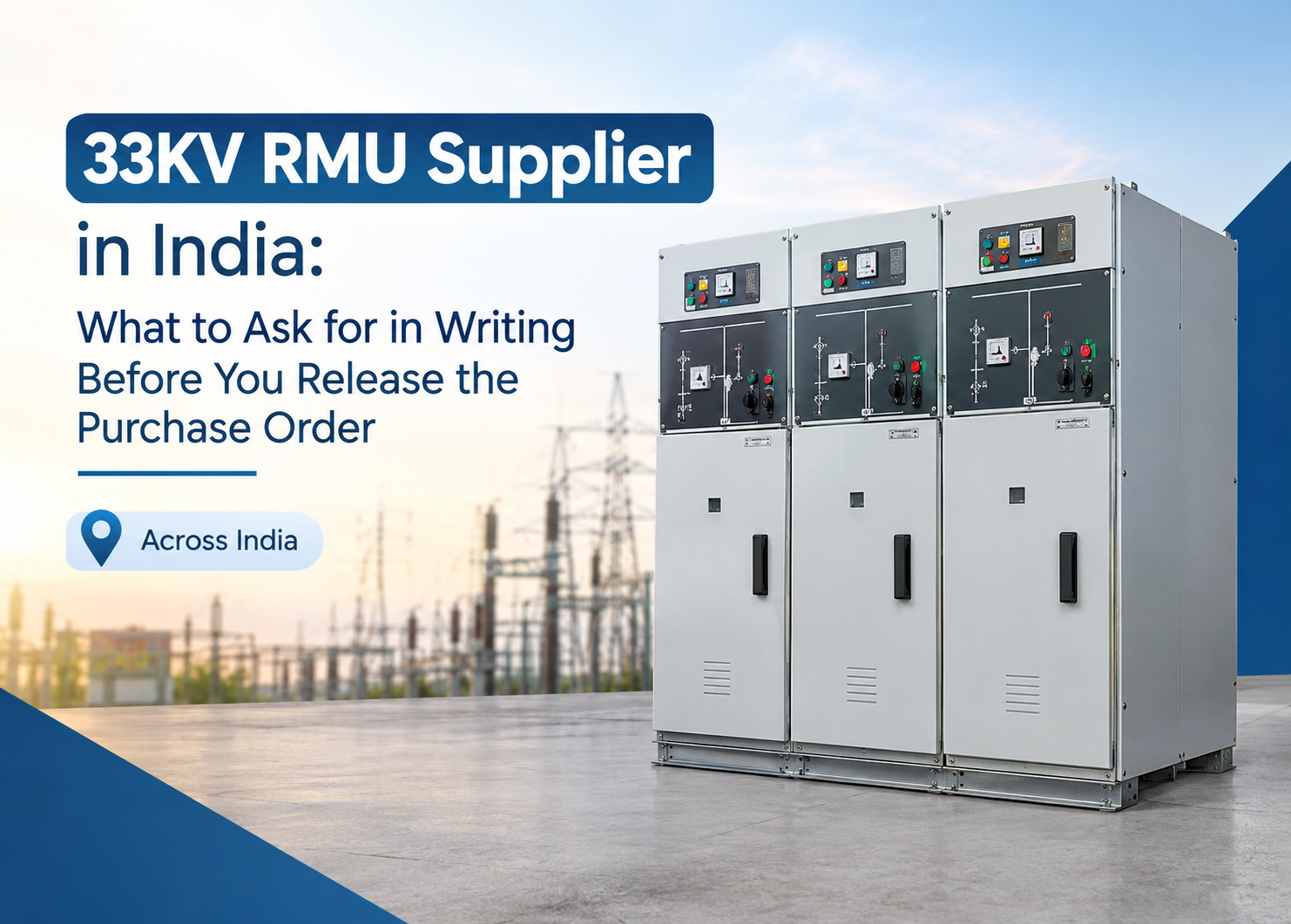
Here’s a pattern I’ve seen more than once. Two quotations for a 33kV ring main unit land on the same desk. The datasheets look almost identical. Same voltage class, same short-circuit rating, same colour of enclosure. The cheaper one wins, and everyone moves on.
Six months later, someone is chasing the supplier for a missing test certificate, or discovering that the cable box is too shallow for the termination kit the cable contractor has already bought.
None of that shows up on a datasheet. It shows up in the paperwork, the factory tests and the handover. That is what this article is about: how to judge a 33KV RMU supplier in India by what they are willing to put in writing, rather than by what they print in a brochure.
If you’re still at the stage of understanding what a ring main unit does and where it sits in a network, start with our earlier guide on what a 33KV RMU is and where it is used. This one assumes you already know that, and you’re about to spend real money.
Start with the voltage class, because the label can mislead
A “33kV” network is built from equipment rated 36 kV. So when a quotation says “33KV RMU” but the datasheet quietly lists 24 kV or 27 kV, stop right there. It happens, usually because a supplier is trying to fit a smaller product into a bigger enquiry.
Ask the supplier to state, in the offer itself:
- Rated voltage (it should read 36 kV)
- Power-frequency and lightning-impulse withstand levels
- Rated normal current for each way
- Short-circuit withstand, with duration (commonly 20 or 25 kA for 1 or 3 seconds, but your system fault study decides this, not the supplier’s catalogue)
Simple, boring, and it filters out a surprising number of mismatched offers.
Type test reports: ask for the right one, not just any one
Every serious 33KV ring main unit manufacturer will say “fully type tested”. Fine. Now ask to see it.
A type test report is only useful if it actually matches what you are buying. Check these four things:
- The standard. For metal-enclosed switchgear this is normally IEC 62271-200, with the switching devices tested to their own parts of the 62271 series. Indian practice also references IS 3427.
- The lab. Reports from recognised labs such as CPRI, ERDA or an internationally accredited laboratory carry weight. A summary page with no lab letterhead doesn’t.
- The variant. A report for a 3-way unit does not automatically cover a 4-way unit with a different cable compartment. Ask the supplier to explain, in writing, how the tested design relates to the one you’re ordering.
- The date and revision. If the design has changed since the test, the report may no longer apply.
If internal arc classification matters to your site (and for any unit installed near people, it should), ask for the IAC test report separately. Don’t accept a one-line claim.
The factory acceptance test is where problems are cheapest to fix
A type test proves the design. The routine and factory acceptance tests prove your unit. Those are different things, and good suppliers are comfortable with that distinction.
Before you place the order, agree on what will be tested and who gets to watch. A reasonable FAT scope for an outdoor ring main unit or indoor unit usually includes:
- Power-frequency voltage test on the main circuit
- Main-circuit resistance measurement
- Mechanical operation checks, including interlocks
- Gas tightness checks for gas-insulated units
- Checks on auxiliary and control circuits
- Partial discharge measurement, where specified
- Visual and dimensional inspection against the approved drawing
Put the FAT in the purchase order. State that you, or your inspection agency, may witness it. Ask for the signed test sheet with the serial number of every unit, not a generic certificate.
It costs almost nothing to include these terms up front. Adding them after the order is signed is a far harder conversation.
Check the interfaces, because that is where site delays are born
Most RMU headaches I hear about aren’t about the switchgear itself. They’re about where it meets something else.
Cable termination. Confirm the bushing interface type and the cable box dimensions against the 36 kV cable and termination kit you’ve actually selected. Stress cones, armour earthing and bending radius all need room. A cable box that is “standard” for the supplier can still be tight for your cable.
Protection and metering. Ring ways are typically load break switches, while transformer or tee-off ways may use a vacuum circuit breaker with a protection relay. Ask who supplies the relay, which CT ratios are fitted, and whether the relay settings are part of the scope or yours.
Earthing and interlocks. The earthing switch should be interlocked with the switch, and the unit should have voltage presence indication. Ask for the interlock logic in a one-page note. If the answer is vague, that’s your answer.
Civil interface. Foundation drawings, cable trench dimensions and gland plate details should come with the approved GA drawing, not after the unit arrives.
If your RMU is going into a packaged substation, read our site checklist on compact substation installation in India, because the same interface thinking applies.
Insulation medium: ask about the lifetime, not just the choice
SF6, air-insulated and solid-insulated designs all exist at 36 kV, and each has a place. I won’t argue for one here. What I’d ask any RMU manufacturer in India is the lifetime question:
- For gas-insulated units: what is the declared leakage rate, how is pressure monitored, and who handles gas servicing at end of life?
- For solid-insulated units: what is the partial discharge performance, and how is the unit tested?
- For air-insulated units: how does the design cope with humidity and dust at your site?
A supplier who has thought about the next 20 years will answer calmly. One who hasn’t will change the subject to price.
Handover: what a complete delivery should look like
A good delivery isn’t just a truck arriving. Before you accept the unit, you should hold:
- Approved GA and foundation drawings (as-built)
- Type test reports and routine test certificates, matched to serial numbers
- Wiring diagrams and relay/CT details
- Operation and maintenance manual
- Recommended spares list
- Warranty terms in writing, including what counts as start of warranty (dispatch, delivery or commissioning)
- Commissioning checklist
At site, the usual checks include insulation resistance, contact resistance, interlock operation, relay secondary injection and cable testing as per your project procedure. If your supplier offers to attend commissioning, take them up on it. The first energisation is the worst time to be reading a manual for the first time.
Spares and response: the unglamorous part of supplier selection
Ask three direct questions:
- What spares do you recommend we keep, and which do you stock?
- Who do we call if an operating mechanism jams or an indicator fails?
- How quickly can someone reach a site in our region?
For projects across Delhi NCR, Haryana, Uttar Pradesh and Rajasthan, a supplier with a New Delhi office and a nearby manufacturing base has a practical advantage here. A phone call and a site visit can happen in days, not weeks. For projects elsewhere in India, ask for the dispatch and support plan in writing instead of assuming it.
Red flags I’d take seriously
- The quotation shows 33 kV where it should say 36 kV rated
- The type test report is “available on request” and then never arrives
- FAT is described as “in-house, no witness”
- No GA drawing before order confirmation
- Warranty starts the day of dispatch
- Nobody can name the standard the unit is built to
One or two of these may have an innocent explanation. Three or more usually don’t.
How we handle this at Arpan Power Projects
At Arpan Power Projects, we supply 11KV RMU, 33KV RMU, indoor and outdoor VCBs, compact substations and transformers, working with established manufacturers including Eaton and KBL among our partners. Our registered office is in Pitampura, New Delhi, and our manufacturing unit is at Khera Kalan Industrial Area, Delhi.
When an enquiry comes in for a 33kV unit, our first step is usually a short technical conversation about the system fault level, cable type and site conditions, before any price is quoted. It saves both sides from re-quoting later. If you’d like your specification reviewed against the checklist above, you can browse our RMU range or contact our team.
If your project also includes outdoor installation, our guide to choosing an Outdoor RMU supplier in India covers monsoon, dust and heat in detail. For the incoming side of a 36 kV system, see our notes on a 33KV indoor VCB supplier in India.
Final thoughts
Choosing a 33KV RMU supplier in India isn’t really a hunt for the lowest number on page three of the quotation. It’s a hunt for the supplier who is comfortable being specific: specific about ratings, specific about tests, specific about what you’ll hold in your hands on handover day.
Ask for things in writing. Put the FAT in the PO. Check the cable box before the cable arrives. Those three habits will save you more money than any discount.
Frequently Asked Questions
1. Which documents should I ask a 33KV RMU supplier for before ordering?
Ask for type test reports, the IAC report if relevant, a GA drawing, a technical datasheet showing 36 kV rating, a proposed FAT plan, and the warranty terms. Ask for these before the PO, not after.
2. Can I witness the factory acceptance test?
You should be able to. Mention it in your enquiry and your purchase order. Most reputable suppliers accept witnessed testing, and hesitation is worth noting.
3. How do I compare two 33KV RMU quotations fairly?
Compare rated values (voltage, current, short-circuit), insulation medium, test scope, what’s included (relays, CTs, cable boxes) and warranty start date. A lower price often means something has been left out.
4. Does an outdoor ring main unit need different checks?
Yes. Along with the points above, check enclosure protection, coating quality and condensation control. Our Outdoor RMU guide goes through these.