

Blog
11KV Indoor VCB in Daryaganj: What to Check When Your Old Switch Room Was Built for a Different Era

Open the door of an old HT room in Old Delhi and you can usually guess the decade it was built. Whitewashed walls, a cable trench with a rusted cover, and a big oil-filled breaker sitting in the corner like it owns the place. It has worked for thirty years, maybe forty, so nobody wants to touch it.
Then the load grows. A floor gets added, the lifts multiply, the air-conditioning doubles, and one day the electrician says the breaker needs attention again. That is usually the moment people start searching for an 11KV Indoor VCB in Daryaganj.
It’s rarely a clean-slate project. It’s an old building, a tired breaker and a switch room designed for a very different era. This guide covers what to check before you order anything, so the new panel fits the room, the load and the people who will actually operate it.
Why Daryaganj switch rooms need more thought than a standard job
Most installation advice assumes a purpose-built substation. Daryaganj isn’t that. The streets around Ansari Road and Delhi Gate mix publishers, printing units, wholesale shops, hotels, clinics and offices, often inside buildings that have been extended floor by floor over decades.
That mix creates three problems that never show up on a datasheet:
- The room hasn’t grown, but the load has. The switch room was sized for the connected load of its day, not for today’s.
- The surroundings are hard on equipment. Paper dust, damp walls in the monsoon and poor airflow are common in older Central Delhi premises.
- Outage windows are short. Shops and offices can’t go dark for days, so the changeover has to be planned like a small operation.
A quick refresher: what an 11KV indoor VCB actually does
A vacuum circuit breaker interrupts current inside a sealed vacuum bottle. When the contacts part, the arc has nothing to sustain itself on and dies out within a few cycles. No oil to burn, no gas to top up, very little to service.
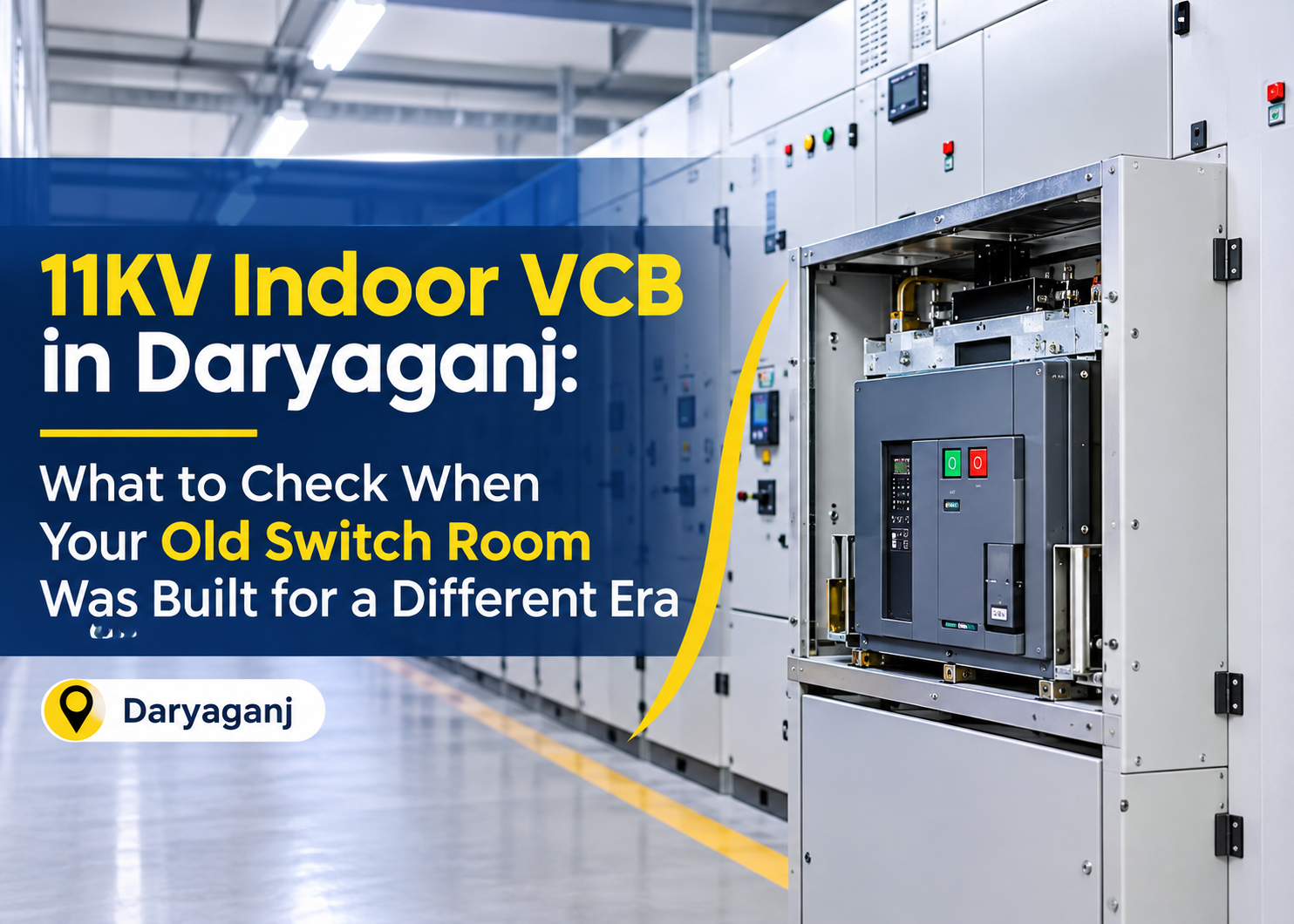
An 11KV indoor VCB is that breaker fitted into a metal-enclosed indoor VCB panel, usually a withdrawable (draw-out) design with busbars, CTs, protection relays and safety interlocks around it. It’s built to live inside a building, out of the rain, which is exactly why the condition of the room matters so much.
Here’s how it compares with the older oil-type breaker many Daryaganj buildings still run:
| Old oil-type breaker | Modern 11KV indoor VCB panel | |
|---|---|---|
| Arc quenching | Oil, which ages and needs testing or replacement | Sealed vacuum interrupter |
| Fire risk | Oil is a fuel source | No oil in the interrupting unit |
| Routine upkeep | Frequent oil checks and contact cleaning | Light, periodic inspection |
| Footprint | Often bulky | Generally more compact |
| Protection | Older electromechanical relays | Numerical relays with fault records |
| Spares | Getting harder to source | Easier to source |
Five checks before you order an 11KV VCB panel
1. Don’t copy the old nameplate blindly
The old breaker’s plate tells you what the network looked like years ago. Supply networks get stronger over time, and the fault level at your 11KV point may have crept up since. Confirm it with your distribution company or your electrical consultant before choosing the short-circuit rating. Panels at this voltage commonly come in 25 kA and 31.5 kA classes, but the right one is the one your system needs, not the one that looks familiar. Size the rated current from the real load, with sensible room for growth.
2. Measure the room like you mean it
Width and depth aren’t enough. A withdrawable breaker needs clear floor in front of the panel so the truck can be racked out and rolled away safely. Ask for the general arrangement drawing and compare its front, rear and overhead clearances against your actual room. Then look at the unglamorous bits: does the old cable trench line up with the new panel’s cable entry, is the floor level and strong enough, and can the sections physically pass through the door and up the staircase?
The delivery side of this problem, getting equipment through a crowded lane, is covered separately in our guide to 33KV indoor VCB panels in Daryaganj. Here we’ll stay inside the switch room.
3. Plan for damp, dust and poor air
Old buildings breathe badly. Moisture condenses on cold busbars, and paper or textile dust finds its way into everything. Look for anti-condensation heaters in the panel, properly sealed cable entries and gland plates, and decent ventilation in the room itself. And clean the room before the panel arrives. Installing brand-new 11KV switchgear into a dusty room is a slow way to ruin it.
4. Check the supporting cast
A breaker is only as good as what tells it to trip. Many older plants have a dead or ageing battery bank, and without healthy DC auxiliary supply the breaker can’t operate when a fault arrives. Check the battery and charger, confirm the CT and PT ratios suit the new relays and metering, and have the earthing system tested. These items are cheap compared to the panel and expensive to discover late.
5. Agree the shutdown window with everyone affected
Talk to the occupants first, then fix the date. Sort out approvals from the distribution company and the electrical inspector before you plan to energise, and keep test certificates ready for that visit. A rehearsed sequence, who isolates what, in what order, with who watching, saves far more time than any shortcut on the day.
Mistakes that keep showing up on retrofit jobs
- Ordering first and measuring later. A panel that’s two inches too tall has no good answer.
- Treating relays as an afterthought. Protection settings decide whether a fault is a small event or a building-wide outage.
- Skipping pre-energisation tests because the panel “came tested from the factory.” Transport and site conditions change things.
- Forgetting the operator. The person who will rack the breaker in and out should be briefed on interlocks before handover, not after the first mistake.
What to ask your supplier for
Before you place an order for an 11KV indoor VCB, ask for the paperwork that proves what you’re buying: type test reports for the breaker and panel from recognised laboratories, routine test reports for your actual unit, the GA and schematic drawings, details of the relay make and settings support, warranty terms, and how spares and service will reach you in Delhi. At Arpan Power Projects, we encourage customers to ask for all of this upfront. If a supplier gets vague at this stage, that tells you plenty.
Indoor or outdoor? A quick word
If your building has no usable room at all, an outdoor enclosure is sometimes the fallback. In a crowded Old Delhi lane, though, a plinth in the open brings its own problems with space, access and public interference. Where even a modest room can be made ready, an indoor VCB panel usually gives you a safer, tidier and better-protected installation.
Getting the right 11KV VCB panel for your building
If you’re weighing options, our 11KV Indoor VCB page lists the configuration and specifications we work with. Our team is based in Delhi, with the registered office at Netaji Subhash Place, Pitampura, so a conversation about a Daryaganj site doesn’t need to start with a long-distance call. Share the single-line diagram, fault level and rough room dimensions, and we can help you narrow down what suits the site.
Frequently asked questions
Can an 11KV indoor VCB replace an old oil circuit breaker?
Often yes, but it is rarely a drop-in swap. Dimensions, CT ratios, cable entry and protection all need checking. In some cases only the breaker can be replaced; in others the whole panel or board makes more sense.
What current and fault rating should I choose?
It depends on your actual load and the fault level at your supply point. Get the fault level confirmed rather than guessing from the old nameplate.
Do I need approvals before energising?
HT installations generally need clearance from the distribution company and the electrical inspector. Check the current requirements with them early, since the process can shape your timeline.
How much maintenance does a VCB need?
Far less than an oil breaker, but not none. Periodic inspection, cleaning, operating checks and relay testing should follow the manufacturer’s schedule.
Final thoughts
A smooth 11KV Indoor VCB in Daryaganj project is mostly decided before the panel is ordered: correct fault level, honest room measurements, a healthy DC supply and an outage window everyone has agreed to. Get those right and the installation itself becomes the easy part.
If you’re planning an upgrade, contact Arpan Power Projects or call +91 98688 64101 with your site details, and we’ll help you shortlist a panel that fits your room, not just your budget.