

Blog
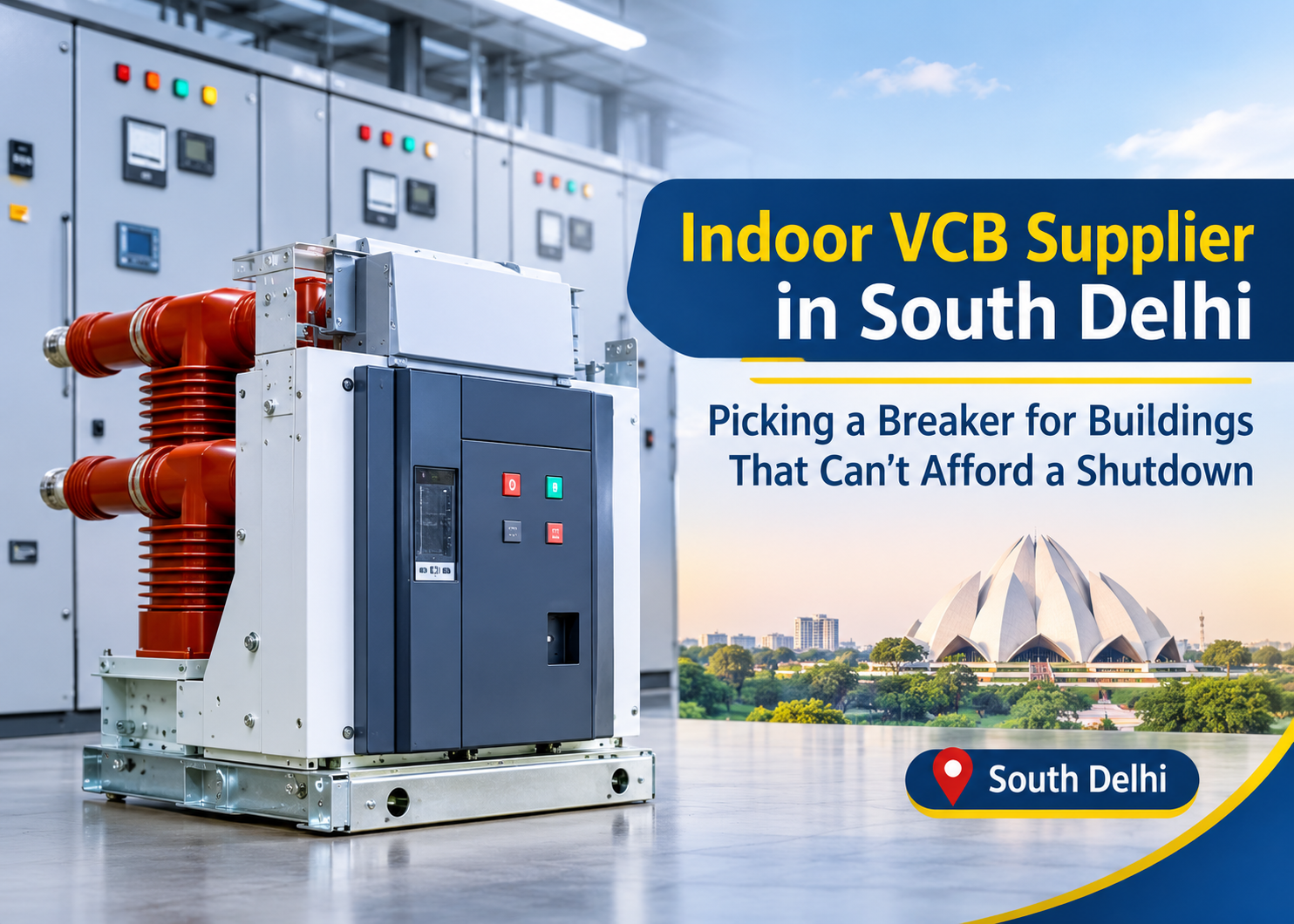
Indoor VCB Supplier in South Delhi: Picking a Breaker for Buildings That Can’t Afford a Shutdown

Think about a hospital in Saket, a mall in Vasant Kunj or a hotel near Nehru Place. Now ask one question: what happens if the main HT breaker needs servicing on a Tuesday afternoon?
In most buildings, the honest answer is “we shut everything down and hope nobody notices.” That’s the problem a good Indoor VCB Supplier in South Delhi should help you solve before you buy, not after.
This guide explains how to choose an indoor VCB for the kind of buildings South Delhi is full of: basements, tight switch rooms and loads that can’t switch off.
What an indoor VCB actually does
A vacuum circuit breaker (VCB) switches load current and clears faults. The contacts sit inside a sealed vacuum interrupter, so the arc dies out in the vacuum. There’s no oil to handle, and routine upkeep is light.
“Indoor” means the breaker lives inside a VCB panel in a protected room, away from rain, dust and sun. For the basics across ratings, our Indoor VCB Supplier in India page covers the 11KV to 36KV range. Here, let’s stick to what matters on a South Delhi site.
Why South Delhi switch rooms are different
Industrial yards have space. South Delhi usually doesn’t. A few patterns show up again and again:
- Basement switch rooms. Space is tight, ventilation is limited and humidity is a real concern in the monsoon.
- Critical loads. Hospitals, hotels, malls, institutions and data rooms can’t accept long outages.
- Mixed neighbourhoods. Panels sit close to people, so safety design matters more than a few thousand rupees saved.
- Okhla and nearby industrial pockets. Factories here need a robust 11KV indoor VCB for incomer and feeder duty.
Fixed or withdrawable: the decision that matters most
This is where most South Delhi buyers should spend their thinking time.
A fixed breaker is bolted into the panel. It’s simpler and usually cheaper. But servicing means the circuit is out of service while you work.
A withdrawable VCB can be racked out of the panel for inspection or replacement. The panel’s shutters close over the live parts when the breaker moves out. For a building where outages are costly, that flexibility is often worth the premium.
My rule of thumb after years of reviewing quotations: if a feeder shutdown would stop patient care, trading or guest services, choose withdrawable. If the load is a simple, non-critical feeder, fixed can be perfectly sensible.
Five checks before you order
1. Ratings that match the system. Confirm system voltage, rated current and short-circuit level. For higher-voltage networks, look at a 33KV indoor VCB instead.
2. The room, not just the panel. Measure the switch room, the door and the route to it. A panel that can’t be moved in is an expensive mistake. Check cable entry direction too.
3. Humidity protection. Ask about anti-condensation heaters and ventilation, especially for basements. Moisture quietly shortens the life of switchgear.
4. Protection relay and metering. The breaker only trips when the relay tells it to. Agree the relay type, CT ratios and any SCADA needs on paper.
5. Interlocks and safety. Ask which mechanical and electrical interlocks come with the VCB panel, and whether internal arc classification is required for your site.
Paperwork and approvals
South Delhi projects usually involve your DISCOM, a consultant and the statutory electrical inspector. Requirements vary by project, so confirm them with your consultant early. Ask your supplier for the drawings, test reports and documentation you’ll need for that process before you finalise the order.
What to send for a useful quotation
If you want a quote you can actually compare, share these:
- System voltage (11KV up to 36KV class)
- Rated current and fault level
- Number of incomer and outgoing feeders
- Fixed or withdrawable preference
- Relay, metering and SCADA needs
- Switch room dimensions and cable entry side
How Arpan Power Projects can help
At Arpan Power Projects, we supply HT switchgear including indoor and outdoor VCBs, RMUs, transformers and compact substations from our Delhi base, with a manufacturing unit at Khera Kalan Industrial Area. Our team helps you match breaker, relay and panel arrangement to your actual room and load, so the equipment fits the building and not just the datasheet.
If you’re comparing options, you may also like our 11KV Indoor VCB page. For a deeper look at panel quantities on a site, see our guide on 11KV Indoor VCB in Pitampura.
Frequently asked questions
Can an indoor VCB be installed outdoors?
No. It isn’t built for rain, dust and direct sun. For open yards, choose an outdoor breaker.
Is withdrawable always better than fixed?
Not always. It suits critical feeders where downtime hurts. For simple, non-critical feeders, fixed is a fair choice.
Does a VCB need a protection relay?
Yes. The breaker trips on a signal from the relay, which reads current through CTs.
Why vacuum instead of oil?
The arc is extinguished in a sealed vacuum interrupter, so there’s no oil to handle and routine maintenance is lower.
Ready to plan your switch room?
Send your voltage, current, feeder count and room details, and our team will help you shortlist the right indoor VCB for your South Delhi site. Visit Arpan Power Projects or use our contact page to request a quotation.