

Blog
From Drawing to Energisation: What a Good 33KV Indoor VCB Supplier in India Helps You Get Right

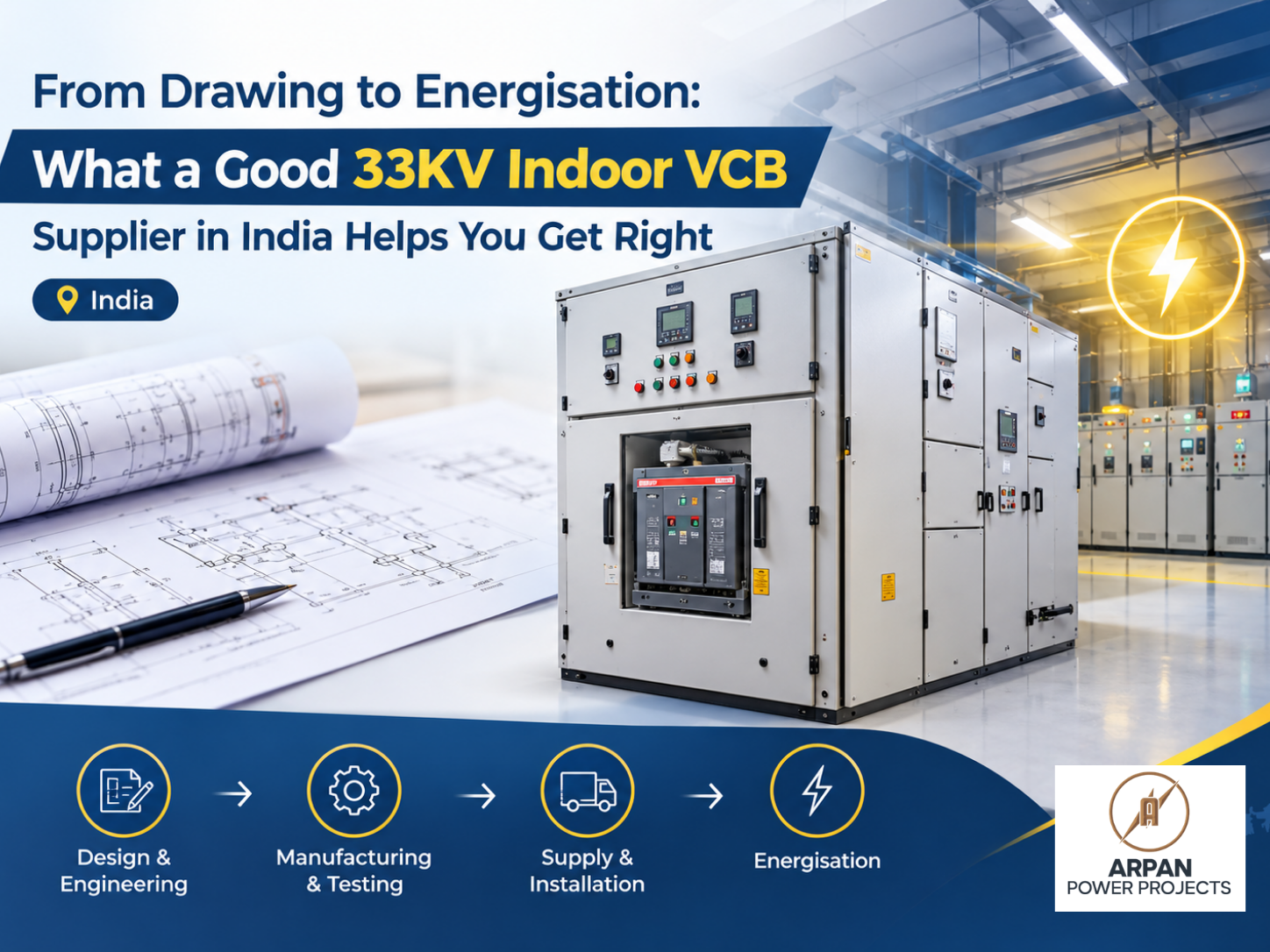
Most conversations about 36kV panels stop the moment the purchase order is signed. That’s a shame, because the expensive surprises usually arrive afterwards. A breaker truck that can’t be pulled out because a wall is a few hundred millimetres too close. A cable trench too shallow for 33kV cable bends. A panel that sits in the room for three weeks because nobody arranged the DC supply.
If you are shortlisting a 33KV Indoor VCB Supplier in India, ratings and price are only half the decision. The other half is whether the supplier can support you between delivery and the first day of energisation. That’s what this guide covers, written from what we see on real projects at Arpan Power Projects.
A Quick Refresher, Without the Textbook
A 33kV VCB panel uses a vacuum interrupter to put out the arc when it breaks a fault current. In India, 33kV systems are served by equipment in the 36kV class, which is why datasheets switch between the two numbers. Same thing, different label.
For this article, assume you’ve already finalised the rating and fault level. Now the panel has to live somewhere.
Planning the Switchgear Room
Civil teams often design the room from an old 11kV drawing. A 36kV indoor VCB panel is taller, deeper and heavier than its 11kV cousin, so that shortcut backfires.
Get the general arrangement (GA) drawing first. Before the floor is cast or the trench is dug, ask your supplier for the GA drawing with the panel width, depth, height and cable entry details. Share it with your civil contractor, not just the electrical team.
Leave room to work. The breaker truck has to come fully out of the panel and onto a service trolley, and somebody has to turn that trolley around. If the front clearance only works on paper, maintenance will be miserable for the next 25 years.
Think about the cable trench. 33kV XLPE cables don’t bend like a garden hose. The trench depth and the space below the panel need to respect the cable’s minimum bending radius, plus room for the terminations.
Respect the climate. Indoor doesn’t mean climate-proof. In Delhi NCR and across north India, summer room temperatures can climb well past what the panel’s standard ambient rating assumes, and monsoon humidity brings condensation. Good ventilation, panel space heaters and sealed cable entries are cheap insurance. If your site is at high altitude, tell your supplier early, because standard ratings need derating above 1,000 metres.
Don’t forget the auxiliary supply. The protection relays and the breaker’s tripping circuit need a healthy DC supply (battery and charger). It’s the thing most commonly forgotten until commissioning week.
Delivery and Handling
A 36kV panel is heavy and its internals are precision parts. Ask how the panels are packed, which lifting points to use, and whether the breaker trucks travel separately. When the shipment arrives, open it with the supplier’s checklist in hand and photograph any damage before signing the receipt. It takes ten minutes and can save a long argument later.
Store the panels in a dry, covered area if the room isn’t ready. Moisture is the quiet enemy of HT switchgear.
Installation: Where Small Shortcuts Become Big Problems
Without turning this into a site manual, these are the points we see skipped most often:
- Levelling the base frame. If the channel isn’t level, panel doors misalign and the breaker truck won’t rack smoothly.
- Busbar joints. Bolt torque matters. A loose joint heats up slowly and fails when the load is highest.
- Cable terminations. Done by a trained jointer with the right kit, not by whoever is free that day.
- Earthing. Every panel, the earth busbar and the room earth need proper, low-resistance connections.
Your supplier’s installation manual should be the reference for torque values and sequence, not memory or habit.
Pre-Commissioning Tests: What Should Happen Before Switching On
Before any HT switchgear is energised, a set of checks should be done and recorded. The exact list depends on the manufacturer’s manual and your project specification, but it typically includes:
| Test | What it tells you |
|---|---|
| Insulation resistance (megger) | Whether moisture or contamination is hiding in the insulation |
| Contact resistance | The condition of the main circuit joints and breaker contacts |
| Vacuum integrity (high-voltage withstand across open contacts) | Whether the vacuum interrupter is still healthy |
| Breaker timing and mechanism check | Opening and closing times, spring charging, trip and close coils |
| Interlock and rack-in/rack-out check | Whether the safety interlocks do what they’re meant to |
| Relay testing and CT/PT checks | Correct settings, ratios and polarity, so protection actually trips when it should |
Keep these records. They become your baseline for every future maintenance visit.
One thing we always tell buyers: if a supplier is reluctant to discuss site testing, treat that as information. A vacuum circuit breaker is a long-life asset, and the first set of readings is worth its weight in gold. For the factory-side documents to ask for, our guide on factory tests and documents buyers often skip applies equally to indoor panels.
The First Few Years: Keep Maintenance Simple
A 33KV vacuum circuit breaker needs far less attention than the old oil breakers, but “less” isn’t “none.” A sensible routine looks like this:
- Visual inspection and cleaning of the panel during planned shutdowns
- Lubrication and operation checks of the breaker mechanism as per the manual
- Checking contact wear indicators and operation counters
- Tightness checks on connections, ideally supported by an infrared scan while the panel is on load
- Repeating the insulation and contact resistance tests and comparing them with your commissioning records
Annual checks are a common starting point. Dusty industrial sites may need them more often.
What a Good Supplier Actually Does for You
Anyone can quote you a panel. Here’s what separates a dependable 33KV Indoor VCB Supplier in India from a transactional one:
- Shares the GA drawing and technical data before the order, not after.
- Provides type test certificates and routine test reports without chasing.
- Offers commissioning support, or at least clear written instructions for your own team.
- Keeps spares available and answers the phone in year five, not just week one.
- Understands how the panel fits with the rest of the chain, from the transformer to the downstream 11KV RMU or a compact substation on smaller sites.
Working With Arpan Power Projects
Arpan Power Projects supplies HT switchgear, RMUs, transformers and compact substations from Delhi. Our registered office is in Pitampura, New Delhi, and our manufacturing unit is at Khera Kalan Industrial Area, so buyers across Delhi NCR can visit, see the equipment and discuss technical details face to face. Projects in other states are supported through dispatch and remote coordination with your site team.
You can see the range on our Indoor VCB (11–36 kV) page. And if your site turns out to be better suited to an open yard, our guide to a 33kV outdoor VCB supplier in New Delhi will help you compare. For the wider picture of 11kV and 33kV panels, the indoor VCB guide is a good place to start.
Frequently Asked Questions
How much space does a 36kV indoor VCB panel need?
It varies by make and configuration, so use the manufacturer’s GA drawing. Plan for the panel footprint plus enough front space to withdraw and turn the breaker truck, and rear or top access as specified.
Do I need a separate battery and charger for a 33kV VCB panel?
Most installations do. The protection relays and the breaker’s trip and close circuits depend on a reliable DC supply, so confirm the requirement early.
Who should commission a 33KV indoor VCB panel?
Trained engineers following the manufacturer’s procedure and your project specification. Many buyers ask the supplier’s team to be present, at least for the first energisation.
Can I install a 33kV indoor panel in a hot, humid location?
Yes, with the right planning: ventilation, anti-condensation heaters, sealed cable entries and derating where needed. Tell your supplier the real site conditions before the order.
Planning a 33KV Project? Let’s Talk Early
The best time to involve your supplier is before the civil drawings are frozen. Send Arpan Power Projects your single-line diagram, the rating and fault level, and the site location. We’ll help you check room dimensions, cable entry and testing requirements, so the panel arrives and goes live without drama.