

Blog
CSS Compact Substation Supplier in India: Why Two Quotes for the Same kVA Never Match (and How to Compare Them Fairly)

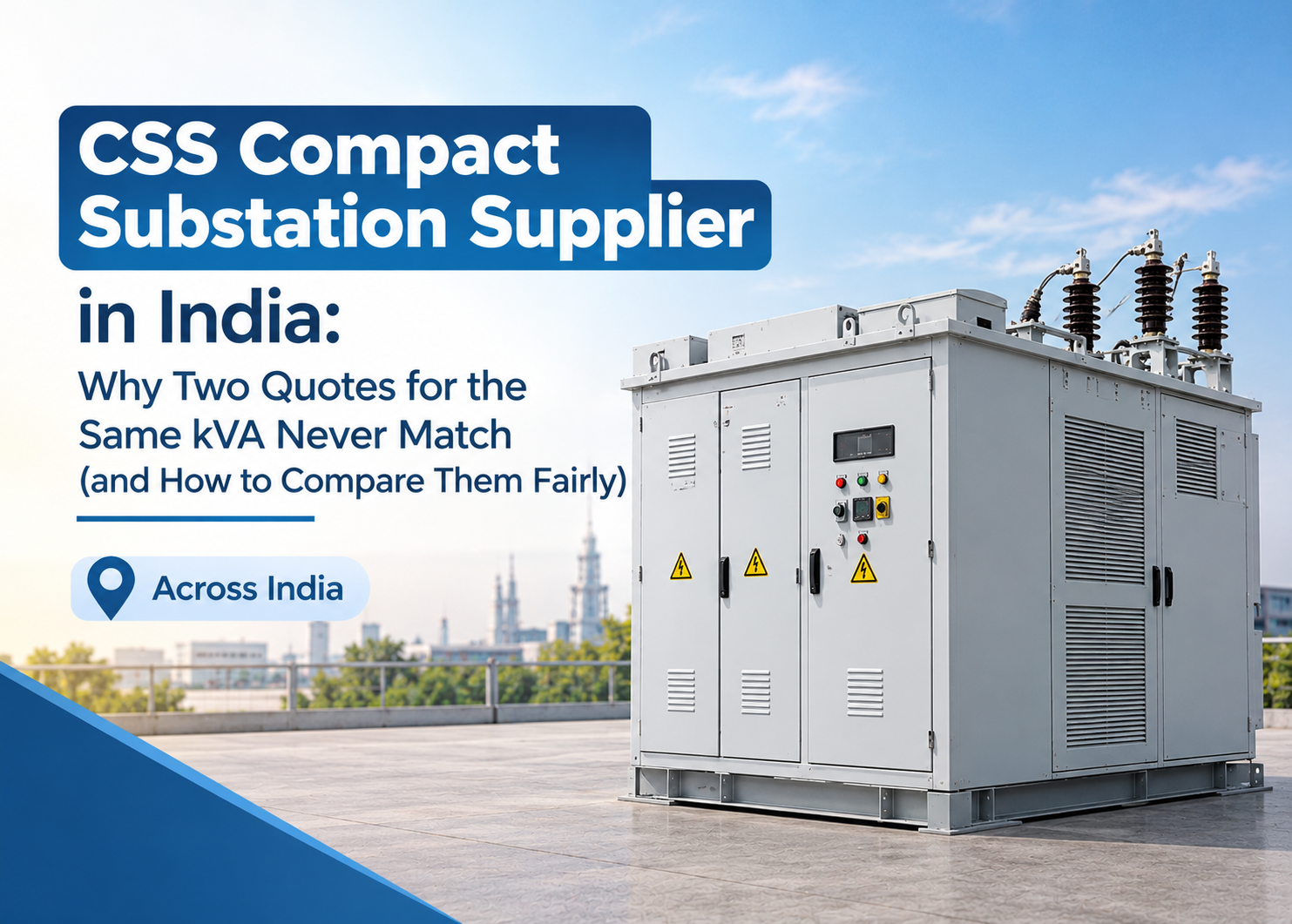
You ask three suppliers for a 1000 kVA, 11 kV compact substation. By evening the quotes are in your inbox. One is suspiciously low, one sits in the middle, and one makes you wince. Same kVA, same voltage, same “CSS” in the subject line. So who is wrong?
Usually, nobody. They are simply quoting three different machines. At Arpan Power Projects we see this almost every week, and it is the part nobody warns you about when you start looking for a CSS Compact Substation Supplier in India. The kVA rating is the headline, but it explains maybe half of the price. The rest hides in choices that never make it into the first enquiry email.
This guide is about reading those quotes properly. If you are still shortlisting companies, our earlier buyer’s checklist for choosing a CSS supplier is a good place to start. Come back here when the quotes arrive and you need to make sense of the numbers.
First, what are you actually paying for?
A compact substation (you will also hear packaged substation, unitized substation or prefabricated substation) puts the HV switchgear, the transformer and the LV panel inside one factory-built enclosure. Prefabricated HV/LV substations are covered by IEC 62271-202, so that is the standard your supplier should be designing and testing against.
Think of the price as four boxes: transformer, HV side, LV side, and the shell around them. Add testing, paperwork and delivery on top. Every one of these is a place where a quote can quietly get cheaper or more expensive.
Where the compact sub station price really comes from
1. The transformer, usually the biggest slice
This is where most of the gap between quotes starts.
- Oil type or dry type. An oil type transformer generally costs less per kVA and handles overload well, which is why it is common outdoors. A dry type transformer (cast resin, for example) costs more but is the usual choice inside buildings, basements and places with strict fire norms.
- Copper or aluminium windings. Both are acceptable when designed properly, but the price difference is real, and a quote rarely says which one it assumes unless you ask.
- Losses. A low-loss transformer needs more and better core and winding material, so it costs more on day one. It also costs less to run for the next 20 years. For a unit that runs all day in a factory, the electricity saving can beat the upfront saving of a cheaper design. Ask for guaranteed no-load and load loss figures in writing.
- Tap changer and vector group. Small items, but they should match your design, not the supplier’s stock.
Oil-type distribution transformers are normally built to IS 1180, and dry types to IEC 60076-11 or the relevant IS. Ask which one the quote follows.
2. The HV side
The choice here is between an RMU and a VCB. An RMU-based unit is sealed, compact and light on maintenance, which suits ring networks and township-style distribution. A VCB based arrangement costs more but gives you relay-based protection, adjustable settings and better handling of higher fault levels.
Within each option the price moves again: the make of the breaker or switch, the type of protection relay, CT and PT quality, and metering. If the HV side is where your questions are, we have written separately about how to size an 11KV RMU and what to ask for in writing on a 33KV RMU order.
3. The LV side
An ACB incomer with six outgoing feeders, metering and APFC is a very different panel from an MCCB incomer with three feeders and nothing else. Both can sit under the same “1000 kVA” label. If one quote looks cheap, count the feeders before you celebrate.
4. The enclosure
Sheet thickness, material, paint or galvanising, ventilation design, roof shape, the IP rating, and internal arc classification of the HV compartment if your project needs it. This is the easiest place to save money on paper, and the place you will feel it by the third monsoon. Outdoor units are often specified around IP54, but follow your consultant’s or tender’s number, not a rule of thumb.
5. Testing and documents
Every unit should have routine test reports. The design itself should have type test reports from a recognised lab such as CPRI or ERDA. Also ask whether your consultant can witness testing at the works, and what documents come with the unit: GA drawing, single line diagram, make list, test certificates, O&M manual.
6. Delivery, commissioning and support
A compact substation is heavy and often an oversize load. Freight, unloading, commissioning help and warranty terms all vary between quotes, and they are rarely written clearly in the first draft.
Same kVA, different quote: where to look
| Line item | What to ask | How it moves the price |
|---|---|---|
| Transformer losses | Guaranteed no-load and load loss in W | Lower losses cost more upfront, less to run |
| Winding material | Copper or aluminium? | Noticeable difference on larger ratings |
| HV equipment | RMU or VCB, which make, which rating | Biggest swing after the transformer |
| Protection relay | Numerical or basic, which make | Affects cost and how finely you can set protection |
| LV breakers | ACB or MCCB, number of feeders, APFC | Cheap quotes often count fewer feeders |
| Enclosure | Sheet thickness, coating, IP rating | Where corners are cut most often |
| Type test reports | Rating-specific, from CPRI/ERDA or similar | Proven design costs more than an untested one |
| Warranty and support | Duration, what is excluded, who visits | Often vague in the first quote |
How to brief a CSS compact substation supplier in India
Here is the simplest trick we know: send every supplier the same one-page brief, and ask them to reply against it. Quotes stop being a guessing game almost immediately. Your brief should carry:
- Transformer rating in kVA, HV and LV voltage, vector group
- Oil type or dry type, and any loss level you want
- HV arrangement: RMU or VCB, short-circuit rating, protection requirement
- LV arrangement: incomer type, number and rating of feeders, metering, APFC if needed
- Indoor or outdoor, expected ambient temperature, site location
- DISCOM or client specification, if there is one
- Tests, inspection and documents you expect
- Delivery schedule, warranty period and payment terms
Then ask each supplier for a make list along with the price. “Or equivalent” written against every item is not a make list.
Red flags we would not ignore in a quote
- No make list, or “as per availability” next to major components
- A price far below the others with no explanation of what was left out
- Type test reports “available on request” that never actually arrive
- No enclosure drawing, only a brochure photo
- A warranty clause that is one line long
- No clear answer on who will attend a fault in your region
None of these automatically means a bad supplier. But each one is a question you should get answered before you release a purchase order.
A note for Delhi NCR buyers
If your site is in Delhi, Gurugram, Noida, Ghaziabad or Faridabad, the conditions are tougher than most catalogues assume. Summer temperatures cross 45°C, dust settles into everything, and monsoon waterlogging near industrial plots is routine. Ask the supplier for temperature rise figures at your ambient, not at a lab standard. Check approvals with your local DISCOM early, since the requirements differ between BSES and Tata Power-DDL areas. And think about distance: when a spare is needed urgently, a team within driving range is worth more than a discount. Our team in Delhi also dispatches to Maharashtra, Gujarat and other states, so the same checks apply wherever your project is.
How we handle quote requests
We would rather ask questions than send you a number that falls apart later. At Arpan Power Projects, a typical enquiry starts with your load, voltage, site conditions and the protection you want. We then come back with a configuration, a make list for the major components and a test plan, so that you can compare our quote against anyone else’s on the same basis. We work as a supplier and channel partner for reputed Indian manufacturers of RMU, VCB, transformers and compact substations, which means the HV, transformer and LV package comes through a single point of contact. We will not always be the cheapest. We aim to be the one whose quote still matches the product when it reaches your site.
Frequently asked questions
Why do compact substation quotes for the same kVA differ so much?
Because kVA only describes the transformer’s size. Quotes also depend on the transformer type and losses, the HV and LV equipment, the enclosure build, the tests included and the support offered. Two units with the same rating can be very different products inside.
What details do I need to send for an accurate quote?
Transformer rating, HV and LV voltage, RMU or VCB preference, number of LV feeders, indoor or outdoor installation, site location and any DISCOM or client specification. The more complete the brief, the closer the final price will be to the first quote.
Is the lowest quote a warning sign?
Not always, but it deserves a closer look. Compare the make list, loss figures, enclosure details and test reports before deciding. A low number is only good news if the product behind it is the same one you asked for.
How long does delivery take?
It depends on the rating, configuration and the supplier’s current schedule. Ask for a dated delivery plan in writing, and confirm what happens if the schedule slips.
Before you decide
A good CSS Compact Substation Supplier in India is one who helps you compare, not one who hides behind a lower price. Line up the quotes against the same brief, check the make list, and ask for the paperwork before the purchase order, not after. If you are planning installation as well, our site engineer’s installation checklist covers what comes next.
Have a project in mind? Share your kVA, voltage and site details with Arpan Power Projects on +91 98688 64101, or send them through the contact page. You can also browse the full CSS compact substation range first, and our team will suggest a configuration that fits your load, not just a catalogue number.