
Blog
11KV Outdoor VCB Kiosk Type in Daryaganj: Can the Crane Even Reach Your Plot in Old Delhi?

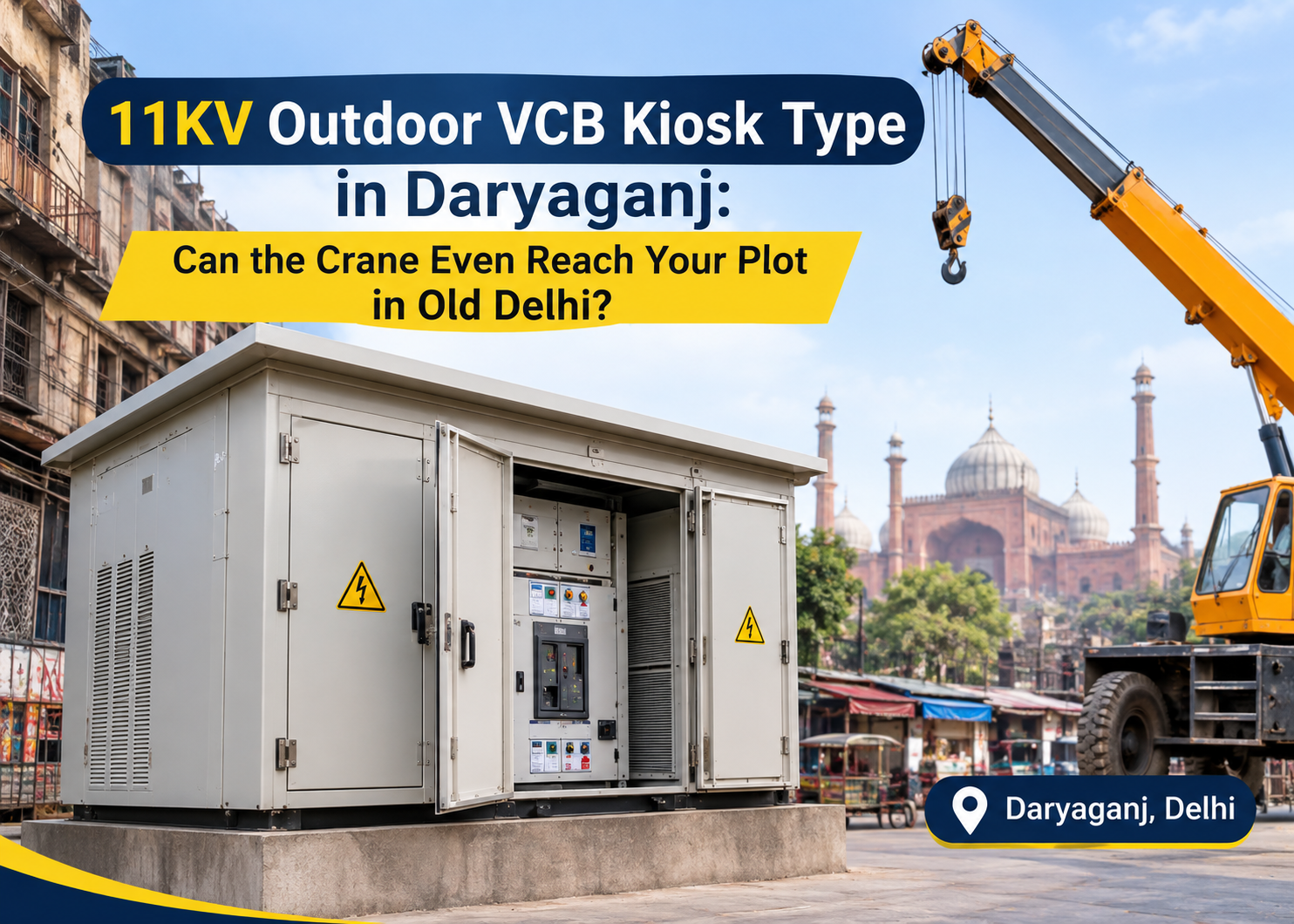
Picture a publisher’s office on Ansari Road. The electrical load has doubled over the years, and the old setup is tired. Someone finally approves a new HT breaker. The drawing looks fine and the specification is clean. Then the delivery truck reaches Delhi Gate, and nobody can say how it will get from there to the gate of the building.
This happens more often than people admit. In most of Delhi, the hard part of an 11KV Outdoor VCB Kiosk Type in Daryaganj is not the equipment. It is the last 200 metres of road.
So this guide is about the things a catalogue won’t tell you. We’ll cover lanes, cranes, paper stock, monsoon water and paperwork, in the order you’ll actually meet them.
Why kiosks suit Daryaganj in the first place
Daryaganj is crowded and old, and every square metre is spoken for. Book warehouses, printing units, small offices and residences sit shoulder to shoulder. A full open-yard substation needs space that most plots here simply don’t have.
A kiosk type VCB panel solves part of this. The 11kV vacuum circuit breaker, the protection relay, the metering section and the cable termination all sit inside one factory-built steel enclosure. You get a compact, weather-protected unit that arrives mostly assembled. Site work shrinks to a plinth, cable laying, earthing and commissioning.
That is the reason an outdoor VCB kiosk is usually the sensible choice for a tight Old Delhi plot. We’ve written about the same trade-off for other parts of the city, for example whether a compact enclosure is right for a South Delhi plot. But “compact” does not mean “easy to bring in”. That is where most projects get stuck.
And if your load is big enough that you need a transformer and HT switchgear together, a packaged unit may fit better. Our guide to sizing a compact substation in Daryaganj covers that case.
Walk the route before you walk the plot
Everyone inspects the plot. Far fewer people inspect the road to it. Before you finalise anything, walk the full delivery route from the nearest main road to your gate and note these things.
| What to check | Why it matters |
|---|---|
| Narrowest point of the lane | The truck and crane must physically fit, with room to turn |
| Overhead cables and signage | Low-hanging wires can stop a crane boom, or turn the lift into a hazard |
| Heavy-vehicle timing rules | Old Delhi often limits heavy vehicles to certain hours. Confirm the current rules locally |
| Parking and market activity | A route that is clear at 6 am can be blocked by 10 am |
| Gate width and ground condition | The kiosk may need to be skidded or rolled the last few metres |
Take photos of each tight spot and send them to your supplier before the order is placed. Honestly, this one habit saves more money than any negotiation on price.
Lifting day deserves its own plan
A kiosk is heavy. Once the enclosure, breaker, CTs and busbars are in, it often weighs well over a tonne, and the exact figure depends on the configuration. Always get the actual weight and lifting-point details from the approved drawing, not from a brochure.
For the lift itself, think about:
- Crane type and reach. A hydra or small mobile crane may work where a large one can’t turn. Match it to the real lane width.
- A night or early-morning window. In crowded areas, moving at low-traffic hours is often the only realistic option.
- A ground check. The place where the crane stands needs to take its load. Old drains and covered nalas run under many Delhi lanes.
- Someone in charge on the day. One person should be able to stop the lift if a vehicle, a hawker or a stray wire gets in the way.
Lifting is only half the story. The other half is the shutdown window and the switching plan for the day you connect. We’ve covered that in our North Delhi kiosk guide on shutdowns and switching, and most of it applies here too.
Paper, cartons and a live panel: a risky mix
This part is specific to Daryaganj, and it is the one we’d ask you not to skip. Many premises here store paper, books, packaging and cartons. These burn easily and burn fast.
An energised kiosk is not a storage shelf. Keep the area around it clear, and keep the working clearances shown on the layout drawing. Stacking stock against the enclosure “just for now” is exactly how a small fault becomes a big fire.
A few simple habits help:
- Mark a no-storage zone around the kiosk and keep it marked.
- Keep suitable fire extinguishers close by, and make sure staff know where they are.
- Check that earthing is done properly and tested, not just installed.
- Have the enclosure’s ventilation and cable entries sealed correctly so rodents and moisture stay out.
Monsoon, drains and plinth height
Many older parts of Delhi flood at street level during heavy rain. A kiosk that stands on a low plinth in a waterlogged lane is asking for trouble. Raise the plinth well above the highest water mark you’ve seen at that spot. Ask the neighbours, because they will remember.
Also check the ingress protection (IP) rating of the enclosure, the door gaskets, and whether an anti-condensation heater is included. Humidity inside a steel box in September is a real problem, and an IP-rated enclosure that is poorly sealed at the cable entry won’t protect anything.
What to put in your enquiry
A vague enquiry gets a vague quote. To get comparable offers from any VCB supplier in Delhi, state at least the following:
- System voltage and the fault level at your point of supply (get this from your DISCOM or your consultant)
- Rated current of the breaker and the number of incomer and outgoing sections
- Protection relay type and the metering arrangement
- Whether the kiosk is for a single feeder or a transformer incomer
- Cable entry direction and expected cable size
- Enclosure IP rating, interlocks and earthing provisions
- Applicable standards, for example IS 13118 / IEC 62271-100 for the circuit breaker, and the relevant standard for metal-enclosed switchgear
If your consultant has a different specification, follow that and tell the supplier clearly. Don’t let the supplier guess.
Approvals: start early, not after delivery
An outdoor HT installation does not just get switched on. You will generally need to deal with your DISCOM for the connection and with the Electrical Inspectorate before energisation, and the installation must follow the Central Electricity Authority safety regulations currently in force. If your plot is close to a protected monument, there may be additional construction restrictions as well.
Rules and procedures change, so check the current requirements with the concerned authorities instead of relying on this article alone. Starting the paperwork in parallel with the order, not after it, can save weeks.
Mistakes we see again and again
- Choosing the kiosk first and checking the route later.
- Forgetting that the crane needs its own standing space.
- Leaving fire clearances to be “sorted out after installation”.
- Setting the plinth level by the plot, not by the monsoon.
- Sending a one-line enquiry and expecting an accurate price.
How Arpan Power Projects can help
Arpan Power Projects supplies 11KV and 33KV VCBs, RMUs, HT panels, transformers and compact substations across India, including kiosk type outdoor VCB units. If you are planning an 11KV Outdoor VCB Kiosk Type in Daryaganj, our team can look at your site photos, your load details and your access constraints, and help you choose a configuration that is practical, not just impressive on paper.
You can also read our related guides on the 11KV Outdoor VCB Panel for Daryaganj and on kiosk installation in other parts of Delhi, which cover the equipment side in more detail.
Frequently asked questions
Is an 11KV outdoor VCB kiosk suitable for a small plot?
Often, yes. Because the breaker, relay and metering are housed in one enclosure, a kiosk typically needs less ground than an open-yard arrangement. You still need clear working space around it, so confirm with the layout drawing.
What is the difference between a kiosk type VCB and an outdoor VCB panel?
Both are outdoor-rated, but a kiosk is a compact, factory-assembled enclosure meant for quick installation on a plinth. A panel is usually a larger multi-bay arrangement. Which one fits depends on your load and your space.
Can an 11kV kiosk be installed in a crowded Old Delhi lane?
It can, if the delivery route, crane access and heavy-vehicle timings have been checked in advance. That’s the step most buyers skip.
How long does it take to install a kiosk after delivery?
It depends on plinth readiness, cable laying and approvals. Site work is usually much shorter than for a conventional substation, but approvals often decide the real timeline.
Planning a kiosk in Daryaganj?
Send us your site photos, the lane details and your load requirement. Arpan Power Projects will help you work out what will really fit and what will really arrive. Contact our team today.