
Blog
11KV Outdoor VCB Supplier in India: The Factory Tests, Documents and Site Checks Most Buyers Skip

Most outdoor VCB problems don’t start at the site. They start on the purchase order.
Someone compares three quotes, picks the lowest, and finds out six months later that the breaker’s fault rating was lower than the network needed. Or the panel’s enclosure couldn’t handle monsoon humidity. Or the test report was for a different model altogether. It happens more often than people admit.
If you’re looking for an 11KV Outdoor VCB Supplier in India, this guide is about what comes after the shortlist: what to verify, what to ask for in writing, and what to inspect before the equipment leaves the factory. If you only want the basics of choosing a supplier, we’ve covered that here. This article goes deeper into the technical side.
First, a quick reality check on what “outdoor VCB” means
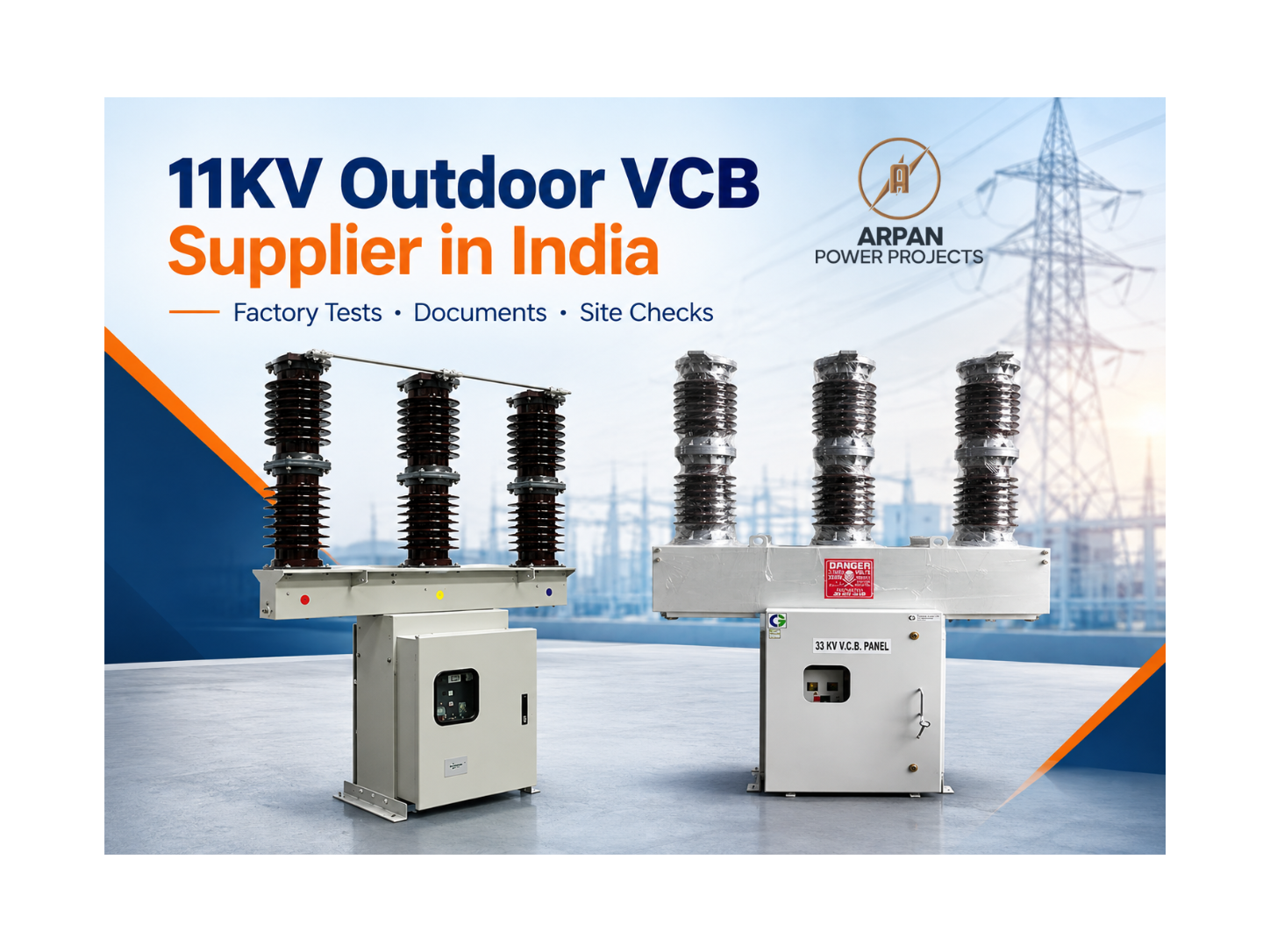
The term gets used loosely. In practice, an 11KV outdoor VCB is a vacuum circuit breaker built to live outside, in a yard, on a plinth, on a pole structure, or inside a weatherproof enclosure. The vacuum interrupter does the real work of extinguishing the arc. Everything around it (the housing, the mechanism, the insulation) decides whether it keeps working after five monsoons.
You’ll typically see three formats:
- Open-type outdoor VCB on a structure in a switchyard
- Polymer-clad VCB (PCVCB) with a sealed, compact design
- A 11KV Outdoor VCB Panel or kiosk, where the breaker, relay and metering sit in one enclosure
If kiosk is your direction, our 11KV Outdoor VCB Kiosk Type buyer’s guide covers that format in detail. Here, I’ll stay on what applies to any outdoor VCB.
The ratings that deserve a second look
Voltage is rarely where mistakes happen. Everyone knows it’s 11 kV (highest system voltage 12 kV). The trouble usually hides in these:
Short-circuit breaking current. Ratings of 16 kA, 20 kA and 25 kA are common. The right one depends on your actual fault level at the point of connection, not on what the last project used. Ask your utility or consultant for the number, then pick a breaker with margin above it.
Rated normal current. 630 A and 1250 A cover most requirements. Don’t size only for today’s load. If a solar plant or factory line is planned for next year, account for it now.
Insulation levels. For 12 kV equipment, power-frequency withstand and lightning impulse values are defined in the standards. A good VCB Supplier in India will state them clearly in the datasheet without being asked.
Mechanical and electrical endurance. Check the operation class. A breaker that switches capacitor banks or feeds frequently operated loads needs a higher endurance rating than one that sits idle for months.
Standards: ask for the paper, not the promise
Any supplier will tell you the equipment “meets standards.” Fair enough. Now ask which ones.
For circuit breakers, the references you’ll normally see are IS 13118 and IEC 62271-100. For enclosures, look for the IP rating (IP54 or higher is a common expectation for outdoor installations). Then ask for the type test reports from a recognised laboratory such as CPRI or ERDA, and check that the report covers the exact rating and design you’re buying. A report for a 20 kA model doesn’t prove anything about a 25 kA one.
This single check filters out a surprising number of suppliers.
Routine tests before dispatch
Type tests prove the design. Routine tests prove your unit. Before anything ships, a serious manufacturer should run, and share records of:
- Power-frequency voltage withstand test
- Main circuit resistance measurement
- Mechanical operation and timing checks (closing and opening time)
- Insulation resistance
- Secondary wiring and control circuit checks
- Verification of CT, relay and protection settings, where supplied
If you can, witness the factory acceptance test yourself, or send your consultant. At Arpan Power Projects, customers are welcome to inspect at our Delhi manufacturing unit before dispatch, because a fifteen-minute look at a test bench saves weeks of site trouble.
Site conditions that change what you should buy
India isn’t one climate. A breaker that’s perfectly fine in Pune can struggle somewhere else.
- Coastal belts (Gujarat, Maharashtra, Tamil Nadu, Odisha): salt-laden air attacks fasteners, busbar joints and enclosure paint. Ask about the coating process and material grade.
- Rajasthan and western desert sites: high ambient temperature (often specified up to 50°C) and fine dust. Ventilation design and derating matter more than people expect.
- Delhi NCR, Punjab, Haryana, UP: heavy dust, fog, wide seasonal swings and a hard monsoon. Condensation inside a poorly sealed panel is a real, quiet killer.
- Hill and high-altitude sites: above 1000 m, air density drops and insulation performance changes. The equipment needs to be specified for it.
Tell your supplier the actual site location when you request a quote. It sounds obvious, but many quotes are prepared without it.
Where these breakers actually get used
Outdoor 11 kV breakers show up in more places than the usual “substation” answer:
- Solar and wind plants, where the evacuation line starts at 11 kV or 33 kV
- Industrial plants and factory boundaries that need an outdoor incomer
- DISCOM and utility distribution networks
- Construction and infrastructure sites needing temporary or semi-permanent power
- Railway, metro and water utility projects
Larger projects also tend to pair VCBs with an 11KV RMU, a compact substation or a distribution transformer. If you’re buying several of these, one supplier who understands how they connect makes coordination a lot easier. And if your project steps up to the next voltage class, see our guide to a 33kV outdoor VCB supplier in New Delhi.
Documents to ask for before you place the order
Keep this list handy. It’s short but it prevents most disputes:
- Technical datasheet with the exact ratings
- General arrangement drawing and foundation details
- Single-line diagram and control schematic
- Type test reports for the offered model
- Routine test certificate (after manufacture)
- Operation and maintenance manual
- Warranty terms in writing
- Spare parts and service support details
Warning signs when comparing quotes
You don’t need to be cynical, just attentive. A few things should make you pause:
- Pricing far below everyone else with no explanation
- No datasheet, or one that looks copied from another brand
- Reluctance to share test reports
- Vague delivery dates
- No clear after-sales contact
A cheaper breaker that fails an inspection costs more than the one that cost a bit extra on day one.
Maintenance: less than you’d think, but not zero
Vacuum technology is popular because it needs far less upkeep than older oil or air-blast breakers. Still, a yearly inspection is sensible: check the operating mechanism, lubrication, contact wear indicators, terminal tightness, and the condition of the enclosure and seals. Follow the manufacturer’s schedule, and record every operation count.
Why buyers talk to Arpan Power Projects
We’re not a catalogue reseller. Arpan Power Projects works as a supplier and channel partner for HT equipment, including the 11KV and 33KV VCB range, RMUs, compact substations and transformers, with manufacturing at Khera Kalan, Delhi, and supply across India. When a customer sends us a requirement, we start with the fault level, the site and the protection scheme, and then talk about the product. You can see the current range on our HT Panel / VCB page.
Frequently asked questions
What is the typical lead time for an outdoor VCB panel?
It depends on the configuration and whether the design is standard or customised. Share your specification and we’ll give you a realistic date rather than an optimistic one.
Can the panel be customised for relay and metering requirements?
Yes, in most cases. Tell us the relay make, CT ratio and metering needs up front so they’re built in, not retrofitted.
Is an outdoor VCB the same as a recloser?
No. A recloser is designed for automatic repeated operation on overhead lines. A VCB is a general-purpose breaker, normally controlled by protection relays.
Do you supply across India?
Yes. We serve Delhi NCR and ship to projects across states, including Haryana, Uttar Pradesh, Rajasthan, Gujarat and Maharashtra.
Final thought
Choosing an 11KV Outdoor VCB Supplier in India isn’t really about who has the nicest brochure. It’s about who can show you the test reports, answer your fault-level question without hesitation, and still pick up the phone after commissioning.