

Blog
11KV Outdoor VCB Panel in Pitampura: A Bay-by-Bay Look Inside Before You Approve the Drawing

The drawing lands in your inbox. One line reads “11kV outdoor VCB panel, 3 bay, with metering.” You check the voltage, glance at the price and tick the box. Fair enough. Most people do.
But an 11KV outdoor VCB panel in Pitampura isn’t a single box you bolt down and forget. It’s a small system: a vacuum circuit breaker, busbars, instrument transformers, a protection relay, a battery and a surprising amount of wiring, all sitting in a steel cabinet that has to put up with Delhi’s summers, monsoon damp and the dust of a busy neighbourhood.
This post walks through what sits inside the panel, bay by bay, what changes because of local conditions, and what I’d check on the day it arrives. It’s written for facility managers, electrical contractors and consultants around Netaji Subhash Place, Rohini and Shalimar Bagh who’d rather understand the equipment than just buy it.
Quick read
- A panel is more than the breaker. The bays, CT/PT metering and relay decide how it behaves on a bad day.
- Heat, damp and dust should show up in the specification, not just in the paint colour.
- Spend ten minutes inspecting the panel before the crane lifts it.
- Ask for the documents early. They’re much harder to get after the invoice is paid.
Panel or breaker: which one are you actually buying?
People use the two words as if they mean the same thing. They don’t.
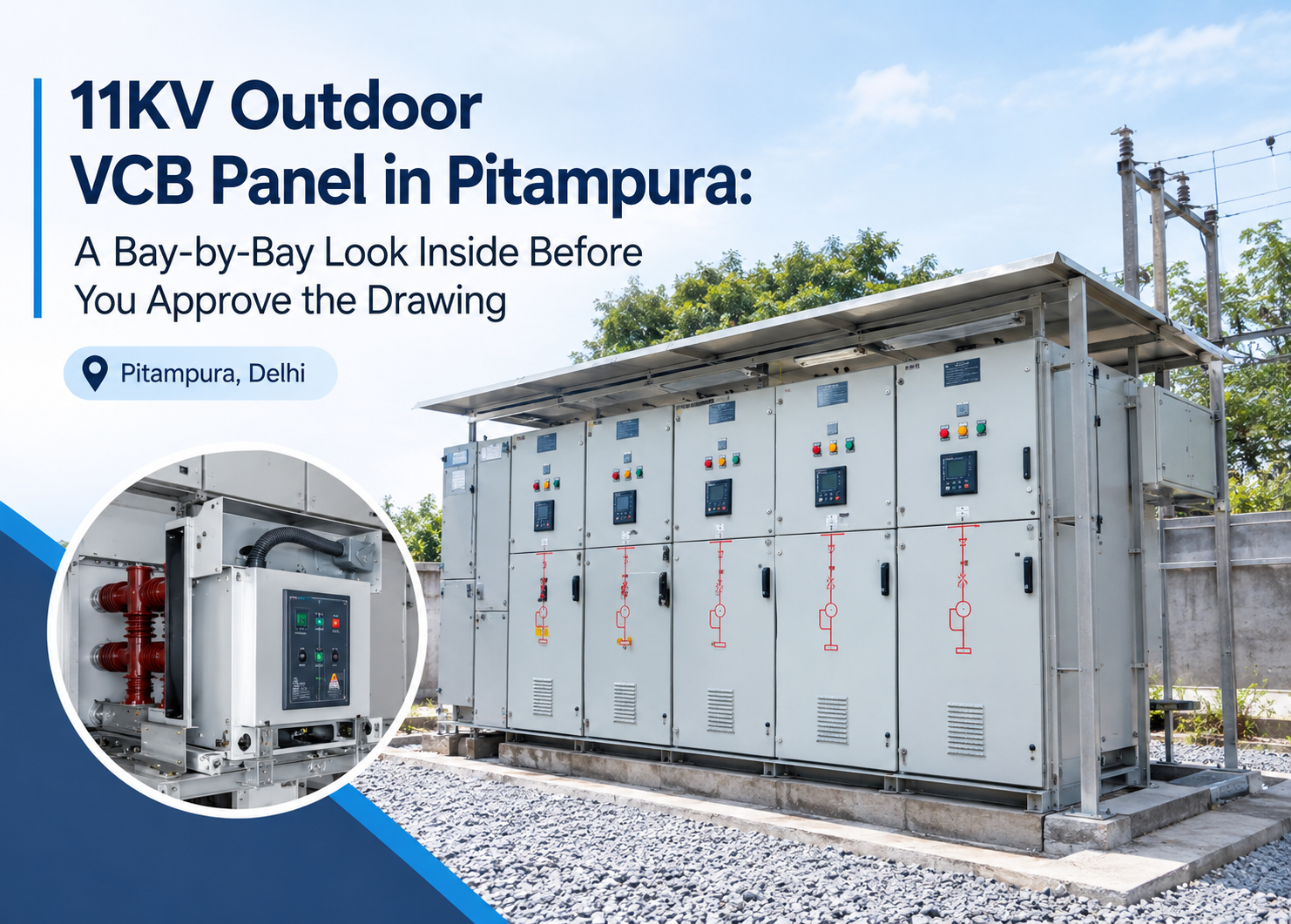
The outdoor VCB (vacuum circuit breaker) is the switching device itself: the vacuum interrupters, the operating mechanism and the poles. The outdoor VCB panel is that breaker plus everything around it, which means the enclosure, busbars, isolator, current and potential transformers, relay, meters, indicators, control wiring and the DC supply.
Why does this matter? Because two quotes can both say “11kV outdoor VCB” and have very different scope. One may include metering and a relay, the other may not. Compare like with like, or the cheaper offer turns out to be the expensive one later. You can see the configurations we list on our 11KV outdoor VCB panel page.
Inside the cabinet: a typical three-bay layout
Layouts change from project to project, so treat this as a common pattern rather than a rule.
The incomer bay
This is where the 11kV supply arrives. It holds the main 11kV vacuum circuit breaker, usually with an isolator, and the cable termination. Everything downstream depends on this bay. Ask early whether the cable enters from the top or the bottom, and whether there’s enough room for the cable to bend without strain.
The metering bay
Here you’ll find the CTs and PTs that feed the energy meter and the protection relay. Metering for an HT panel follows the distribution company’s rules, and in this part of Delhi that usually means Tata Power-DDL. Rules change, though, so confirm the current requirements with the concerned office before you freeze the drawing.
The outgoing bay
This bay feeds your transformer or the next section of the network. It often has its own breaker and its own relay settings, which need to coordinate with the incomer. If the two bays “argue” during a fault, the wrong breaker trips and half your site goes dark for no good reason.
The relay and control compartment
This is the low-voltage section: the relay, auxiliary contactors, selector switches, indicator lamps and the DC supply wiring. It’s the part people open on commissioning day. Neat, ferruled, properly labelled wiring tells you a lot about how a maker builds everything else. Messy wiring tells you that too.
Why an 11KV outdoor VCB panel in Pitampura needs more than a catalogue default
A panel that works fine in a cool, dry yard can struggle on a rooftop plinth in June. Four local factors deserve a line in your specification.
Heat. Delhi’s peak summers push well past 40°C, and a closed steel cabinet in direct sun runs hotter still. Ask what current rating the panel carries at your site’s ambient temperature, and whether a sun canopy or ventilation is part of the design.
Monsoon and humidity. Damp air condenses inside cabinets overnight. Anti-condensation heaters with a thermostat, sealed cable glands and good door gaskets keep moisture off live parts and relays. Raise the plinth above the level where water collects on your plot. Low-lying yards around here do waterlog.
Dust and pollution. Fine dust gets into everything. An IP54 rating is a common starting point for outdoor cabinets, though your consultant may ask for more. Also check the coating, since powder-coated or galvanised finishes last far better than thin paint.
Pests. Rodents and birds love an open cable entry. Seal every gap. It costs almost nothing and prevents a very annoying fault.
The ten-minute check when the panel arrives
Before anyone lifts it off the truck, walk around it with the approved drawing in hand.
- Match the nameplate to the purchase order: voltage, rated current, short-circuit rating and duration.
- Look for dents, scratches or damaged door seals from transit.
- Check the relay model and CT ratios against the approved schematic.
- Look inside for loose wiring, missing ferrules or open terminals.
- Confirm the manual and drawings are in the box, and that the factory test report is ready.
- Take photographs before and after unloading, so any damage claim has evidence behind it.
If something looks wrong, say so then, in writing. A polite email on day one beats a long argument on day thirty.
Standards and papers worth asking for
For the switchgear assembly, ask which part of IEC 62271-200 the panel is built and tested to. For the breaker, ask about IEC 62271-100 and IS 13118. Request the type-test certificates and ask which recognised laboratory issued them. Standards get revised, so confirm which version your tender or consultant expects.
Paperwork won’t make a panel better, but a supplier who hands it over without fuss usually runs a tidy operation.
Mistakes that show up again and again
- Ordering before the cable and earthing drawing is ready. The panel arrives, and nobody knows where the cable lands or where the earth pit sits.
- Forgetting working space. Doors need room to swing open, and a technician needs room to stand safely in front of the breaker.
- Ignoring the DC supply. A battery that’s never tested is a trip circuit nobody trusts.
- Treating it as maintenance-free. A vacuum breaker needs less care than the old oil types, but a yearly service (mechanism, contacts, coils, seals, battery) still matters.
For the commercial side of the decision, our guide on choosing an 11KV outdoor VCB supplier in Pitampura covers the four site questions worth settling before you ask for a quote. If space is the bigger worry, a kiosk type may suit you better, and our piece on ratings and protection goes further into the numbers.
Why a local team makes this easier
Most of the points above get settled faster when someone can actually stand on your site. Arpan Power Projects has its registered office at GDITL Tower, Netaji Subhash Place, Pitampura, and a manufacturing unit at Khera Kalan Industrial Area, Delhi. That means a drawing review, a site visit and a pre-delivery check can happen without long travel or long waits. We supply 11KV and 33KV VCBs, RMUs, transformers and compact substations, and we’re happy to look at your drawing or site photos before you commit to anything.
Frequently asked questions
Is an outdoor VCB panel the same as an outdoor VCB?
Not quite. The VCB is the breaker. The panel is the breaker together with its enclosure, busbars, CT/PT, relay, meters and control wiring. Always confirm which one a quotation covers.
How often should an outdoor VCB panel be serviced?
A yearly service is a sensible baseline, and more often in dusty or very humid locations. Follow the maker’s manual and keep a simple logbook of every visit and test.
Can the panel be placed on a terrace or rooftop?
Sometimes, but it depends on structural load, crane access, cable routing and approvals. Get a structural engineer’s confirmation before you finalise the location.
Do I need approval before energising?
HT installations generally need clearance from the electrical inspectorate and the distribution company. Requirements change, so check the latest process with the concerned offices early in the project.
Before you sign off the drawing
A good 11KV outdoor VCB panel in Pitampura is one that suits its bays, its relay, its metering and its local weather, and not just the voltage on the nameplate. If you’d like a second opinion on a drawing or a site, send us the details through our contact page. The team at Arpan Power Projects will come back with a clear, practical recommendation.