
Blog
11KV Outdoor VCB Kiosk Type in Pitampura: Will It Really Fit Your Plot, Your Neighbours and Your Monsoon?

Most outdoor breaker decisions in North West Delhi get settled on a site plan long before anyone talks about ratings. The question is usually simple. Is there enough open ground, and can that ground be made safe?
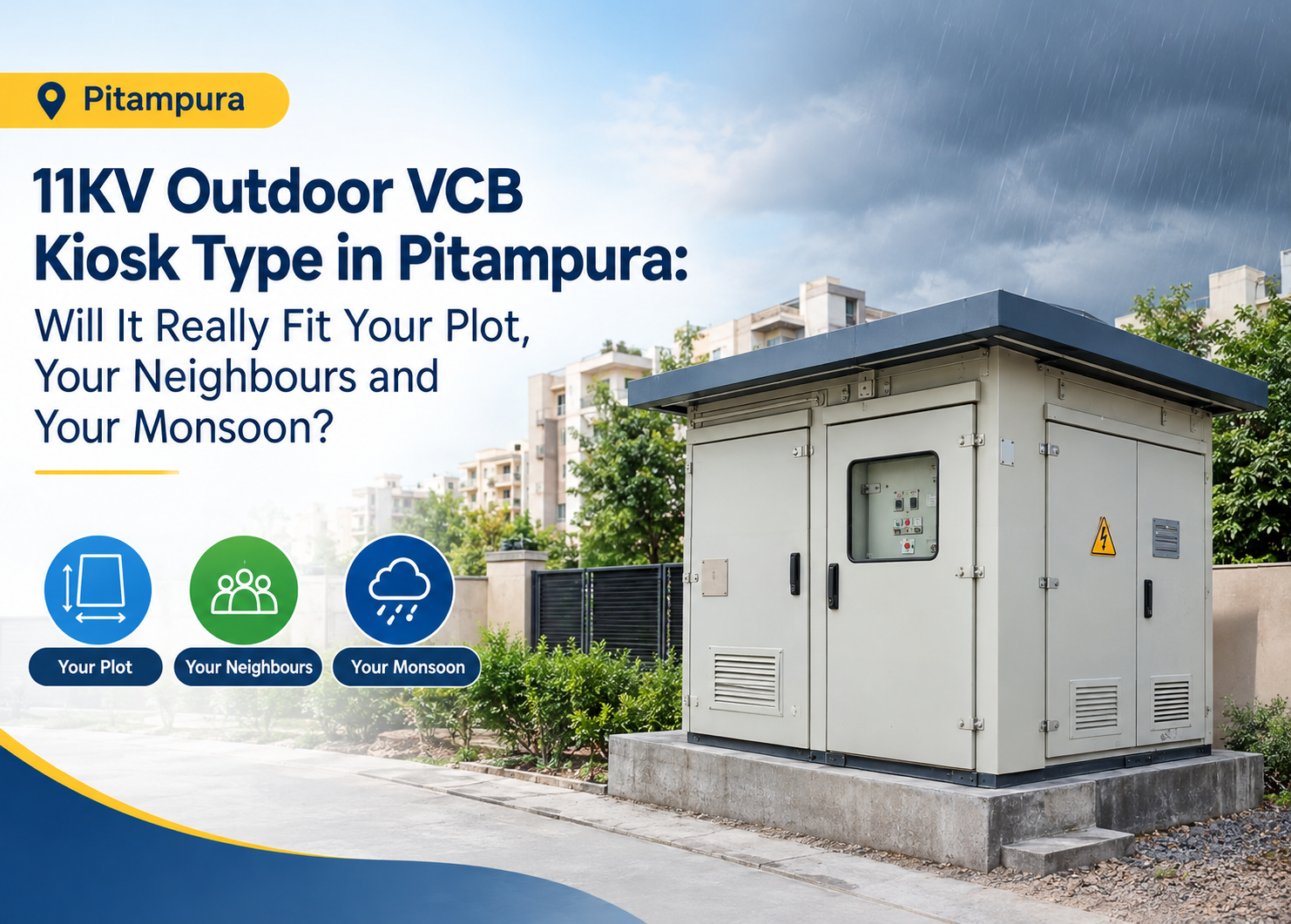
That is exactly where an 11KV Outdoor VCB Kiosk Type in Pitampura earns its place. The breaker, relay and controls sit together in one lockable enclosure. You get a smaller working footprint and better protection from weather and curious hands.
A kiosk is not automatically the right answer, though. This guide helps you decide, using the kind of plots, societies and campuses you actually find around Netaji Subhash Place, Rohini, Shalimar Bagh and Ashok Vihar.
Quick read
- A kiosk suits tight, public-facing plots. An open yard suits spacious, fenced ones.
- Check working clearance, public access, weather exposure, plinth height and future expansion.
- Judge the enclosure on its own, not just the breaker inside it.
What a kiosk type changes compared with an open-yard breaker
A vacuum circuit breaker does the same job in both cases. It opens the circuit quickly when a fault appears. What changes is everything around it.
In an open-yard installation, the breaker stands on a steel structure. The relay and control panel are mounted separately, and the area is fenced.
In a kiosk type VCB panel, the breaker, relay, metering and control wiring are housed in one outdoor enclosure. It arrives as a single assembled unit, with doors, roof and cable entry already designed in.
That one difference affects four things: footprint, safety, weather protection and how much civil work you need.
Five checks before you choose a kiosk
1. Footprint and working clearance
The kiosk may be compact, but it still needs room in front of it. Doors must swing fully open, and an engineer must be able to stand, operate and withdraw equipment safely.
Plots in Pitampura are rarely generous. A side lane, a boundary wall or a parked-car zone can quietly eat into the clearance. Measure the clearance on the ground and do not rely on the drawing alone. If the drawing and the plot disagree, the plot wins.
2. Who walks past it every day
This is the check people skip most often. Housing societies, schools and commercial complexes put an HT enclosure close to people, including children, delivery staff and security guards.
A kiosk helps because live parts stay behind locked doors. Even so, ask about door locking, warning signs, earthing of the enclosure and the layout of any fencing. The whole point is that an ordinary visitor should never be able to touch anything live.
3. Delhi weather is hard on enclosures
Summers go well past 45°C. Monsoon brings heavy humidity and driving rain. Dust is constant. An enclosure has to handle all three.
Ask about the ingress protection rating, roof design, door seals and ventilation. Also ask how the kiosk deals with condensation, because moisture inside a closed panel causes problems that rarely show up on a datasheet. An anti-condensation heater is a common answer, but confirm exactly what is fitted in the unit you are quoted.
4. Plinth height and cable entry
Many compounds in this part of Delhi see waterlogging after a heavy spell. A plinth that looks fine in April can be a problem in August.
Set the plinth height with the worst monsoon in mind, and plan the cable trench and entry before the kiosk is lifted into place. Cables entering from below need to stay clear of standing water.
5. What happens when load grows
New lifts, extra AC load and EV charging all push demand up. Ask whether your layout leaves room for another bay or a larger transformer later. A kiosk is fixed in size once it is built, so it pays to think about expansion now.
Kiosk type vs open-yard outdoor VCB at a glance
| Factor | Kiosk type | Open-yard breaker |
|---|---|---|
| Land needed | Smaller footprint | Larger, fenced area |
| Public safety | Live parts behind locked doors | Depends on fencing and discipline |
| Weather protection | Enclosure and roof included | Controls need separate housing |
| Civil work | Plinth and cable trench | Structure, plinth and control room or cabinet |
| Flexibility to expand | Limited by enclosure size | Easier to extend |
| Best suited to | Tight, public-facing sites | Large, secure compounds |
Where a kiosk makes the most sense in North West Delhi
- Housing societies and group housing: limited space, many residents, strong safety expectations.
- Schools and hospitals: public presence and a need for tidy, secure installations.
- Commercial complexes near Netaji Subhash Place: tight setbacks and visible frontage.
- Small industrial clusters such as Wazirpur: dust and heat call for a closed, protected unit.
When I would still choose an open-yard breaker
Be honest about this, because a kiosk is not always the better answer.
If you own a large, fenced compound, have no public access nearby and expect heavy future expansion, an open-yard breaker on a proper stand can be simpler and more flexible. If you already have a dedicated substation room, an indoor panel may suit you better still.
Questions to ask about the kiosk itself
Your enquiry is stronger when it goes beyond the breaker’s voltage rating. Ask the supplier:
- What is the enclosure’s ingress protection rating?
- How are the doors locked and interlocked?
- How is ventilation handled, and is there an anti-condensation heater?
- What stops birds, rodents and insects getting in?
- Which standards does the assembly follow?
- Can I see a drawing with exact dimensions, door swing and cable entry?
For the deeper electrical questions on fault level, relay settings and control supply, we cover those separately in our guide to four site questions. When you are ready to compare quotes, our RFQ guide will help you write one that gets honest responses. For what happens after the kiosk arrives, see the site preparation and commissioning guide.
Why local support matters for a kiosk
Because a kiosk arrives as a single unit, mistakes in dimensions or cable entry are expensive to fix. A supplier who can visit your plot before the design is frozen can catch them early. Arpan Power Projects has its registered office at GDITL Tower, Netaji Subhash Place, Pitampura, and a manufacturing unit at Khera Kalan Industrial Area, Delhi. That means site photos, plot measurements and drawing questions can be settled quickly. You can look at the kiosk-type outdoor VCB configurations on the product page.
Whichever supplier you choose, confirm the distribution company’s current metering and approval requirements before you freeze the design. In this area that is typically Tata Power-DDL, but rules can change.
Frequently asked questions
Can a kiosk-type outdoor VCB be installed inside a residential society in Pitampura?
Usually yes, provided there is a suitable open spot with safe clearances, proper access and the required approvals. Share the layout with your supplier and the distribution company before choosing the location.
Is a kiosk type safer than an open-yard breaker?
Generally the kiosk keeps live parts enclosed and locked, which reduces accidental contact. Safety still depends on good earthing, correct signage and proper operating practice.
Does a kiosk need less civil work?
Often yes, because the enclosure comes assembled. You still need a properly built plinth, cable trench and earthing, so do not treat it as “no civil work”.
Can the kiosk be moved later?
It can be relocated, but this needs planning, a crane and a shutdown. It is better to choose the right spot at the start.
How early should I involve the supplier?
Before the layout is finalised. The cost of changing a drawing is small. The cost of changing a built kiosk is not.
The bottom line
Choosing an 11KV Outdoor VCB Kiosk Type in Pitampura comes down to your plot, your neighbours and your weather. If space is tight, people are nearby and the monsoon is a real concern, a kiosk usually makes sense. If you have room and a secure compound, an open yard may do the job.
If you would like a second opinion before you commit, send your layout or site photos through our contact page. The team at Arpan Power Projects will tell you plainly which option fits your site.